Seoul Airport: Incheon vs Gimpo and the Best Route Downtown
On this page
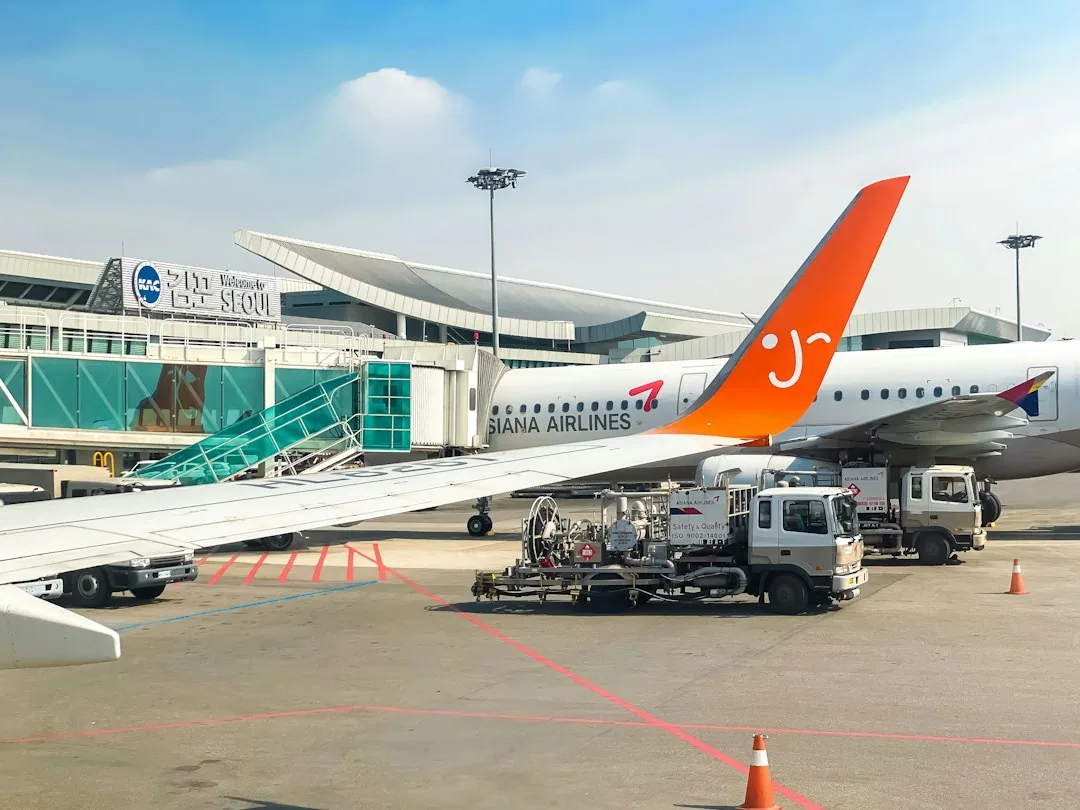
Before you book a hotel or buy a train ticket, find the three letters printed next to “Seoul” on your booking. ICN is Incheon, the big international airport out in Incheon’s Yeongjong-gu, which Visit Korea places about 60 km from the centre of Seoul. GMP is Gimpo, the older airport inside the city’s own Gangseo-gu district. One rail line joins them, yet the best way to reach Myeongdong, Hongdae, Gangnam or Jongno changes completely depending on where you touch down. Settle the Seoul airport question first, Incheon vs Gimpo, and the transfer advice gets short.
Quick answers
- The airport code on your booking settles it: ICN is Incheon, GMP is Gimpo, and SEL is IATA’s code for the whole Seoul metropolitan area, so it can mean either.
- Gimpo’s international list, as updated in May 2026, is eight airports in Japan, China and Taiwan, so every other international flight to Seoul lands at Incheon.
- In 2026 the AREX express runs from Incheon Terminal 1 to Seoul Station in 43 minutes for ₩13,000, while the all-stop AREX from Gimpo to Seoul Station costs ₩1,750.
Seoul Airport, Incheon vs Gimpo: Which One Is on Your Ticket?
The three-letter code beside each flight is your answer, because both are Seoul airports and the city name alone can’t tell them apart. IATA’s own code directory lists ICN as Incheon International, GMP as Gimpo International and SEL as Seoul “Metropolitan Area”, a city-level code rather than an airport. A fare search under SEL can therefore mix flights into both, so open the itinerary and read the code on every leg.
Gimpo has the shorter list, which makes it the one to check. Visit Korea’s international flights page, updated in May 2026, names eight Gimpo destinations: Tokyo Haneda, Osaka Kansai, Nagoya Chubu, Taipei Songshan, Kaohsiung, Shanghai Hongqiao, Beijing Capital and Beijing Daxing. Notice that it lists airports, not just cities. A flight from Tokyo Narita, Taipei Taoyuan or Shanghai Pudong isn’t on it, which makes it an Incheon flight. So is anything from North America, Europe, Southeast Asia or Australia.
The short list has a history. Korea’s policy briefing service records that Gimpo handed all its international routes to Incheon when the new airport opened, and that government policy brought international flights back to Gimpo in 2003. What it runs today is a short list of city-to-city routes, not a second hub.
Gimpo also runs a domestic terminal. Visit Korea’s domestic flights page, updated in June 2026, lists its routes to Jeju, Gimhae (Busan’s airport), Ulsan, Yeosu, Sacheon, Pohang/Gyeongju and Gwangju. If a side trip to Jeju’s Studio Ghibli cafe is on the plan, check whether that leg shows GMP.
| Incheon (ICN) | Gimpo (GMP) | |
|---|---|---|
| Where it is | Yeongjong-gu, Incheon, about 60 km from central Seoul | Gangseo-gu, inside Seoul |
| International routes | Everything not on Gimpo’s list | Eight airports in Japan, China and Taiwan |
| Rail at the airport | AREX express and all-stop | AREX, Line 5, Line 9, Gimpo Goldline, Seohae Line |
| AREX all-stop to Seoul Station | ₩4,750 from T1, ₩5,350 from T2 | ₩1,750 |
| AREX express to Seoul Station | 43 minutes from T1, ₩13,000 | Not served |
Incheon adds one more variable: two terminals with separate AREX stations. Terminal 2 is the end of the line, so the express needs 51 minutes from Seoul Station instead of 43, and the all-stop needs 66 instead of 59. Check the terminal on your e-ticket or the airline’s check-in page before you buy the train ticket.
How Do You Get From Incheon Airport to Seoul?
Take AREX, and choose the train by where you’re sleeping: the express if your hotel is near Seoul Station or one of the subway lines that meet there, the all-stop for almost anywhere else on the route. AREX’s fare pages in 2026 put the express at ₩13,000 for an adult, against a posted standard fare of ₩18,500 to Terminal 1 and ₩19,100 to Terminal 2, and at ₩9,500 for a child. It runs non-stop between Seoul Station and the airport. The all-stop train calls at every station on the way, Gimpo and Hongik University included, and charges ₩4,750 from Terminal 1 on a transit card, taking 59 minutes to Seoul Station.
Visit Seoul’s getting-to-Seoul page still quotes the express at ₩9,500 each way. On AREX’s own fare page, ₩9,500 is the child fare. Whether the ₩8,250 gap between the two trains buys enough time on a short visit is worked out hour by hour in our 3-day Korea trip breakdown.
The express doesn’t stop at Hongik University or Gimpo, which is why the neighbourhood matters more than the train’s speed:
| Staying in | Simplest rail route from Incheon |
|---|---|
| Myeongdong | Express to Seoul Station, then Line 4 two stops (Hoehyeon, Myeong-dong) |
| Hongdae | All-stop straight to Hongik University, ₩4,650 from Terminal 1 |
| Gangnam | All-stop to Magongnaru or Gimpo Airport, then Line 9 express to Express Bus Terminal, Sinnonhyeon or Bongeunsa |
| Jongno | Express to Seoul Station, then Line 1 two stops to Jonggak or three to Jongno 3-ga |
For Gangnam, Line 9’s express is what makes the long way round worthwhile: the line’s operator says express trains stop at only 16 of its 38 stations. Hongdae is the case where the cheap train is also the direct one. If you’re still deciding between that neighbourhood and Seongsu, our Seongsu vs Hongdae comparison settles it before you pick a stop.
Buses save the stairs if you’re carrying heavy bags. Incheon Airport’s own Seoul bus list includes route 6015 to Myeongdong Station, 6701 to City Hall and Gwanghwamun, 6703 to Gangnam and COEX, and 6020 to Yeoksam Station. That list prints no fares, so confirm the price before you board.
Two jobs are easier settled before you reach the platform: an eSIM or a pocket wifi router for the maps on the way in, and a T-money card, whose balance refund at the airport becomes your last errand on the way out.
How Do You Get From Gimpo Airport to Seoul?
By subway, and without the long ride. Gimpo Airport station sits inside Seoul and links AREX with Line 5, Line 9, the Gimpo Goldline and the Seohae Line, so Hongdae, Gangnam and Jongno are each one train away. The fares show how much closer you are. In 2026 AREX charges ₩1,750 from Gimpo to Seoul Station and ₩1,650 to Hongik University on a transit card, barely above the ₩1,550 base fare for the first 10 km, against ₩4,750 from Incheon’s Terminal 1.
| Staying in | Simplest rail route from Gimpo |
|---|---|
| Hongdae | AREX three stops to Hongik University (₩1,650) |
| Myeongdong | AREX five stops to Seoul Station (₩1,750), then Line 4 two stops |
| Gangnam | Line 9 express straight to Express Bus Terminal, Sinnonhyeon or Bongeunsa, no transfer |
| Jongno | Line 5 to Gwanghwamun or Jongno 3-ga with no transfer, or AREX to Gongdeok and Line 5 from there |
Line 5 is the no-transfer choice for Jongno, but it calls at 21 stations between Gimpo Airport and Gwanghwamun. Riding AREX four stops to Gongdeok and switching to Line 5 there cuts the count to eight, at the cost of one change. Myeongdong has no single-line option at all, and AREX to Seoul Station plus two Line 4 stops keeps it to seven stops and one change.
Taxis are slower than the map suggests. The taxi estimates Korea Airports Corporation posts for Gimpo, checked in October 2026, give 40 minutes and ₩15,000 to Hongik University, 50 minutes and ₩20,000 to Myeong-dong, and 60 minutes and ₩28,000 to Gangnam Station in a standard cab, and the airport calls those the minimum with no congestion. The meter starts at ₩4,800 for the first 1.6 km, with a 20% night surcharge from 22:00 to 23:00 and from 02:00 to 04:00, and 40% in between. Before you surface, the right subway exit number matters more for the last few hundred metres than the choice of line.
What If You Land at One Airport and Fly Out of the Other?
Give the airport-to-airport transfer real time, because the express doesn’t serve it. On rail, only the all-stop AREX links the two airports, at ₩4,350 from Gimpo to Terminal 1 and ₩4,950 to Terminal 2 in 2026. Korea Airports Corporation’s taxi table puts Gimpo to Incheon Airport at 40 minutes and ₩45,000 including the toll, before traffic.
The usual reason for the switch is a domestic leg. Fly into Incheon from Europe, fly on to Jeju from Gimpo, and on separate tickets you’ll clear immigration, collect your bags, ride between the airports and check in all over again. The return works the same way in reverse, with your international departure as the flight you can’t afford to miss.
Which Airport Should You Choose When You Have the Option?
Choose Gimpo whenever your departure airport offers it at a similar fare. The train into town costs a fraction of Incheon’s, and the airport station puts three visitor neighbourhoods on a single line each. Choose Incheon when the flight times are better or the fare gap is real. For a hotel near Seoul Station or Myeongdong, the express narrows the difference to 43 minutes plus two stops on Line 4.
| Your situation | Better pick |
|---|---|
| Flying from Haneda, Kansai, Chubu, Songshan, Kaohsiung, Hongqiao or a Beijing airport, staying in Hongdae, Gangnam or Jongno | Gimpo, if the fare is close |
| Flying from anywhere outside Japan, China and Taiwan | Incheon, with no alternative |
| Hotel near Seoul Station or Myeongdong | Either; from Incheon, take the express |
| Connecting to Jeju or Busan the same day | Gimpo, so you skip the airport-to-airport ride |
| Landing at Incheon late in the evening | Check the last express (22:40 from T2, 22:48 from T1) |
Frequently Asked Questions
Q: What does SEL mean on a flight to Seoul?
SEL is IATA’s code for the Seoul metropolitan area, not for a single airport. Results under SEL can include flights into Incheon (ICN) or Gimpo (GMP), so open the itinerary and check the code on each leg before you plan the ride into town.
Q: Is the AREX express worth it from Terminal 2?
Only if 15 minutes matter more to you than ₩7,650. From Terminal 2 the express takes 51 minutes for ₩13,000, against 66 minutes and ₩5,350 on the all-stop, and it pays off only if Seoul Station, or a line that meets it, is where you’re heading.
Q: Do all flights from Tokyo land at Gimpo?
No. Gimpo’s Tokyo route uses Haneda, so a flight from Narita lands at Incheon. Even from Haneda, read the code on your ticket rather than assuming.
Q: What is the earliest AREX express to Incheon Airport?
The first express leaves Seoul Station at 06:00, on weekdays and holidays alike, and reaches Terminal 1 in 43 minutes and Terminal 2 in 51. For a flight too early for that, the fallback is the all-stop line or a taxi.
Q: Can you use a T-money card on AREX?
Yes on the all-stop train, whose fares AREX quotes for prepaid and postpaid transit cards. Buying a single-use ticket instead adds ₩100 to the fare plus a ₩500 deposit, which you get back at your destination station.
Read the code, match the line to your neighbourhood, and the airport stops being the hardest part of arriving in Seoul.
Part of Seoul Travel Guide