Chogiwa Meaning in Korean: It's Jeogiyo (저기요)
On this page
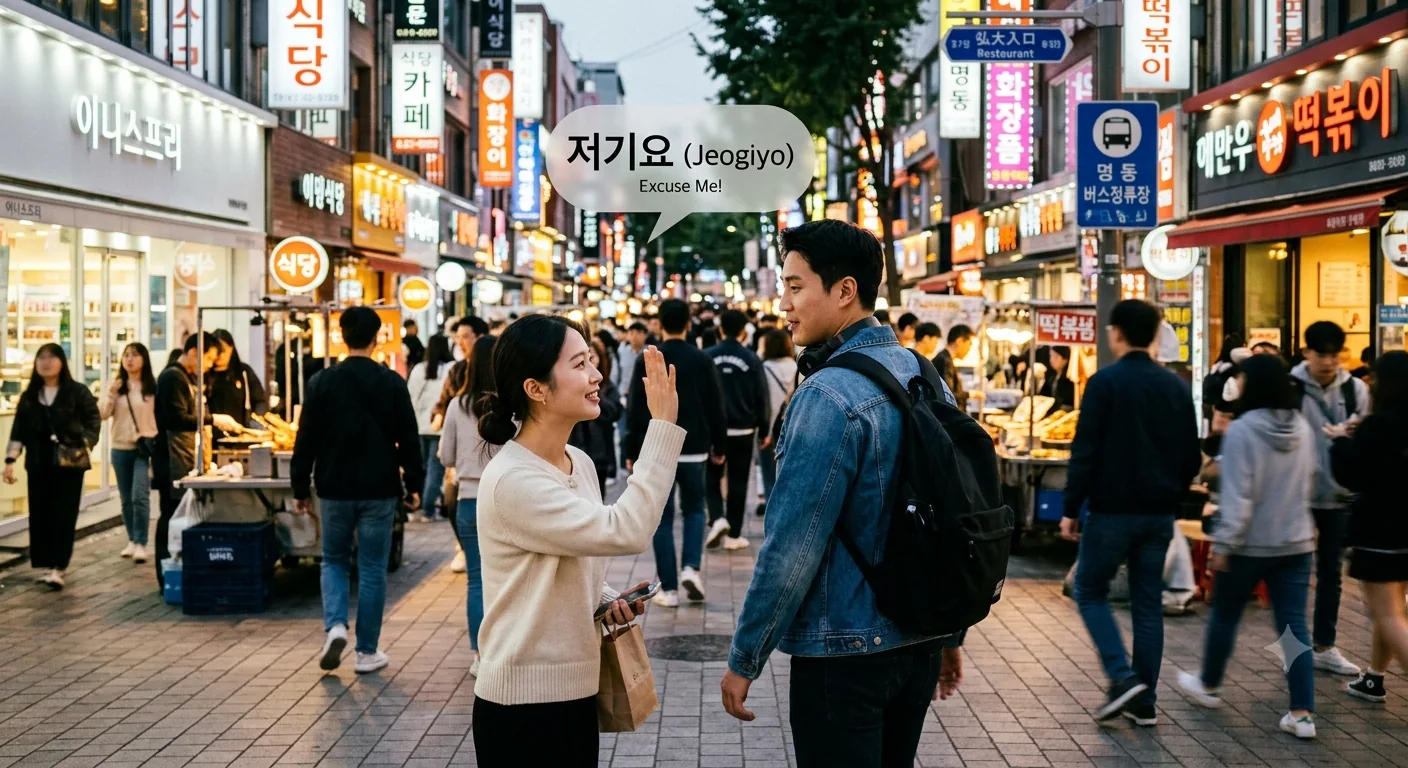
Chogiwa is not a Korean word, though the sound behind it is one of the most useful things to learn before your first meal in Seoul. What travelers hear is 저기요, written jeogiyo in the official romanization and pronounced closer to “juh-gee-yo”. Koreans say it to flag down a server, to stop a stranger who just dropped a transit card, or to open a question to someone whose name they do not know. Its meaning sits almost exactly where English puts “excuse me”, and the reason it reaches an English ear as “chogiwa” comes down to two sounds that Korean and English divide up differently.
Quick answers
- “Chogiwa” is an English-ear spelling of 저기요 (jeogiyo), the everyday Korean for “excuse me” that works on servers, shop staff and strangers alike.
- Calling out is not rude here. In 2017 the National Institute of Korean Language asked people what they actually say to a stranger, and 62.5% named 저기요, ahead of 아주머니/아저씨 at 33.5% and 여기요 at 16.9%.
- Use 여기요 (yeogiyo, literally “over here”) when you are ready to order, and 저기요 when you simply want someone’s attention.
Chogiwa Meaning in Korean: The Word Is 저기요 (Jeogiyo)
저기요 means “excuse me” in the attention-getting sense, and 저기 on its own means “over there”, so the phrase points away from you before it asks for anything. The romanization is fixed by rule rather than taste: under the Revised Romanization of Korean, the standard the Ministry of Culture, Sports and Tourism has kept in force since 2014, ㅈ is always written j and ㅓ is always written eo. That gives jeogiyo, never chogiwa.
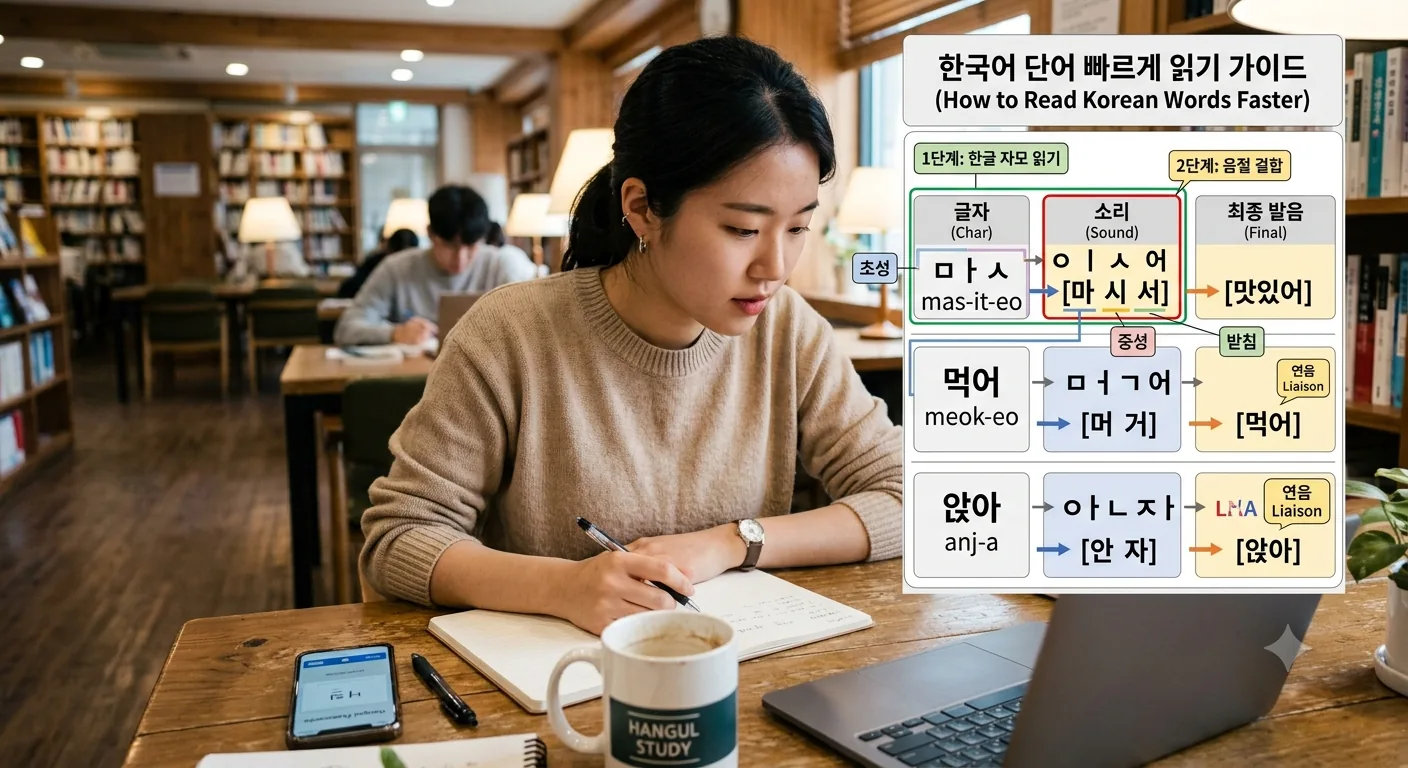
So where does the “ch” come from? ㅈ at the front of a word is a lenis, unaspirated affricate, sitting between English “j” and “ch” with almost none of the breath an English speaker expects to hear. The same gap turns 김 into a passport “Kim” that Korean ears register closer to “Gim”, a mismatch worked through in the guide to pronouncing Korean surnames. The vowel ㅓ is the second trap, because it is flat and unrounded with no tidy English equivalent, and “o” is the letter most people reach for. Add a final 요 that trails off, and you get the spelling that brought you here.
Myth: Calling Out to a Server Is Rude
The myth: shouting for staff marks you as impatient, so a polite foreigner should sit tight and wait to be noticed.
Waiting is the mistake. Korean restaurants are staffed on the assumption that the table will call, and plenty of mid-range places have no assigned server at all, which is why a call buzzer sits bolted to so many tables. Silence gets you a long wait and cold banchan, not a reputation for good manners.
The numbers back this up, and they come from the institute’s own report on language etiquette in public places, built on a nationwide usage survey it ran in 2017. Asked how they felt when a stranger called them with 저기요, 77.0% of respondents said it bothered them little or not at all, against 23.0% who found it somewhat or very unpleasant. The customer-to-staff figures are sharper still: 46.6% objected to being addressed as 아저씨 or 아주머니, the highest rate of any term tested, while 여기요 and 저기요 together drew 33.9%. Guessing at someone’s age or job is the rude move, not raising your voice.
Myth: 여기요 and 저기요 Are Interchangeable
The myth: the two are the same word with a different first syllable, so use whichever comes out.
They overlap, but they are not twins, and the institute’s open dictionary splits them cleanly. 저기요 is glossed as a word “used to call someone you do not know well”, which is why it reaches far beyond restaurants. 여기요 gets the narrower definition “used to call an employee in order to place an order”, and that is exactly how it behaves at a table: 여기요 when the menu is closed and the decision is made.
There is a generational tilt as well. The 2017 survey found younger speakers reaching for 저기요 most readily, while older listeners were the likeliest to feel a flicker of displeasure at it. The institute’s own etiquette manual, 표준 언어 예절 from 2011, still recommends 여기요 and 여보세요 for calling staff, a recommendation the same survey found everyday usage had already overtaken. Neither word will earn you a raised eyebrow in a casual restaurant.
Myth: 저기요 Only Works Inside Restaurants
The myth: it is a restaurant word, so out on the street you need something else.
저기요 is a general-purpose way to address a stranger, and the dictionary gloss says nothing about food at all. Use it to stop someone who dropped a glove, to ask a shopkeeper where the fitting room is, or to get a bus driver’s attention before the doors close. The one thing it will not do is work as a greeting: 저기요 buys you a second of somebody’s attention, and then you have to say something.
Here is a detail worth knowing. The 표준국어대사전, the institute’s standard dictionary, carries no headword for 저기요 at all. It lists 저기 on its own as an interjection meaning “a word used when something does not come to mind”, the hesitant “um” at the start of an awkward sentence. The calling sense lives instead in 우리말샘, the institute’s open, user-contributed dictionary. That gap is a fair summary of the word’s standing: universal in speech, still catching up in the reference books.
Why 저기요 Lands as Polite
The politeness is carried by one syllable: 요. Korean marks respect at the end of the phrase rather than inside the vocabulary, and 요 is the everyday polite ending that turns 저기 (“over there”) into 저기요 (“excuse me”). Drop it and you get a bare 저기, which lands somewhere between blunt and childish when aimed at an adult you do not know. Keep it and you are in the same register as 감사합니다 and 주세요, two more phrases worth memorising before you land, both covered in the week-trip grammar phrases rundown.
This is also why 저기요 beats the alternatives an English speaker might invent. Titles like 아저씨, 아주머니 and 아가씨 each encode a guess about the listener’s age, gender or marital status, and a wrong guess is what survey respondents objected to most. 저기요 encodes nothing but respect, which is why it travels across ages better than any title does. The wider logic of Korean address terms, including the surname-plus-씨 combination that sounds polite and is not, is worth reading before you use anybody’s name: see Korean honorific mistakes.
Frequently Asked Questions
Q: Is jeogiyo rude if the person is older than you?
Not by default. The institute’s public advice service took this exact question in October 2025 and declined to call it impolite, answering that the judgement depends on the situation. Survey data does show older listeners are somewhat likelier to bristle, so with an elderly stranger 실례합니다 (sillyehamnida) is the gentler choice.
Q: How do you actually pronounce 저기요 without sounding foreign?
Three syllables, even stress, no bounce: “juh” with a short flat vowel, “gi” with a soft g, “yo” clipped rather than sung. The most common English error is a hard “ch” at the front and a long “oh” at the end. Aim for a conversational volume that carries two tables, not a shout.
Q: What should you say if nobody responds to jeogiyo?
Repeat it once, slightly louder, and switch to 여기요 if you are seated and ready to order. Many restaurants keep a call button on the table or hand out ordering tablets, and pressing the button is completely normal rather than a last resort.
Q: Can you use 저기요 in an email or a text message?
No. It is spoken address only, and in writing it reads as either a transcript or a very casual chat opener. For messages, open with 안녕하세요 and the person’s title.
Learn one phrase before the trip and make it this one. 저기요 opens more doors than any greeting on a phrasebook’s first page, and nobody will think less of you for using it.
Part of Korean for Beginners