Korean Pharmacy Phrases for Tourists: What to Say When Sick
On this page
- Which Korean Pharmacy Phrases for Tourists Matter Most?
- How Do You Say Headache in Korean at the Counter?
- What Do You Say for an Upset Stomach or Indigestion?
- How Do You Say You Have a Cold or Fever in Korean?
- What Will the Pharmacist Ask You Back?
- Where Do You Find a Pharmacy at Night or on a Holiday?
- What Can a Convenience Store Sell When Pharmacies Are Closed?
- When Will a Pharmacist Send You to a Clinic Instead?
- Frequently Asked Questions
Expect to hear 어디가 아프세요? (eodiga apeuseyo, “where does it hurt?”) the moment you reach a Korean pharmacy counter, and you don’t need a paragraph to answer it. Point to the spot, then say one short sentence ending in 아파요 (apayo, “it hurts”). The Korean pharmacy phrases for tourists in this guide follow the visit in the order it happens: your symptom first, then the pharmacist’s follow-up questions, then what to do when the shutters are down or the pharmacist says you need a doctor. Each line is short enough to say out loud, and every one works just as well held up on a phone screen.
Quick answers
- One pattern covers most symptoms: body part + 가/이 아파요, so 머리가 아파요 (meoriga apayo) means “I have a headache” and 배가 아파요 (baega apayo) means “my stomach hurts.”
- The pharmacist’s follow-up questions take one-word answers such as 어제부터요 (eojebuteoyo, “since yesterday”), 없어요 (eopseoyo, “none”) and 네 (ne, “yes”).
- In 2026 Seoul runs 39 public late-night pharmacies open from 10 p.m. to 1 a.m., and registered 24-hour convenience stores may sell products from a government list of 13 household medicines.
Which Korean Pharmacy Phrases for Tourists Matter Most?
Two patterns do nearly all the work: a body part plus 아파요 to say what hurts, and a medicine word plus 주세요 (juseyo, “please give me”) to ask for the remedy. Learn those two and the rest of this guide is vocabulary you slot in.
아파요 (apayo, “ah-pah-yo”) is the polite present tense of 아프다, “to hurt” or “to be sick.” Korean usually leaves out “I,” so 아파요 on its own already means “I’m sick” or “it hurts.” Put a body part in front, followed by 가 after a vowel or 이 after a consonant, and you have a full sentence: 머리가 아파요 (“my head hurts”), 목이 아파요 (“my throat hurts”). The -요 at the end keeps the whole thing polite, which is the right level for a stranger behind a counter.
The second pattern turns any medicine word into a request. 두통약 주세요 (dutongyak juseyo) is “headache medicine, please,” and the same 주세요 that gets you water in a restaurant, covered in the week-trip grammar phrases guide, works here unchanged. If the pharmacist is busy with someone else, a clear 저기요 (jeogiyo, “excuse me”) gets you noticed politely, and the chogiwa guide explains why calling out like that isn’t rude.
The three symptom groups below match what people actually buy after dark. Seoul’s public late-night pharmacies recorded 249,029 sales in 2025, and the Seoul Metropolitan Government’s breakdown puts pain, fever and anti-inflammatory medicines first at 30.4%, digestive medicines second at 21.8% and respiratory medicines third at 10.6%. Pain and fever, stomachs and colds, in that order.
How Do You Say Headache in Korean at the Counter?
Say 머리가 아파요 (meoriga apayo, “muh-ree-gah ah-pah-yo”), literally “my head hurts,” and add 두통약 주세요 if you want the pharmacist to go straight to headache tablets.
두통 (dutong, “doo-tong”) is the formal word for headache, built from the Sino-Korean roots for “head” and “pain.” In speech, 머리가 아파요 is the everyday choice. 두통이 있어요 (dutongi isseoyo, “I have a headache”) is also correct but sounds a little like reading from a form, and either one will be understood.
Adding how much and how long helps the pharmacist choose. 조금 (jogeum) means “a little,” 너무 (neomu) means “really” or “too much,” and 계속 (gyesok) means “it keeps going,” so 머리가 계속 아파요 is “my head keeps hurting.” Korean also has sound-and-shape words for pain, and the one to know here is 지끈지끈 (jikkeun-jikkeun), which the Standard Korean Language Dictionary defines as a head that keeps aching as if something were stabbing it. Say 머리가 지끈지끈 아파요 and you have described a throbbing headache the way Korean speakers do.
Two related medicine words are worth knowing. 진통제 (jintongje, “jin-tong-jeh”) is a general painkiller, and 해열제 (haeyeolje, “heh-yuhl-jeh”) brings down a fever. The body-part pattern handles other aches too:
| Say or show | Romanization | Meaning |
|---|---|---|
| 목이 아파요 | mogi apayo | ”My throat hurts” |
| 이가 아파요 | iga apayo | ”I have a toothache” |
| 허리가 아파요 | heoriga apayo | ”My lower back hurts” |
| 발목을 삐었어요 | balmogeul ppieosseoyo | ”I sprained my ankle” |
What Do You Say for an Upset Stomach or Indigestion?
Start with 배가 아파요 (baega apayo, “beh-gah ah-pah-yo”), “my stomach hurts,” then narrow it down: 소화가 안 돼요 for indigestion, 체했어요 for a meal that won’t go down, and 설사해요 for diarrhea.
A small aside to make you smile: 배 also means “pear” and “boat.” Context sorts it out instantly, and nobody at a pharmacy counter will think you want fruit.
소화가 안 돼요 (sohwaga an dwaeyo, “so-hwa-gah an dweh-yo”) literally says “digestion isn’t happening,” which is exactly how it feels. 체했어요 (chehaesseoyo, “cheh-heh-ssuh-yo”) is more specific and very Korean. The Standard Korean Language Dictionary defines 체하다 as food that has not digested and sits heavily in the belly, the stuck, leaden feeling after a meal eaten too fast. English has no single word for it, which is exactly why this one is worth learning. For either complaint, the medicine to ask for is 소화제 (sohwaje, “so-hwa-jeh”), a digestive aid: 소화제 주세요.
When the problem is lower down, 설사해요 (seolsahaeyo, “sul-sah-heh-yo”) means “I have diarrhea,” and the medicine word is 지사제 (jisaje). For nausea, 속이 안 좋아요 (sogi an joayo, “so-gee an jo-ah-yo”) is the gentle, vague version, since 속 means your insides. 토할 것 같아요 (tohal geot gatayo, “toh-hal kkuht ga-ta-yo”) is the urgent one: “I think I’m going to throw up.” Motion sickness from a bus or ferry has its own word, 멀미 (meolmi), and the tablets are 멀미약 (meolmiyak).
How Do You Say You Have a Cold or Fever in Korean?
감기에 걸렸어요 (gamgie geollyeosseoyo, “gahm-gee-eh guhl-lyuh-ssuh-yo”) means “I caught a cold,” and 열이 나요 (yeori nayo, “yuh-ree nah-yo”) means “I have a fever.”
The verb in the first sentence, 걸리다, is also the verb for getting caught or snagged, so Korean pictures the cold catching you. The second sentence uses 나다, “to come out,” and it deserves attention because other cold symptoms share it: 기침이 나요 (gichimi nayo, “I have a cough”) and 콧물이 나요 (konmuri nayo, “I have a runny nose”). Learn one frame and you have three symptoms.
Pronunciation trips people up here more than grammar does. 콧물 is written with a ㅅ but said 콘물, “kon-mul,” because a stop turns nasal in front of ㅁ, one of the four rules in the guide to reading Korean words faster. 열이 slides together into “yuh-ree” and 목이 into “mo-gi,” since a final consonant moves forward into an empty next syllable. Get it slightly wrong and a hand on your throat still makes the meaning clear.
For the remedy, 감기약 (gamgiyak, “gahm-gee-yak”) is cold medicine, and 해열제 is the fever reducer from the headache section. If swallowing is what hurts, put 침 삼킬 때 (chim samkil ttae, “when I swallow”) in front: 침 삼킬 때 목이 아파요.
What Will the Pharmacist Ask You Back?
Expect short questions about when it started, what else you take and whether you have allergies, and every one of them has a one-word answer.
Listen for the ending. Because the pharmacist is talking about you, the questions carry the honorific -시- inside them: 아프세요, 아프셨어요, 있으세요. Your answers drop it, since Korean never puts honorifics on yourself. Replying to 아프세요? with 아파요 is exactly right, and the wider logic of where politeness lives in a Korean sentence is laid out in Korean honorific mistakes.
| Pharmacist asks | Romanization | Meaning | Your one-word answer |
|---|---|---|---|
| 어디가 아프세요? | eodiga apeuseyo | ”Where does it hurt?” | Point and say 여기요 (yeogiyo, “here”) |
| 언제부터 아프셨어요? | eonjebuteo apeusyeosseoyo | ”Since when?” | 어제부터요 (eojebuteoyo, “since yesterday”) |
| 열 있으세요? | yeol isseuseyo | ”Do you have a fever?” | 네 (ne, “yes”) or 아니요 (aniyo, “no”) |
| 알레르기 있으세요? | allereugi isseuseyo | ”Any allergies?” | 없어요 (eopseoyo, “none”) |
| 드시는 약 있으세요? | deusineun yak isseuseyo | ”Are you taking any medicine?” | 없어요, or show the box |
| 임신 중이세요? | imsin jungiseyo | ”Are you pregnant?” | 아니요 or 네 |
Time answers bend easily: 오늘 아침부터요 (oneul achimbuteoyo) is “since this morning,” and 이틀 됐어요 (iteul dwaesseoyo) is “it’s been two days.” If you do have an allergy, type the drug’s English name on your phone and add 알레르기 있어요 (allereugi isseoyo, “I’m allergic”). A name on a screen is far easier to show than to pronounce.
Instructions come back in the same polite register. 하루 세 번 드세요 (haru se beon deuseyo) is “take it three times a day,” 식후에 드세요 (sikhue deuseyo) is “after meals,” and 졸릴 수 있어요 (jollil su isseoyo) is a warning worth catching: “it may make you drowsy.” Repeating the number back as a question, 세 번요? (se beonyo, “three times?”), is a perfectly normal way to check.
Where Do You Find a Pharmacy at Night or on a Holiday?
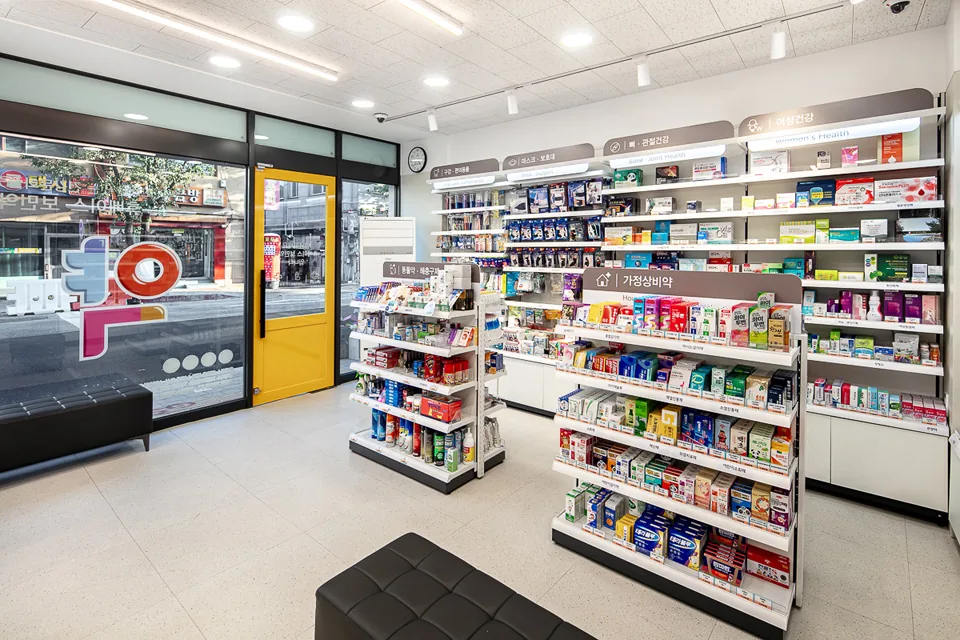
During the day, look for the syllable 약 (yak, “medicine”) on a sign; after hours, turn to Seoul’s public late-night pharmacies or to the holiday-duty pharmacies listed nationwide.
The full word is 약국 (yakguk), said closer to “yak-kook” because the second ㄱ tenses after the first. In 2026 Seoul runs 39 public late-night pharmacies (공공심야약국, gonggong simya yakguk) across all 25 of its districts, open from 10 p.m. to 1 a.m. The city says 28 of them open every day of the year and the other 11 only on set weekdays, so check the day before you walk over. Seoul’s Smart Seoul Map shows the locations, and typing 공공심야약국 into a Korean search bar brings them up too. Other cities and provinces run their own, under an amendment to the Pharmaceutical Affairs Act passed in March 2023 that lets local governments designate pharmacies for late nights and public holidays.
For Sundays and holidays anywhere in the country, the 휴일지킴이약국 (“holiday guardian pharmacy”) website searches duty pharmacies by region, and the National Emergency Medical Center’s E-Gen service has a pharmacy finder of its own. You can also call 119. The government’s Easy-to-Find Law service notes that the emergency line will tell callers which pharmacy nearby is open, including on holidays.
What Can a Convenience Store Sell When Pharmacies Are Closed?
Only a short list of household medicines: since November 15, 2012, stores registered to sell them and open 24 hours a day, year-round, have been allowed to stock them without a pharmacist.
The health ministry’s list, on a page it last updated in March 2026, names 13 products: five fever and pain relievers, four digestive aids, two cold medicines and two pain-relief patches. The rules are strict. Each purchase is limited to one package of each product, and stores may not sell them to children under 12.
This is where reading Hangul pays off. Brand names are written in Hangul by sound, so 타이레놀 reads “ta-i-re-nol,” which is Tylenol. The category words are ones you have already met: 감기약 for cold medicine, 소화제 for digestion, and 파스 (paseu), the everyday word for a medicated pain-relief patch. Keep in mind that the clerk at the till is not a pharmacist, so for anything you can’t match to a box, the pharmacy in the morning is the better call.
When Will a Pharmacist Send You to a Clinic Instead?
When you need a prescription-only drug, or your symptoms sound like more than an over-the-counter fix, you will hear 병원에 가 보세요 (byeongwone ga boseyo, “you should go and see a doctor”).
Korean law lets pharmacies hand over prescription-only medicines only when filling a doctor’s or dentist’s prescription, while ordinary over-the-counter medicines need none. Antibiotics are the classic example. Korea split prescribing from dispensing in July 2000, so a doctor writes the prescription and a pharmacist fills it, and the split was designed so that patients could not buy high-risk drugs such as antibiotics on their own.
Don’t take 병원 too literally. It means “hospital,” but in everyday speech 병원에 가다 simply means “go to the doctor,” and for a cold or a stomach bug the place to go is usually a small neighborhood clinic whose sign ends in 의원 (uiwon). Two phrases get you through reception: 진료 받고 싶어요 (jillyo batgo sipeoyo, “I’d like to see a doctor”) and 외국인이에요 (oegugin-ieyo, “I’m a foreigner”), which explains in advance why you’ll be pointing a lot. You leave with a 처방전 (cheobangjeon, “prescription”), take it to a pharmacy, and hand it over with 처방전 여기 있어요 (cheobangjeon yeogi isseoyo, “here’s my prescription”).
Frequently Asked Questions
Q: How do you say “I feel sick” in Korean without naming a body part?
몸이 안 좋아요 (momi an joayo, “mo-mee an jo-ah-yo”), literally “my body isn’t good,” is the all-purpose version, and a bare 아파요 works too. Pair it with a hand on your forehead or stomach, and the pharmacist’s questions will do the rest.
Q: How do you read the dosage instructions on a Korean medicine bag or box?
Look for three pieces. 1일 3회 means three times a day, 1회 1정 means one tablet per dose, and 식후 (sikhu) means after meals, with 식전 (sikjeon) for before meals and 취침 전 (chwichim jeon) for bedtime. 정 counts tablets, while 포 counts sachets of powder.
Q: What should you say if it’s an emergency, not a pharmacy problem?
Call 119, Korea’s emergency number for ambulances and fire, and to anyone nearby say 도와주세요 (dowajuseyo, “please help”) and 구급차 불러 주세요 (gugeupcha bulleo juseyo, “please call an ambulance”). A pharmacy is the right stop for a headache, not for chest pain or trouble breathing.
Q: Who can interpret by phone if you and the pharmacist share no language?
Dial 1330, the Korea Tourism Organization’s travel hotline, which in 2026 offers tourist interpretation by phone in eight languages year-round, and hand the phone across the counter. An offline translation app covers the moments a call can’t, and the translation app guide shows which features keep working without a signal.
Nobody expects perfect Korean from a traveler with a fever. Two patterns, a pointed finger and a phone screen will get you the right box, and 감사합니다 (gamsahamnida, “thank you”) on the way out finishes the job.
Part of Essential Travel Phrases