Korean Grammar Phrases for a Week Trip (Not a Full Course)
On this page
- Korean Grammar Phrases for a Week Trip: What You Actually Need First
- Step 1: Introduce Yourself and Name Things with -이에요/예요
- Step 2: Ask for What You Want with -주세요
- Step 3: Find Anything with -이/가 어디예요?
- Step 4: Ask the Price with 얼마예요?
- Step 5: Say What You Want to Do with -고 싶어요
- Step 6: Say No Politely with 아니요 and 안
- The Mistakes That Trip Up First-Time Visitors
- Frequently Asked Questions
Six Korean grammar patterns (not a full course, not a conjugation chart) carry you through most of a one-week trip to Korea. The one you’ll lean on hardest is 이거 얼마예요? (igeo eolmayeyo, “how much is this?”), a point-and-ask line for markets, stalls, taxis, and pharmacies. Each pattern is a fixed ending: memorize it once, drop in whatever noun or verb you looked up that morning, and the sentence still comes out right.
Quick answers
- About 6 sentence endings, including -이에요/예요, -주세요 and 얼마예요?, cover ordering, prices and directions on a 7-day trip to Korea.
- Korean grammar is modular: swap the noun or verb stem in front of a fixed ending, and the sentence still works correctly.
- Skip verb conjugation tables and honorific levels entirely, because the polite standard form (-요) covers everything a short-term visitor needs.
Korean Grammar Phrases for a Week Trip: What You Actually Need First
What you need first is the six endings in this table, each paired with a sentence you can use on day one.
| Pattern | What it does | Say it | Romanization |
|---|---|---|---|
| -이에요/예요 | names or describes something | 이거는 물이에요 | igeoneun mul-ieyo |
| -주세요 | asks for something | 물 주세요 | mul juseyo |
| -이/가 어디예요? | finds a place | 화장실이 어디예요? | hwajangsil-i eodiyeyo |
| 얼마예요? | asks the price | 이거 얼마예요? | igeo eolmayeyo |
| -고 싶어요 | says what you want to do | 비빔밥을 먹고 싶어요 | bibimbap-eul meokgo sipeoyo |
| 아니요 / 안 | says no, negates a verb | 안 매워요 | an maewoyo |
You don’t need to read hangul fluently before you land, though it helps; a phrase app with romanization gets you through the first few days just fine. The romanizations here follow the National Institute of Korean Language’s Revised Romanization of Korean, which spells the vowel 어 as “eo” (said close to the “u” in “cup,” not “e-o”), a spelling that trips up plenty of first-time readers. What actually matters is understanding that Korean sentences build around a small set of endings, and once you know six of them, you can slot in almost any noun or verb you look up on the fly. This isn’t a shortcut to fluency. It’s the minimum viable grammar for ordering food, finding a bathroom, and not paying double at a market.
Step 1: Introduce Yourself and Name Things with -이에요/예요
Attach -이에요 to a word ending in a consonant, or -예요 to one ending in a vowel, and you’ve said “is/am/are.” “저는 [name]이에요” (jeoneun [name]-ieyo) means “I’m [name],” and “이거는 물이에요” (igeoneun mul-ieyo) means “this is water.” That 는 in 이거는 is the topic marker. It sets “this” up as what you’re about to describe, the same job 저는 does for “I” one sentence earlier. Once you’ve got this pattern down, you can point at almost anything and name it, a skill that gets you out of more confusing situations than you’d expect.
Step 2: Ask for What You Want with -주세요
Add -주세요 (juseyo) after any noun to mean “please give me ___.” “물 주세요” (mul juseyo) gets you water at a restaurant; “영수증 주세요” (yeongsujeung juseyo) gets you a receipt. Regulars at any Korean restaurant will tell you this single ending covers ordering, requesting extra side dishes, and asking for the check. It’s the workhorse of the entire trip.
Step 3: Find Anything with -이/가 어디예요?
To ask where something is, attach -이 (after a consonant) or -가 (after a vowel) to the noun, then add 어디예요 (eodiyeyo). “화장실이 어디예요?” (hwajangsil-i eodiyeyo) means “where’s the bathroom?” You’ll also hear the longer, equally common version 어디에 있어요? (eodie isseoyo, “where is it located?”). Both work, and Koreans use the two interchangeably when giving directions, so don’t stress over picking the “correct” one.
Step 4: Ask the Price with 얼마예요?
이거 얼마예요? (igeo eolmayeyo, “how much is this?”) is the single most repeated sentence you’ll say all week, whether you’re at a Myeongdong street stall or a Busan fish market. The answer comes back in Sino-Korean numbers grouped by 만 (man, 10,000) instead of by thousands: 오천 원 (ocheon won) is ₩5,000, 만 원 (man won) is ₩10,000, and 삼만 오천 원 (samman ocheon won) is ₩35,000. Most tourist-facing shops mark their prices, so the question earns its keep at markets where labels are missing or written only in Korean. If the number flies past you, 다시 한번 말해 주세요 (dasi hanbeon malhae juseyo, “please say it once more”) gets a slower repeat.
Step 5: Say What You Want to Do with -고 싶어요
Attach -고 싶어요 (go sipeoyo) to a verb stem to say “I want to ___.” “비빔밥을 먹고 싶어요” (bibimbap-eul meokgo sipeoyo) means “I want to eat bibimbap.” This pattern is what turns you from someone pointing at a menu into someone who can actually state a preference, which pays off with taxi drivers, tour guides, and anyone at a hotel front desk.
Step 6: Say No Politely with 아니요 and 안
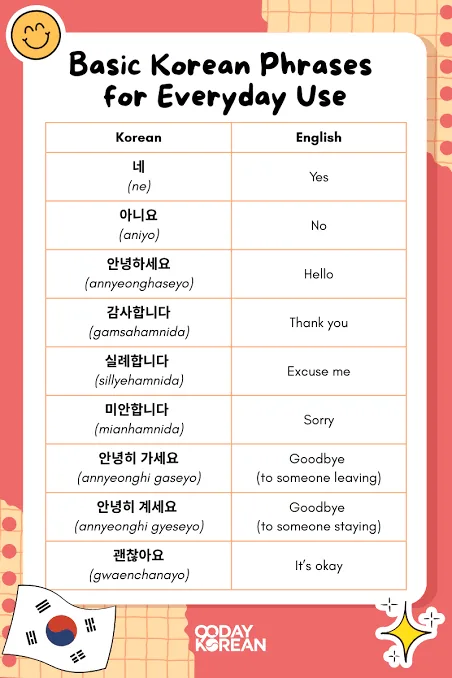
아니요 (aniyo) is your all-purpose “no,” and adding 안 directly before a verb negates it: “안 매워요” (an maewoyo) means “it’s not spicy.” What surprises most first-time visitors is how far these two tools go. 아니요, 괜찮아요 (aniyo, gwaenchanayo, “no, I’m fine”) turns down a sample or an extra side dish, and 안 in front of a verb covers the rest, from correcting an order to checking whether a dish will burn.
The Mistakes That Trip Up First-Time Visitors
The most common slip mixes up two similar-looking patterns: -이에요/예요 (to describe or name something) and -이/가 있어요/없어요 (to say something exists or doesn’t).
The other common stumble is choosing the wrong half of -이에요/예요. The choice depends only on the noun’s last sound: 물이에요 (mul-ieyo) after a consonant, 커피예요 (keopi-yeyo) after a vowel. Particles are where you can relax. Spoken Korean drops the object marker before 주세요 all the time, which is why you’ll hear 물 주세요 far more often than 물을 주세요 (mul-eul juseyo).
Frequently Asked Questions
Q: How long should I practice Korean grammar phrases for a week trip?
A week of short daily sessions is enough: one pattern a day covers all six before you fly. Build each practice sentence from your own itinerary, like 명동역이 어디예요? (myeongdongyeok-i eodiyeyo, “where’s Myeongdong Station?”) or 아메리카노 주세요 (amerikano juseyo, “an americano, please”), and say it out loud, because on the trip you’ll be producing these on the spot rather than reading them.
Q: What does 주세요 (juseyo) mean, and can I use it with verbs?
주세요 is 주다 (“to give”) in its polite request form, so after a noun it means “please give me ___”: 물 주세요 (mul juseyo) gets you water. After a verb it becomes -아/어 주세요, “please do it for me,” which is how you pay and how you get out of a taxi: 계산해 주세요 (gyesanhae juseyo, “the bill, please”) and 여기서 세워 주세요 (yeogiseo sewo juseyo, “please stop here”).
Q: Do I need to learn hangul before a week trip to Korea?
No. Romanized phrases work fine for a week-long trip, though hangul was built to be learned fast: Jeong In-ji’s 1446 postface to the Hunminjeongeum promised that a quick learner could master it within a morning and a slow one within ten days. Once the letters click, a few sound-change rules are what turn letter-by-letter decoding into reading menus and signs.
Q: Is it rude to only speak polite standard Korean (-요) the whole trip?
Not at all. The -요 ending is the safe, standard-polite register for any stranger, shopkeeper, or service worker, and sticking to it for your entire trip is completely normal and expected from a visitor. If you’ll be meeting people by name, the honorific mistakes that actually offend (like attaching 씨 to a bare surname) are a shorter list than you’d fear.
Q: What’s the single most useful Korean phrase for a short trip?
이거 얼마예요? (“how much is this?”) edges out every other phrase, since it works in restaurants, markets, taxis, and pharmacies, and the “이거” (this) part means you never need to know the actual name of the item.
Q: Can I get by in Korea in 2026 using only English?
In major tourist areas of Seoul and Busan, yes, to a point, since many signs and menus include English. But even six Korean grammar patterns noticeably change how people respond to you outside those areas, and asking things like “얼마예요?” tends to open up a follow-up conversation in a way pointing and gesturing doesn’t.
Q: What’s the difference between 어디예요? and 어디에 있어요?
Both mean “where is it?” and either one gets you pointed in the right direction, so this isn’t a mistake you can actually make. The small grammatical difference: 어디예요? (eodiyeyo) treats the place itself as the answer, the same way -이에요 names anything else on this list, while 어디에 있어요? (eodie isseoyo) uses 있다 (“to exist”) to ask where something is located (more literally, “at where does it exist?”). Use whichever comes out first; Koreans answer both the same way.
Q: What does 이거는 mean, and why does 이거 얼마예요? drop the 는?
이거는 (igeoneun) is just 이거 (“this”) plus 는, the topic marker that flags what you’re about to describe. That’s why “이거는 물이에요” reads like “this, specifically, is water.” Quick questions like 이거 얼마예요? usually skip 는 because you’re pointing and asking on the spot, not setting something up for contrast. Dropping or keeping 는 won’t confuse anyone either way.
You don’t need a semester of TOPIK prep to have a real week in Korea. Six patterns, used confidently, will carry you through almost everything on the trip.
Part of Korean Grammar Basics