Saju vs. MBTI: Korea's Two Favorite Personality Systems
On this page
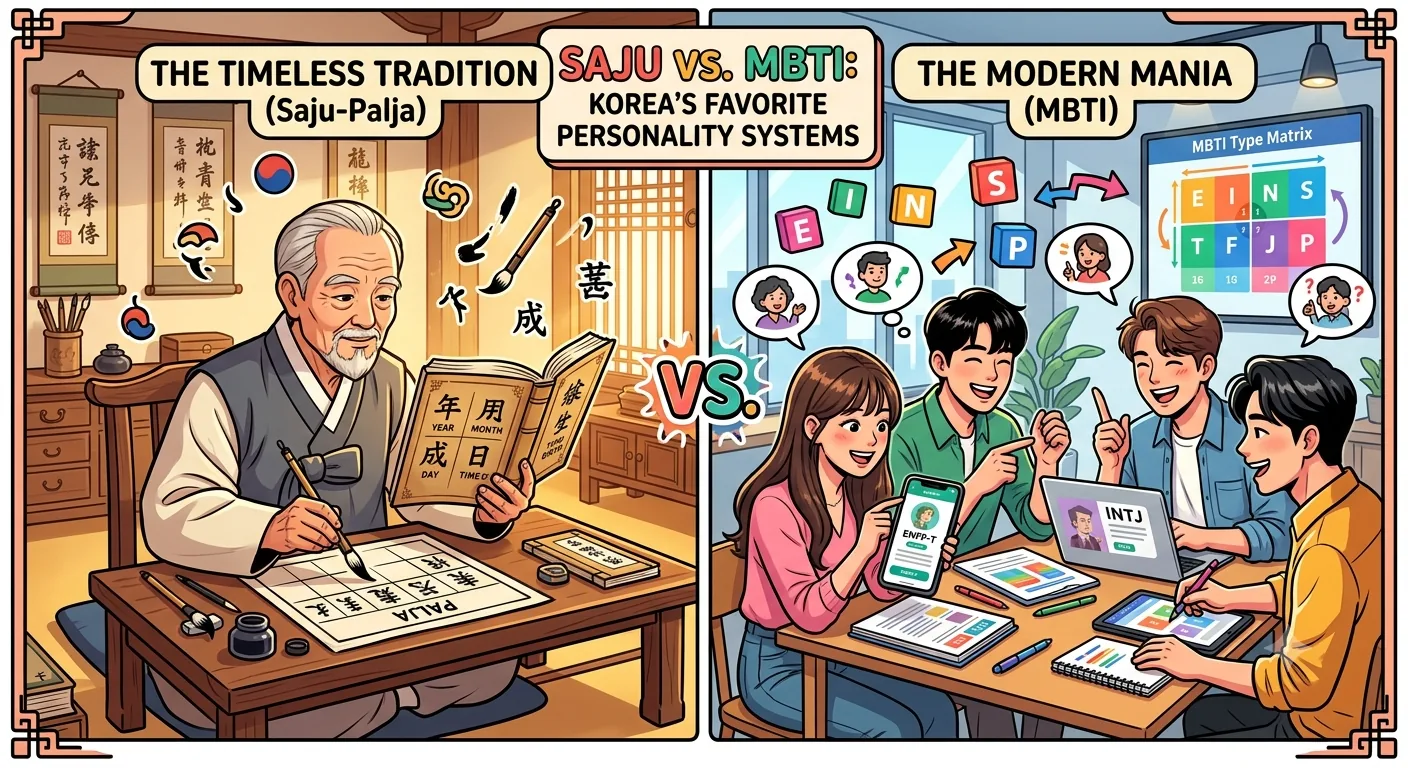
The Saju vs MBTI Korea personality comparison comes down to one surprise: Koreans don’t choose between them, they run both. Saju (사주) is a centuries-old birth-chart reading pulled out for weighty decisions like a wedding date or a career change, while MBTI is a Western self-report test that runs everyday social identity, from dating profiles to workplace icebreakers. Outsiders assume one is modern and credible, the other quaint superstition. That framing gets Korea backwards.
Quick answers
- Saju (사주) reads the year, month, day and hour of your birth as four “pillars” written in eight characters; MBTI is a self-report questionnaire whose first version was developed in the United States in 1943.
- Koreans generally don’t pick one: saju comes out for wedding dates, baby names and career moves, while MBTI shapes everyday social identity, and 90% of Koreans aged 18 to 29 had taken an MBTI test in a December 2021 Hankook Research poll.
- Neither is rigorous science: by the MBTI publisher’s own figures, only about 50% of people get the same four-letter type on retest, and a saju reading is only as good as the practitioner interpreting the chart.
Saju vs MBTI Korea Personality Comparison: Which Should You Trust?
Neither one, if you’re looking for lab-grade accuracy, because they’re not answering the same question. Saju interprets your birth data through the Four Pillars of Destiny to describe timing, fortune and life patterns; MBTI sorts self-reported preferences into one of sixteen personality types. Treating them as competitors is like asking whether a compass or a clock is “more correct.” Side by side, the difference is plain:
| Saju (사주) | MBTI | |
|---|---|---|
| Origin | Chinese Four Pillars astrology, used in Korea for centuries | First version developed in 1943 in the US by Katharine Briggs and Isabel Myers |
| Input | Exact birth date and hour | Self-reported answers to a questionnaire |
| Same answer twice? | The chart never changes; the reading depends on the reader | About 50% get the same four-letter type on retest |
| Typical use in Korea | Wedding dates, baby names, career moves | Dating profiles, team bonding, social identity |
| Who delivers it | A practitioner in person, or a saju app | An app, quiz site, or printed test |
Where Saju and MBTI Actually Come From
A common assumption is that MBTI, being “psychology,” carries more scientific pedigree than saju’s old-world fortune-telling. The actual histories complicate that. Saju grew out of Chinese Four Pillars astrology, and in Korea the stems-and-branches system behind it once had state backing: the Joseon court’s astronomy bureau, the Gwansanggam, ran a myeonggwahak division that chose auspicious dates and hours for royal ceremonies, recruited partly through a specialist state exam. MBTI is younger than it sounds. According to the Myers-Briggs Company, its first version was developed in 1943 by Katharine Briggs, whose degree was in agriculture, and her daughter Isabel Myers, a political science graduate; what they brought instead was years of studying Carl Jung’s theory of psychological types. Korea’s MBTI wave is newer still. Hankook Research traces the boom to a June 2020 episode of the MBC variety show Hangout with Yoo (놀면 뭐하니?), in which Yoo Jae-suk, Lee Hyo-ri and Rain took the test on air, and its December 2021 poll of 1,000 adults found 45% had already taken it.
How Accurate Is Each System, Really?
The instinct is to call MBTI “science” and saju “superstition,” but that split doesn’t survive scrutiny. The clearest evidence comes from the MBTI publisher itself: about 50 percent of people get the same four-letter type when they retake it, even though around 90 percent match on three or four of the four scales. In other words, roughly one retaker in two walks away with a different label, a shaky base for something people put in their dating bios. Korean respondents were skeptical too: in the same Hankook Research poll, only 26% said using MBTI in hiring was appropriate, against 43% who said it wasn’t. Saju was never built to be falsifiable either. Your chart can’t change, since your birth hour doesn’t, but reading it is an interpretive craft, closer to a counseling session than a diagnostic test. A 30-minute session at a Hongdae saju cafe cost ₩50,000 in a March 2025 Korea Herald report, and what you’re paying for is a practitioner’s interpretation, not a printout.
Why Koreans Use Both Instead of Choosing One
The real reason saju and MBTI coexist is that they answer different questions. Saju gets pulled out for decisions with weight, and weddings are the classic case. In the traditional sequence described by the Encyclopedia of Korean Culture, the groom’s family sends his saju to the bride’s family, who choose the wedding date and send it back; the same chart feeds gunghap (궁합) compatibility readings and baby naming, both listed among saju’s uses. Modern weddings often pass the date on by word of mouth instead of a formal letter, long before guests start weighing how much to put in the cash-gift envelope. MBTI runs the lighter, social layer of daily life. It’s practically a conversation starter, turning up in dating-app bios alongside the slang of Korean dating chats, on team-building slides, and in friend-group debates about who’s the “T” in the group chat. Since 2024 that dual demand has spilled into tourism: the state-run Seoul Tourism Organization began promoting saju cafes as a tourism product that year, though its tourism-service team lead told the Korea Herald they may never become a mainstream attraction. For visitors chasing the “living like locals” trend, a fortune teller now sits on the same list as a bathhouse or a PC café.
Frequently Asked Questions
Q: What does “saju” mean in Korean?
Saju (사주, 四柱) literally means “four pillars”: the year, month, day and hour of your birth. Each pillar is written with two characters drawn from the ten heavenly stems and twelve earthly branches, which is why Koreans also say saju palja (사주팔자), “four pillars, eight characters.”
Q: Is MBTI actually popular in Korea?
Yes. In Hankook Research’s December 2021 poll of 1,000 adults, 45% had taken an MBTI test, and among 18- to 29-year-olds the figure was 90%.
Q: Can foreigners get a saju reading in Seoul?
Yes. Saju cafes in Myeong-dong and Hongdae post signs in English, Japanese and Chinese, some employ readers who speak foreign languages or provide free interpretation, and travel platforms such as Creatrip handle reservations.
Q: Is saju the same thing as Chinese astrology?
Saju uses the same Four Pillars system that Chinese fortune-tellers call bazi (八字), so the method is shared. It isn’t the same as the twelve-animal zodiac, which looks only at the branch of your birth year; saju reads all eight characters. What’s distinctly Korean is the setting, from the saju letter sent before a wedding to the Seoul cafes now reading charts for tourists.
Whichever one you try first, don’t expect a verdict. Expect two very different lenses on the same question of who you are, and in Korea it’s perfectly normal to keep both in rotation.