When Did South Korea Become Rich? Four Datable Answers
On this page
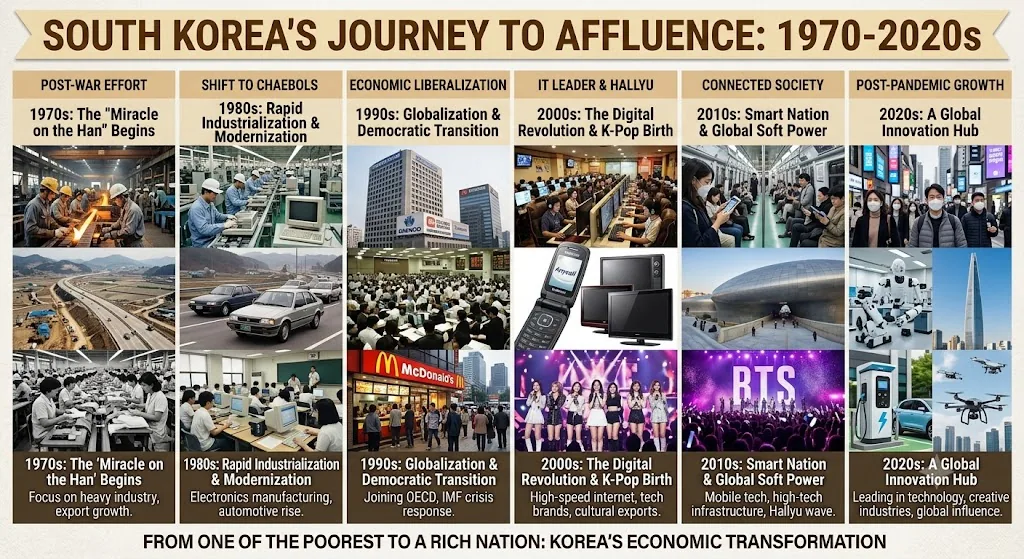
For three years at the end of the 1990s, the World Bank took South Korea back off its list of high-income economies. That reversal is why this question has no clean answer. Korea did not get rich on a single dated afternoon. It crossed a measurable statistical line in 1995, cleared a diplomatic one in 1996, dropped back under the first one from 1998 to 2000, and returned in 2001. Each of those years belongs to a different yardstick, and knowing which yardstick someone is holding is the whole trick. The mechanics of how the money was actually made (the export-first industrial plan, the state-directed loans, the chaebol gambles) are a separate story, told in how South Korea got so rich so fast. What follows is the ledger of when it counted.
Quick answers
- South Korea first met the World Bank’s high-income threshold in 1995, the earliest date any standard measure supports.
- The Asian Financial Crisis pushed it back down into the upper-middle-income group from 1998 to 2000, and it regained high-income status in 2001.
- The last major institution to relabel Korea was UNCTAD, which moved it from developing to developed economies in a classification update dated 12 April 2022.
When Did South Korea Become Rich? The Short Answer
South Korea became rich in 1995 and became permanently rich in 2001. The first date is when it first crossed the World Bank’s high-income threshold; the second is when it crossed back after the Asian Financial Crisis and never slipped below again. Ask when South Korea became wealthy rather than rich and you land on the same four candidate years: the word changes, the list does not. The starting line, at least, is easy to place: the armistice signed at Panmunjom on 27 July 1953, which is why the two Koreas remain technically at war, left the South an agrarian aid recipient with almost no industry. Everything after that is an argument about which threshold counts as the finish line, and most sources never say which one they are using.
What Year Did South Korea Officially Become High-Income?
- That was the first year the World Bank’s own income classification placed South Korea in the high-income group, so if you are asking when South Korea became a high-income country by the standard measure, that is the year. It is also the year nobody celebrates, because the world had already made up its mind seven years earlier. The IOC’s account of the Seoul Games credits them with transforming Korea’s image from “a poor, war-stricken and divided country to a rising economy” back in 1988, a full seven years before the statistics agreed. So if you want the moment Korea looked rich, 1988 is defensible. If you want the moment a neutral institution measured it as rich, it is 1995, and the gap between those two dates is the most interesting thing about the question.
Why Does 1996 Get the Credit Instead?
Because 1996 is the year with a ceremony attached: South Korea joined the OECD on 12 December 1996 as the organisation’s 29th member. Encyclopedias and news explainers gravitate here because club admission produces a signing, a photograph and a press release, while a statistical reclassification produces a spreadsheet row. Be precise about what accession is, though. It is a peer decision, not a measurement of income: a candidate is reviewed committee by committee and then invited in. Korea had already cleared the income bar a year earlier. In 1996 it was simply let into the room.
Did South Korea Stop Being Rich in 1997?
On paper, yes: Korea was classified back down to upper-middle income from 1998 through 2000, and its economy shrank 4.9 percent in 1998 on the World Bank’s national accounts. The crisis moved fast. On 4 December 1997 the IMF Executive Board approved a stand-by credit of SDR 15.5 billion, about US$21 billion, and the largest arrangement in the Fund’s history at that point. In the months after, households queued to hand over wedding rings and gold jewellery toward the national debt, a detail that tells you more about how the period felt than any growth figure can. Ask anyone in Seoul who was carrying a mortgage then when Korea got rich, and you’ll find the answer is rarely a year at all — it’s a story about the IMF era. Timelines that jump straight from the 1996 OECD photograph to today’s skyline are not simplifying. They are leaving out the part where it came apart.
When Did the Wealth Actually Stick?
- Korea returned to the World Bank’s high-income group that year and closed out its IMF debt in the same stretch of months. The three-year stand-by arrangement had already expired on 3 December 2000, and on 23 August 2001 Korea repaid the final installment ahead of schedule: SDR 111.2 million, roughly US$142.3 million, settling total drawings of about US$19.5 billion. If the question is when South Korea became rich and stayed rich, 2001 is the only answer that carries no asterisk.
When Did the Rest of the World Call Korea Developed?
Later than almost anyone guesses. UNCTAD, the UN’s trade and development body, moved the Republic of Korea out of “developing economies” and into “developed economies” in a classification update dated 12 April 2022. Statistical categories are sticky, and institutions run on separate clocks: one had Korea rich in 1995, another admitted it to the developed-country club in 1996, and a third did not rearrange its own country groupings until the 2020s. What surprises most people who go looking at these tables is how little they agree with one another. The physical evidence had stopped being ambiguous decades before the paperwork caught up: memory chips now do the export work that wigs and plywood once did, a shift with numbers of its own in Korea’s semiconductor exports and the AI boom.
Frequently Asked Questions
Q: When did South Korea become wealthy enough to stop receiving foreign aid?
Korea took in roughly US$13 billion in aid between 1945 and 1995, left the OECD’s list of aid recipients in 2000, and a decade later joined the OECD’s Development Assistance Committee as a donor in 2010. If you want the moment the money started flowing outward instead of in, that pair of dates is the cleanest answer on this page, and it sits nowhere near 1995.
Q: How did Korea become rich so fast, and what powered the growth?
Exports, and a state that chose the exporters. Light manufacturing in the 1960s gave way to steel, ships and chemicals in the 1970s, financed by state-directed credit and run through the chaebol conglomerates, with semiconductors and cars following in the 1980s. The years on this page are the scoreboard rather than the game; the mechanics are in how South Korea got so rich so fast.
Q: What year did South Korea become a developed country?
It depends on which institution you ask. The OECD admitted Korea on 12 December 1996; UNCTAD did not move it into the developed-economies group until a classification update dated 12 April 2022. Both are honest answers to the same question, which is why sources contradict each other so freely.
Q: Did South Korea really lose its rich-country status after 1997?
Yes. Korea was reclassified as upper-middle income from 1998 to 2000 after the Asian Financial Crisis, with the economy shrinking 4.9 percent in 1998, and it regained high-income status in 2001.
Q: Is 1995 or 1996 the correct answer?
1995 if you are asking about income, 1996 if you are asking about recognition. The cleanest single date is 2001, because it is the only crossing that was never reversed.
Q: How long did the transformation take?
From the armistice in 1953 to the income threshold in 1995 is 42 years; to the 2001 recovery, 48. Either way it fits inside one working life — the same person could have been born into an aid economy and retired out of a high-income one.
Stand on any bridge over the Han today and the answer looks obvious, which is precisely the problem: the dates that actually settled it were the ones nobody noticed while they were happening.
Part of Modern Korea