How Did South Korea Get So Rich So Fast? The Real Story
On this page
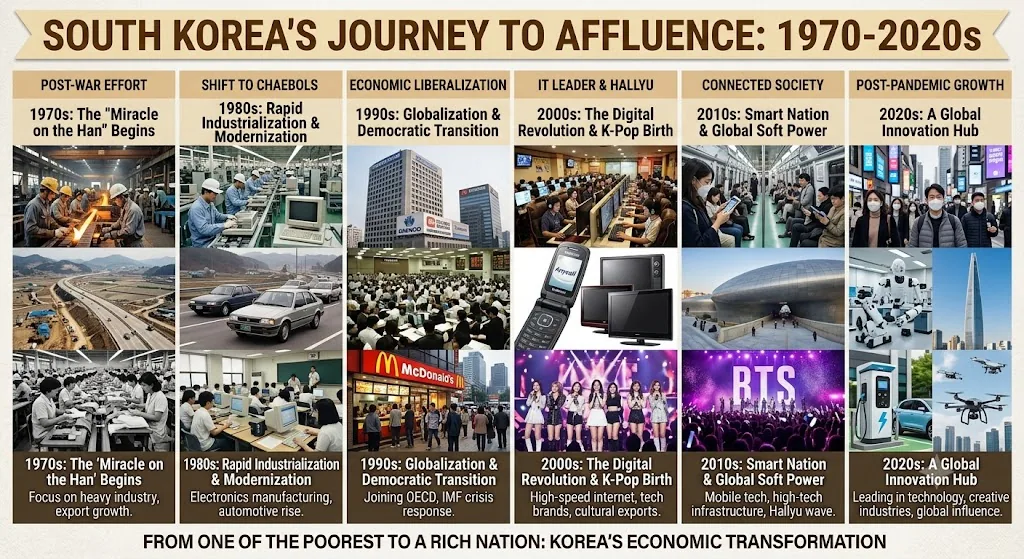
South Korea got so rich so fast because a military government bet the whole country on exports in 1962, then spent three decades forcing a handful of family-run conglomerates to sink or swim in foreign markets. The starting line is easy to underrate: World Bank figures put income per head at $158.84 in 1960, below Ghana’s $174.86 and barely half of the Philippines’ $269.47. By 2024 the same series reads $36,238.64. That is the compressed version of why a country with almost no natural resources now anchors the world’s supply of memory chips, ships and cars, and the fuller answer is stranger and far more deliberate than “they just worked hard”.
Quick answers
- Income per head ran $158.84 in 1960 and $36,238.64 in 2024 on the World Bank’s current-dollar series, a climb most Western economies needed a century to make.
- The turn is credited to Park Chung-hee’s export-first industrial policy, launched with the first Five-Year Plan in 1962 and financed by state-directed loans to a few family conglomerates, the chaebols.
- The paperwork caught up on 12 December 1996, when Korea joined the OECD as its 29th member, 34 years after that first plan.
How Did South Korea Get So Rich So Fast? The Short Answer
The short answer is that exports became the entire national strategy in 1962, and nearly every lever of the economy (credit, the exchange rate, tariffs, schooling) was bent toward that single target. Rather than shelter domestic industry the way most postwar economies did, planners under Park Chung-hee pushed Korean firms into foreign markets almost immediately, on the theory that only international buyers would tell you honestly whether your product was any good. It was a brutal, top-down bet. It paid off over the following three decades, though not evenly and not without a currency crisis in the middle.
What Was South Korea’s Economy Like Before the Boom?
Before the boom this was an agrarian economy living on American aid. The familiar line that Korea was poorer than most of Africa is close but sloppy: in 1960 its $158.84 per head sat below Ghana ($174.86) and far under the Philippines ($269.47), while running ahead of Nigeria ($93.14) and Kenya ($102.82). The Korean War had ended seven years earlier, splitting the peninsula, flattening much of Seoul, and leaving a border that is still governed only by an armistice. Add almost no natural resources, a literacy rate the new government was scrambling to raise, and an export ledger that was a rounding error next to imports, and you get a country nobody serious expected to out-earn most of Europe within two generations. Exactly when it crossed the line into rich is a datable question with four answers.
What Sparked the Miracle on the Han River?
The spark was the first Five-Year Economic Development Plan, rolled out from 1962 after Park’s 1961 military coup, which turned the country away from import substitution toward aggressive export manufacturing. Cheap textiles, wigs and plywood gave way within a decade to steel, with POSCO breaking ground at Pohang in 1968, and then to ships: Hyundai Heavy Industries held its Ulsan groundbreaking in 1972 and christened two 260,000-deadweight-ton supertankers in 1974, finishing the shipyard and its first hulls at roughly the same moment. What surprises most people who read the era’s paperwork is how conditional the money was. The government handpicked a small number of family conglomerates, funnelled subsidised credit to them, and cut support fast when export targets were missed. Koreans still call the period 한강의 기적, the Miracle on the Han River, and by the late 1970s the bet on Samsung, Hyundai, LG and SK had turned an aid recipient into a genuine industrial exporter.
What Does South Korea’s Wealth Look Like Today?
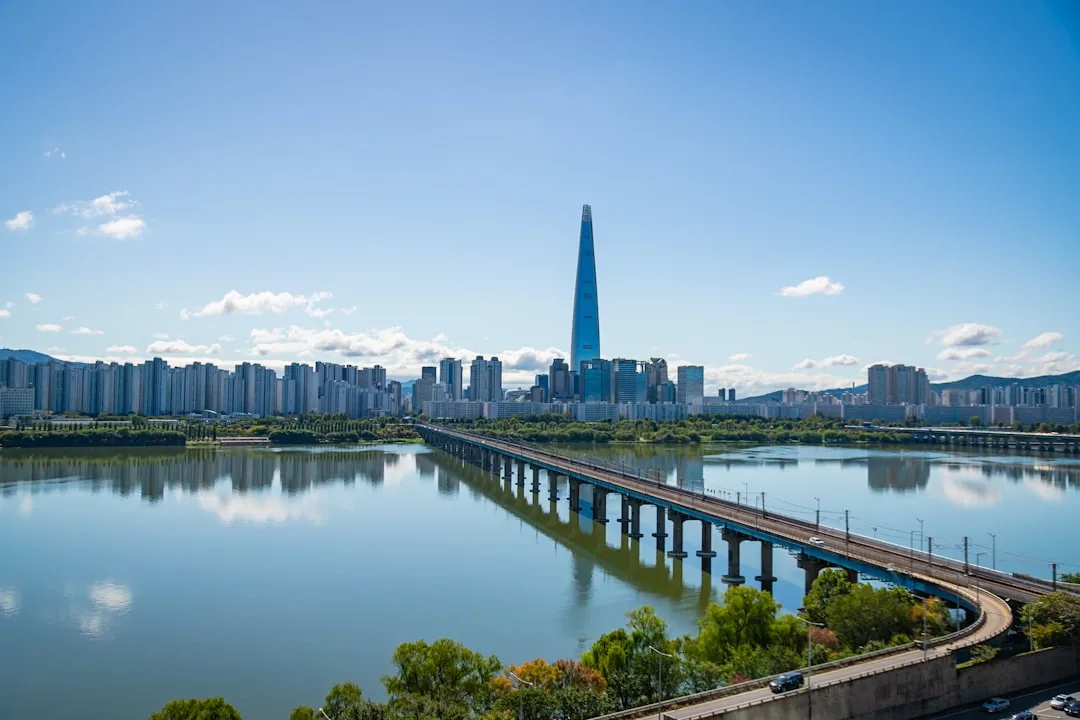
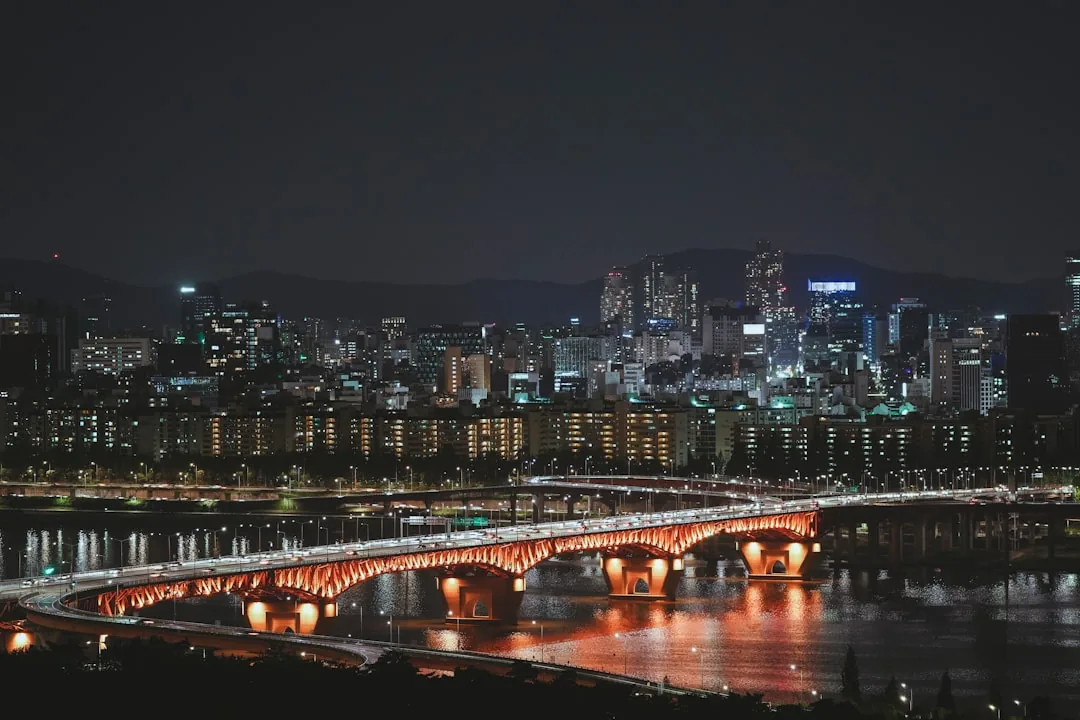
Today the same playbook shows up as dominance in a few very specific, very high-value industries. Samsung and SK Hynix together supply most of the world’s memory chips, the business behind Korea’s semiconductor export boom, while Hyundai and Kia sell cars in markets that once treated “Made in Korea” as a punchline. You’ll find the compressed-growth story is not just economic trivia: it shapes how Koreans talk about work, schooling and risk, because most people over 60 lived through both the poverty and the boom. Walk through Seoul now and the evidence is physical. Gangnam’s glass towers stand on land that was still farmland in the early 1970s, the KTX network reaches most of the country, and a cultural export machine (K-pop, K-drama) that barely existed as an industry before the 1990s now sells worldwide.
Frequently Asked Questions
Q: How much of the early growth came from American aid?
Aid did not create the boom, but it kept the patient alive beforehand: through the 1950s US assistance covered a large share of the government’s budget and nearly the whole import bill, because exports were tiny by comparison. The switch that mattered came in 1962, when export earnings began replacing aid dollars as the country’s main source of foreign currency.
Q: Was South Korea really poorer than North Korea at one point?
Yes. Through the 1960s, North Korea’s Soviet-backed heavy industry gave it the higher GDP per capita of the two, and the economies did not clearly diverge in the South’s favour until the export boom accelerated through the 1970s.
Q: How long did it take South Korea to get rich?
Most economists date the transformation from 1962, when the first Five-Year Plan began, to 12 December 1996, when Korea joined the OECD as its 29th member. That is 34 years, roughly one working life.
Q: Is South Korea richer than Japan now?
On the World Bank’s current-dollar measure, yes, and only recently: Korea’s GDP per capita passed Japan’s in 2023 ($35,674 against $35,215) and widened the gap in 2024 ($36,239 against $33,797). A weak yen does much of that work, so read the crossover as a photo finish rather than a verdict.
Q: Did South Korea recover after getting rich, or did the growth stop?
Growth was never uninterrupted. The 1997 Asian Financial Crisis pushed Korea into what was then the largest programme in IMF history, a three-year stand-by credit of SDR 15.5 billion, about $21 billion, approved on 4 December 1997, followed by a painful corporate restructuring. Recovery came within a few years, though growth now runs in low single digits rather than the high-single-digit pace of the boom decades.
The next time someone tells you a country cannot industrialise fast without oil, minerals or a head start, Korea’s postwar ledger is the counterexample worth pulling up.
Part of Modern Korea