Gisaeng vs Geisha Difference, Finally Explained
On this page
Ask a search engine what a gisaeng was and you’ll usually get a three-word answer: “Korean geisha.” It’s tidy, it’s memorable, and it’s wrong in almost every detail that matters. The two traditions rhyme. Both trained women to sing, dance, hold a room, and make powerful men feel cultured. But they grew out of different countries, different centuries, and completely different legal systems. What surprises most people who dig into the records is that Korea’s gisaeng came first, by a wide margin.
Quick answers
- Gisaeng were state-registered Korean entertainers of the Goryeo and Joseon eras, legally locked into the lowest social caste; geisha are private Japanese artists who appeared only in the 1700s.
- Neither was primarily a sex worker: both were trained performers first, and the ”= prostitute” shorthand is the oldest mistake in the book.
- Geisha still work in Japan today (as of 2026); the gisaeng system was abolished over a century ago and survives only in museums, poetry, and period dramas.
The Gisaeng vs Geisha Difference in One Line
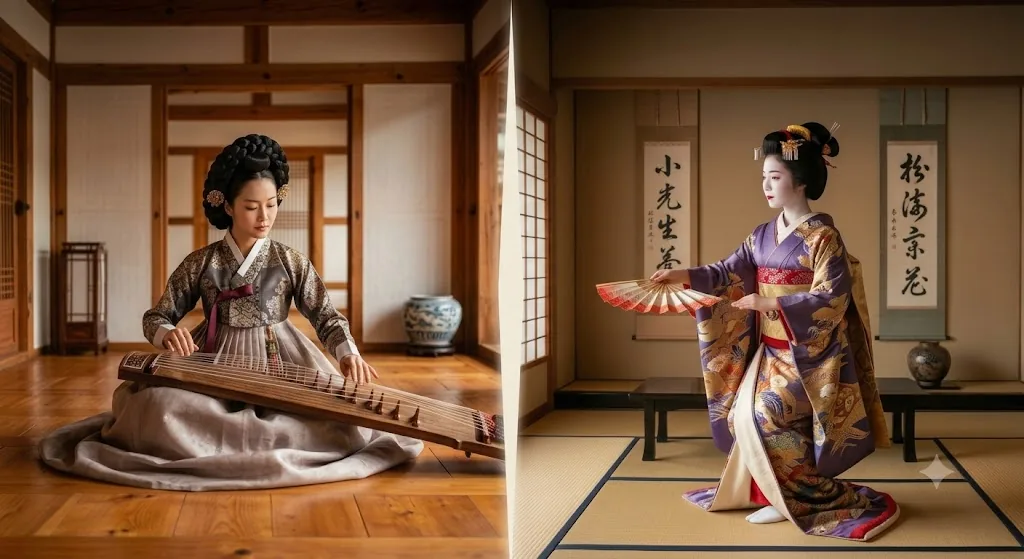
Here’s the verdict up front: gisaeng and geisha are parallel institutions, not the same one wearing different flags. A gisaeng was a woman entered into a government register and bound to the bottom of the Joseon dynasty’s rigid Confucian class hierarchy. One was defined by the state and by caste. The other, the geisha, was a commoner who apprenticed into a private house of the arts in Edo-era Japan, defined by a guild and a craft.
| Gisaeng (기생) | Geisha (芸者) | |
|---|---|---|
| Country / era | Korea; Goryeo (918–1392) into Joseon (1392–1910) | Japan; emerged c. 1700s (Edo period) |
| Legal status | Cheonmin: lowest caste, state-registered | Commoner; privately employed |
| Trained in | Music, dance, poetry, calligraphy, sometimes medicine | Shamisen, dance, song, tea, conversation |
| Employer | Royal court and government offices | Private geisha houses (okiya) and teahouses |
| Today | Abolished; a historical memory | Still practicing, mainly in Kyoto (2026) |
Were gisaeng just Korean geisha?
No, and the timeline alone settles it. Gisaeng appear in Korean records as registered female entertainers as far back as the Goryeo dynasty, centuries before anything like a geisha existed. The geisha profession only crystallized in Japan around the 1700s, during the mid-Edo period. Calling a gisaeng a “Korean geisha” therefore reverses the chronology and borrows the wrong country’s institution to explain the older one.
What did a gisaeng actually do?
A gisaeng’s job was to make the powerful look cultured — through art, not just attendance. Girls often entered training as children in a state institution and studied for years before performing at official banquets and court functions. They learned music, dance, and calligraphy, were expected to compose and trade sijo poetry with yangban officials, and the elite medical branch, the uinyeo, even practiced medicine inside the palace. The rooms where a gisaeng lived and received guests had a name of their own, the gibang. That position was inherited: the Academy of Korean Studies’ Encyclopedia of Korean Culture records that most Joseon gisaeng received it down the maternal line and held the legal standing of gwan-nobi, government slaves. The most gifted of them outgrew the role entirely. Hwang Jini, a 16th-century gisaeng from Kaesong, is remembered as one of Korea’s finest poets, while Nongae, in 1593 during the Japanese invasions, is said to have pulled an enemy commander off a cliff to their shared death.
How is that different from a geisha’s world?
The geisha grew out of a city entertainment economy, not a royal court. Organized around okiya (geisha houses) and hanamachi districts like Kyoto’s Gion, the profession took shape in the pleasure quarters of the 1700s. Girls apprenticed as maiko, then debuted as full geisha (called geiko in Kyoto), performing shamisen, dance, and conversation at private banquets for paying guests. Crucially, the geisha never carried a hereditary caste stigma, and the craft survives: a few hundred still work in Kyoto and Tokyo as of 2026.
Were gisaeng or geisha sex workers?
Neither profession was built on sex — that is the most common misconception about both, and it flattens two rich traditions into a single tired cliché. In Japan, a clear line separated geisha, who were artists, from the courtesans of the licensed quarters. Korea’s gisaeng were entertainers first, though some became concubines to officials, and the lowest tiers were genuinely vulnerable to exploitation because of their caste. The blunt “gisaeng equals prostitute” equation is largely a distortion from the colonial era and later pop culture, not an honest picture of the Joseon institution. Even the authorities that licensed them kept the two apart on paper: in 1908 the police bureau issued its control ordinance for gisaeng and a separate one for changgi on the same day, and the National Institute of Korean History’s Woori History Net notes that the first term covered performers working in song and dance while the second meant women selling sex.
What happened to the gisaeng?
The gisaeng vanished because the world that required them was legislated out of existence. By 1894, the Gabo Reform had abolished the cheonmin caste and hereditary slavery, dissolving the legal foundation the whole system rested on. The court that had employed them was unravelling at the same speed; within a year the queen who dominated it was murdered inside her own palace. The office of the gwangi, the government gisaeng, was wound up in 1908, when supervision of the profession passed to the police, and the trade associations gisaeng were then obliged to join were renamed kwonbeon in 1914. Under Japanese colonial rule (1910–1945), the role drifted toward ordinary commercial entertainment, and by the mid-20th century the tradition had faded from daily life. Today you’ll meet a gisaeng mainly in museum displays, in Hwang Jini’s poems still taught in Korean schools, and in period K-dramas. Cross the strait, and the geisha’s lantern-lit alleys in Gion are still lit each evening.
Frequently Asked Questions
Q: Do gisaeng still exist today?
No. The institution ended with the fall of the Joseon class system in the early 20th century and has no living practitioners; Japan’s geisha, by contrast, still perform as of 2026.
Q: Was Hwang Jini a real gisaeng?
Yes. Hwang Jini was a real 16th-century gisaeng from Kaesong, celebrated then and now as a master of the sijo poetic form, proof that a gisaeng could also be a literary star.
Q: Are “gisaeng” and “geisha” related words?
No. “Gisaeng” (기생, 妓生) is Korean and “geisha” (芸者) is Japanese; they share neither pronunciation nor etymology. In Korean it sounds roughly like “kee-sang,” not “gay-sha.”
Q: What does gibang mean?
Gibang (기방, 妓房) is the Korean word for a gisaeng’s quarters. The National Institute of Korean Language’s Standard Korean Dictionary defines it as the place where gisaeng resided, and traces the -bang (房, “room” or “office”) to the state bureaus they were attached to: the gyobang, which ran song and dance under Goryeo, and under Joseon the palace pharmacy, where the uinyeo practiced medicine, or the royal wardrobe office, where others took on needlework. In ordinary later usage the word came to mean the house where a gisaeng received guests.
Q: Which came first, gisaeng or geisha?
Gisaeng, by a wide margin: Korean records describe registered female entertainers as far back as the Goryeo dynasty (918–1392), while the geisha profession only took shape in Japan in the 1700s.
Strip away the shared shorthand, and you are left with two proud, separate crafts: one preserved in poems and palaces, the other still pouring tea a short flight away.