Korean Cold Noodles: Mul or Bibim, and How to Eat Them
On this page
- Mul or Bibim: Which Korean Cold Noodles Should You Order?
- Pyongyang or Hamhung Style: What Changes in the Bowl?
- How Do You Eat Naengmyeon Without Fighting the Noodles?
- Why Do Koreans Order Cold Noodles After Korean BBQ?
- Is Naengmyeon a Summer Food or a Winter Food?
- If Not Naengmyeon, Which Cold Noodle Should You Try Next?
- Frequently Asked Questions
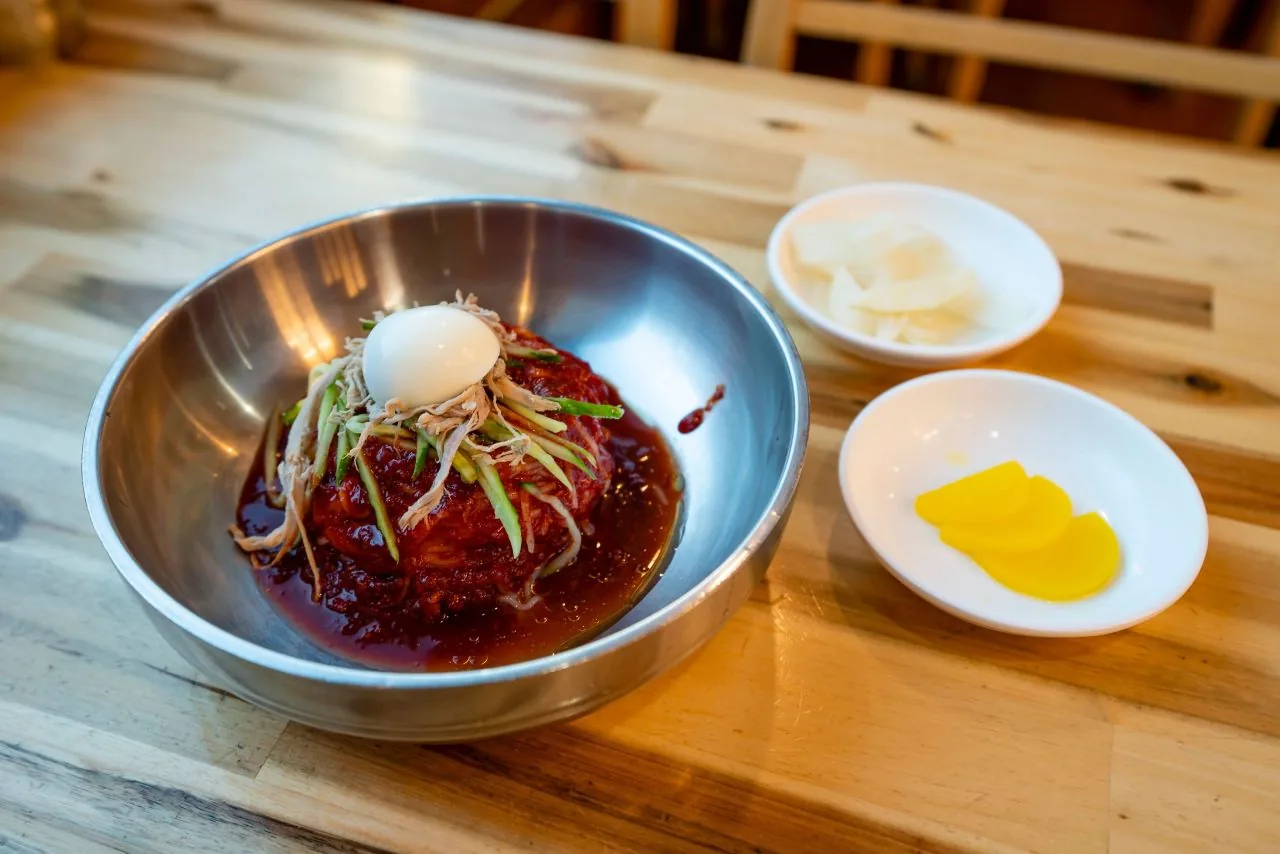
Naengmyeon arrives cold enough to fog the outside of the bowl: a tight nest of long, springy noodles, a few slices of boiled meat, some egg, and either a pool of tangy broth or a slick of red sauce. The name 냉면 (冷麵) literally means cold noodles, it’s the headliner among Korean cold noodles, and the first thing the menu asks of you is a two-way choice. 물냉면 (mul-naengmyeon) puts the noodles in chilled broth. 비빔냉면 (bibim-naengmyeon) skips the broth and coats them in a sweet, fiery gochujang sauce. Choose well, cut and season the bowl the way Korean tables do, and you’ve got one of the best things to eat on a hot day in Seoul.
Quick answers
- Order 물냉면 (mul-naengmyeon) for noodles in icy, tangy broth, or 비빔냉면 (bibim-naengmyeon) for noodles tossed in sweet-spicy gochujang sauce with no broth at all.
- Cut the long noodles with the scissors the restaurant provides, taste the broth plain, then add mustard and vinegar to your liking.
- A bowl of naengmyeon averaged ₩12,692 in Seoul in 2026, the highest regional average in the Korea Consumer Agency’s dine-out price table.
Mul or Bibim: Which Korean Cold Noodles Should You Order?
Order mul-naengmyeon if you want something cooling and clean-tasting, and bibim-naengmyeon if you want heat and a sauce that clings to every strand. The open dictionary 우리말샘 (Urimalsaem) spells out the difference. Mul-naengmyeon is noodles in a broth, topped with sliced boiled meat, fresh vegetables and egg, then finished with mustard and vinegar. Bibim-naengmyeon has no broth at all and gets mixed with meat or raw skate, seasoned vegetables and a stack of seasonings.
| 물냉면 (mul-naengmyeon) | 비빔냉면 (bibim-naengmyeon) | |
|---|---|---|
| What’s in the bowl | Noodles in chilled broth, with sliced boiled meat, fresh vegetables and egg | Noodles mixed with sauce and no broth, with meat, raw skate or seasoned vegetables |
| How it tastes | Cold, tangy, savory, gentle | Sweet, spicy, sharp |
| Where the kick comes from | The mustard you add yourself | Gochujang sauce, already in the bowl |
| Pick it when | It’s hot out, you’ve just eaten grilled meat, or spice isn’t your thing | You love chili heat or a plain broth sounds like a letdown |
So which one is yours? Go mul on a sweltering afternoon or if you’re spice-shy. Go bibim if you crave the sweet heat of a good plate of tteokbokki and want that same sticky red sauce on cold noodles. With two people, there’s no need to choose: order one of each, eat half, and swap bowls. One lunch like that tells you more about your own taste than any guide can.
Pyongyang or Hamhung Style: What Changes in the Bowl?
The noodle changes most. Pyongyang style leans on buckwheat, while Hamhung style is built on starch for a chewy strand that doesn’t break easily. The Encyclopedia of Korean Culture describes the Pyongyang original as buckwheat flour with a little starch mixed in, served under pheasant broth and dongchimi, a mild radish water kimchi. Hamhung’s version used potato starch, a crop Hamgyeong Province produced in quantity, and crowned the noodles with raw fish such as flatfish or skate, dressed in gochujang and mixed hot. That pairing still shows up in the Standard Korean Language Dictionary, which names Pyongyang’s mul-naengmyeon and Hamhung’s bibim-naengmyeon as the famous ones.
Both styles came south. The encyclopedia says naengmyeon spread nationwide after the Korean War, carried by people who moved down from the North, which is why a Seoul restaurant can still put a North Korean city name on its sign. Read that name as a hint about the house specialty, not a rule.
Expect the Pyongyang style to taste quiet. The Korea Times’ 2025 naengmyeon guide describes the beef-and-pork broth at Eulji Myeonok as mild and understated enough to catch first-time visitors off guard. That’s the style, not a flaw. Taste it plain once before you reach for anything on the table.
Hamhung-style noodles are another story. The Korea Herald’s 2018 guide to the two styles says it’s best to cut them with the scissors the restaurant provides before diving in, and anyone who has tried to bite through a mouthful of starch noodles will understand why.
How Do You Eat Naengmyeon Without Fighting the Noodles?
Cut, taste, season, then eat: snip the noodles, sip the broth plain, and only then add mustard and vinegar.
- Cut. If scissors come to the table, use them. Two snips in a cross through the middle of the nest is plenty, and you’ll still get long strands to slurp.
- Taste. Sip the broth, or try one forkful of a bibim bowl, before you change anything. Every kitchen balances its broth differently.
- Season. Mustard (겨자, gyeoja) and vinegar (식초, sikcho) are yours to add. The Encyclopedia of Korean Culture says vinegar, mustard and sugar go in at the moment of eating, and Urimalsaem’s definition of mul-naengmyeon ends with exactly that step. Start small, stir, taste again.
- Cool down or warm up. Bibim can get fierce. The Korea Times notes that Haeju Naengmyeon in Seoul’s Songpa District lets you have as much warm beef broth as you want, which helps ease the burn.
Ordering at a touchscreen instead of a server? Our kiosk walkthrough covers the taps, and on the screen you’ll find the two dishes written as 물냉면 and 비빔냉면.
Why Do Koreans Order Cold Noodles After Korean BBQ?
Because an icy, tangy bowl resets your palate after a table of grilled meat. The Korea Herald describes naengmyeon as a refreshing food to finish off a meal of grilled meat, and the Standard Korean Language Dictionary even has a four-character word for the drinker’s version of the habit: 선주후면 (先酒後麵, seonju-humyeon), drinking first and eating noodles after.
Time it so the bowl lands when the grill is nearly empty. Mul is the gentler reset after rich pork belly, and bibim suits a table that wants one last hit of heat. The other classic finish is fried rice pressed into the meat drippings, which our guide to the best meat to order at Korean BBQ walks through. Can’t decide between them? Get one naengmyeon for the table and pass it around.
Is Naengmyeon a Summer Food or a Winter Food?
Today it’s a summer food, but it started out as a winter one. The Encyclopedia of Korean Culture says naengmyeon was prized as a delicacy of the cold months, and that Dongguk sesigi, Hong Seok-mo’s 1849 record of the year’s customs, counted it among the winter seasonal foods. Its entry on seasonal food is blunter still: mandu and naengmyeon are winter specialties.
The logic is in the broth. Dongchimi, the radish water kimchi poured over the Pyongyang original, is the kind the Standard dictionary says is usually made in winter, which fits a bowl built for the cold months.
The same encyclopedia records the switch: these days naengmyeon is eaten more as a summer seasonal food than a winter one, and the Korea Herald reports demand peaking in summer. When the heat sets in, it shares the job of cooling the city down with bingsu, Korea’s shaved-ice dessert. Order a bowl in January anyway. You’ll just be eating it the old way.
If Not Naengmyeon, Which Cold Noodle Should You Try Next?
Try milmyeon in Busan, makguksu in Gangwon Province, kongguksu when the weather turns properly hot, and jjolmyeon at any snack shop.
| On the menu | Where it comes from | What you get | Order it if |
|---|---|---|---|
| 밀면 (milmyeon) | Busan, after 1950 | Wheat and sweet potato starch noodles in bone broth, or mixed in chili sauce | You’re in Busan and want naengmyeon’s wheat cousin |
| 막국수 (makguksu) | Gangwon Province | Buckwheat noodles in kimchi broth with cucumber, sesame and chili flakes | You liked the Pyongyang style and want more buckwheat |
| 콩국수 (kongguksu) | Eaten mostly in summer | Noodles in cold ground-soybean broth, often with ice | You want rich and creamy instead of tangy |
| 쫄면 (jjolmyeon) | Incheon, early 1970s | Thick, chewy noodles with vegetables, egg and a sweet-sour gochujang sauce | You want a cheap, punchy snack-shop lunch |
Milmyeon is Busan’s answer to naengmyeon. The Encyclopedia of Korean Culture traces it to people from the North who fled to Busan during the Korean War and began making noodles from wheat flour mixed with sweet potato starch. It went by 밀냉면 (wheat naengmyeon), Busan naengmyeon and Gyeongsang naengmyeon before the short name stuck. The broth is simmered from beef or pork bones, chicken bones, or beef brisket and shank, and there’s a spicy mixed version too, bibim milmyeon, tossed in a chili sauce with garlic and onion.
Makguksu belongs to Gangwon Province, whose highlands suit buckwheat. The encyclopedia files it as a Gangwon local dish: buckwheat noodles in kimchi broth, whether dongchimi, nabak kimchi or cabbage kimchi, topped with sliced kimchi and salted cucumber and scattered with sesame salt and chili flakes. It even suggests cutting the kimchi broth half and half with chilled meat stock. Once a late-night snack, makguksu gradually became a lunch dish.
Kongguksu trades tang for richness. It’s noodles in a broth of ground soybeans, which the Standard dictionary says is mostly eaten in summer with ice floating on top. The encyclopedia pitches it as a bowl that builds you back up in the sweaty months, because the soybeans keep their protein and fat in the broth.
Jjolmyeon is the snack-shop pick. The encyclopedia says an Incheon noodle factory began mass-producing the thick, chewy strands in the early 1970s, and the sauce is gochujang sharpened with garlic, vinegar, sugar, ginger and lemon juice. It’s still a signature dish of the 분식집 (bunsikjip), Korea’s casual snack restaurant.
Frequently Asked Questions
Q: How much does a bowl of naengmyeon cost in Korea?
In the Korea Consumer Agency’s dine-out price table, naengmyeon averaged ₩12,692 in Seoul in 2026, the highest of any region listed. Busan averaged ₩12,000, and North Chungcheong Province was the cheapest at ₩9,714. The table gives one naengmyeon price per region, not separate mul and bibim figures.
Q: What do 물냉 and 비냉 mean on a menu?
They’re the clipped forms of mul-naengmyeon and bibim-naengmyeon, and Urimalsaem lists both with the full dishes’ definitions. 물냉 is pronounced [물랭], roughly “mul-laeng,” so “물냉 하나, 비냉 하나 주세요” gets you one of each.
Q: What is hoe-naengmyeon?
회냉면 (hoe-naengmyeon) is cold noodles with raw fish: Urimalsaem defines it as naengmyeon mixed with raw fish and assorted seasonings, with no broth. The Korea Times says the signature bowl at Ojang-dong Heungnamjip in Seoul comes crowned with marinated raw stingray.
Q: Is naengmyeon gluten-free?
Don’t assume it is. Milmyeon, Busan’s cousin of naengmyeon, is made with wheat flour by definition. Recipes differ from kitchen to kitchen, so ask “밀가루 들어가요?” (“Is there wheat flour in it?”) before you order.
Q: Is there a hot version of naengmyeon for winter?
Look for 온면 (onmyeon). The Standard dictionary defines it as noodles eaten warm, usually in jangguk, a clear seasoned broth, and the Korea Times’ 2025 roundup notes that Ojang-dong Heungnamjip in Seoul serves it for anyone who wants something milder than the cold bowls.
Next hot afternoon in Korea, sit down, say 물냉 or 비냉, pick up the scissors, and let the mustard and vinegar do the rest.
Part of Noodles & Rice Dishes