Where Is Myeongdong Street Food? Streets and Subway Exits
On this page
Myeongdong street food doesn’t live in a market hall, so there’s no gate to find and no single opening bell. It’s a line of licensed carts on the shopping streets between two subway stations, Myeongdong on Line 4 and Euljiro 1-ga on Line 2, which sit at opposite ends of the district. Once the carts are up in the late afternoon, you’ll smell the deep-fried tornado potatoes before you see them, and the skewers, tanghulu and crepe stands fill both sides of the main street. Finding the street is easy. The part that catches people out is timing, because the carts work a rota and the lineup shifts from one day to the next.
Quick answers
- The carts run from Myeongdong Station exit 6 (Line 4) along the main shopping street and Myeongdong-gil, the street that links Noon Square, Myeongdong Theater and Myeongdong Cathedral.
- Myeongdong Theater sits roughly halfway between the two stations: 360 m from Myeongdong Station exit 6 and 350 m from Euljiro 1-ga Station exit 6 on Line 2.
- Jung-gu Office counted 346 licensed stalls in March 2026, and permit holders work an alternate-day rota, so come from late afternoon and expect the lineup to shift day to day.
Where Is Myeongdong Street Food, Exactly?
Myeongdong street food lines the main shopping street that starts at Myeongdong Station exit 6 and the stretches of Myeongdong-gil it leads into, a street whose address numbers run from 14 at Noon Square through 35 at Myeongdong Theater to 74 at Myeongdong Cathedral. Korea Tourism Organization’s Korean-language street food guide, last updated in January 2019, traces the carts from exit 6 along the central street to the areas around the cathedral and Noon Square. Seoul’s official tourism site describes food stalls lining both sides of the main street, and Jung-gu Office’s year-end crowd plan for 2025 names the Noon Square three-way junction and the Myeongdong Theater crossroads as the two stall-lined corners where operators scaled back to free up walking space.
The whole district is compact. When Jung-gu drew a price-display zone over it in 2023, the stretch from Myeongdong Station to Euljiro 1-ga Station, underground shopping arcade included, measured just 0.42 km². You won’t get lost here; the real risk is walking straight past the cart you came for.
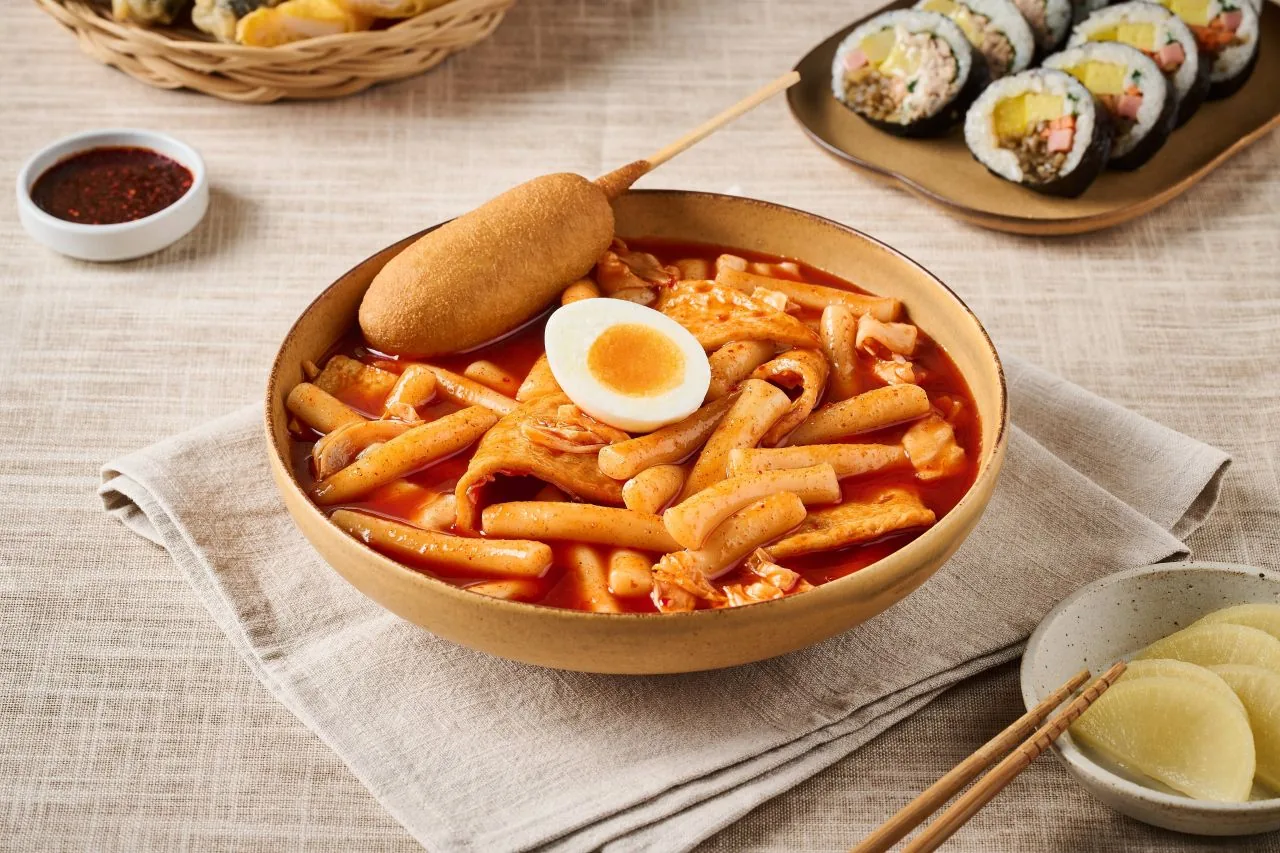
The menu is broad. VisitSeoul lists skewers, tornado potatoes, japchae, kimchi-wrapped pork belly and takoyaki, plus tanghulu, crepes, fruit juice and ice cream on the sweet side. Not every cart sells food, though: of the 346 stalls Jung-gu counted in March 2026, 243 (70.2%) sell food, which leaves roughly three in ten selling something else. If a cart has a pan of red rice cakes bubbling away, our guide to the types of tteokbokki will tell you which style you’re looking at.
Which Subway Exit Gets You Closest to the Stalls?
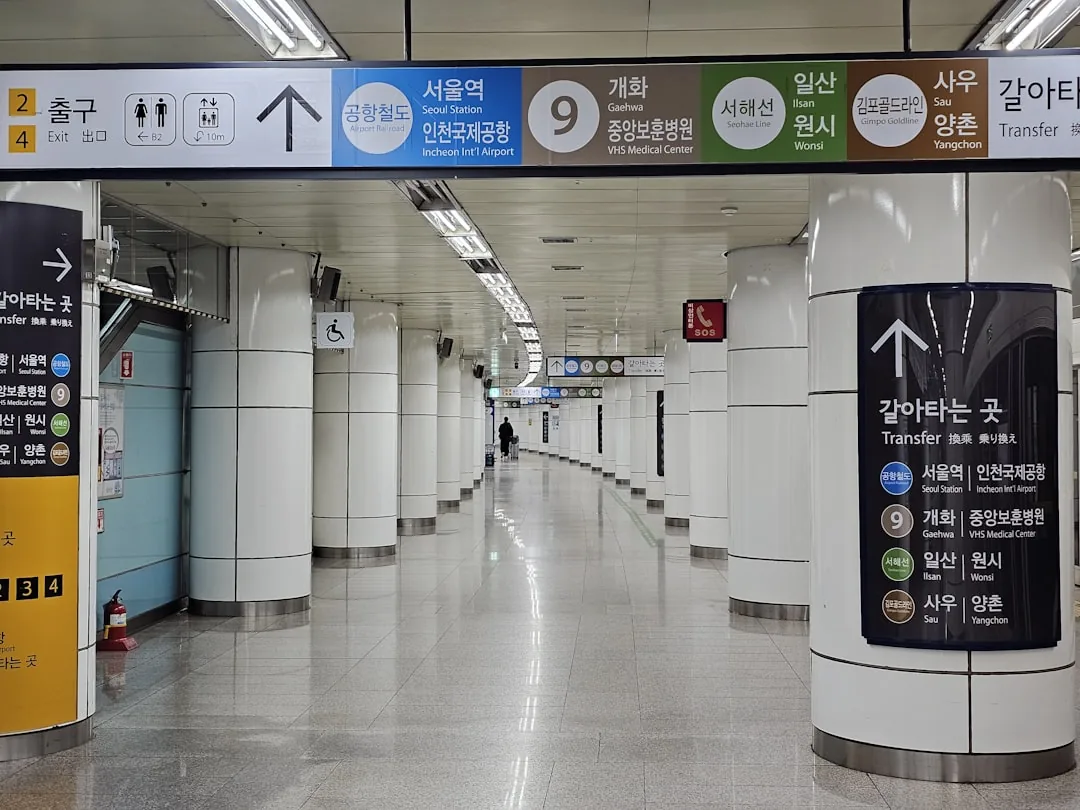
Take exit 6, whichever line you ride: exit 6 of Myeongdong Station on Line 4, or exit 6 of Euljiro 1(il)-ga Station on Line 2 (을지로입구 on Korean signs). Seoul’s official guide lists exits 5 to 10 of Myeongdong Station for the district as a whole, but exit 6 is where the stall street begins, and it’s the exit VisitSeoul’s 2026 listing for Myeongdong Theater gives from both stations.
| Coming on | Station and exit | Landmark and distance (VisitSeoul) |
|---|---|---|
| Line 4 | Myeongdong, exit 6 | Myeongdong Theater, 360 m |
| Line 4 | Myeongdong, exit 8 | Myeongdong Cathedral, 590 m |
| Line 2 | Euljiro 1-ga, exit 6 | Myeongdong Theater, 350 m |
| Line 2 | Euljiro 1-ga, exit 5 | Myeongdong Cathedral, 616 m |
| Line 2 | Euljiro 1-ga, exit 7 | Myeongdong Underground Shopping Center, 243 m |
Exit 8 and Euljiro 1-ga exit 5 suit a visit that starts at the cathedral end of Myeongdong-gil. The underground shopping center earns its place on wet evenings: it’s open 09:00 to 22:00 and connects to Noon Square, Lotte Young Plaza and Lotte Department Store Avenuel, so you can stay under cover until the Noon Square end of the stalls. A topped-up T-money card works on both lines, so arriving on one and leaving on the other takes no extra planning.
What Time Do the Carts Set Up?
Late afternoon. Korea Tourism Organization’s Korean-language guide, last updated in January 2019, had most carts trading from 5 pm to 11 pm on weekdays and from 2 pm to 11 pm on weekends. Those figures are more than seven years old, so read them as a window rather than a promise. What the rules do fix is that each cart keeps to its licensed hours: Jung-gu’s street-stall regulation, in the version in force since January 2025, lists ignoring the permitted business hours among its prohibited acts.
The rota matters more than the clock. When Jung-gu counted 359 stalls in 2023, they were trading on alternate days, and the district’s June–July 2025 crackdown still penalized stalls for breaking the alternate-day rule. So the tanghulu cart you liked on Monday may be off on Tuesday, while one that was dark yesterday may be frying today. Crowds change the picture too. On Halloween and over the year-end, Jung-gu runs the stalls in reduced numbers to keep people moving, a practice it listed among its 2024 stall-management results.
Why Do the Stalls Stick to Certain Streets?
Because every cart is licensed to a specific patch of pavement. Jung-gu has run a permit system for Myeongdong’s street stalls since 2016, the first district in Seoul to do so, and in 2023 it described the goal plainly: allow temporary road occupation so the stalls could operate stably, stop them sprawling at random, end the renting and selling of stall rights, and help low-income operators support themselves.
The current stall regulation spells out the geometry. A cart may stand only where the district head has measured out and permitted its footprint, and it has to stay at least 2.5 m from subway, underpass and underground-arcade entrances, crosswalks and overpasses, and 2 m clear of either end of a bus or taxi stop. So even at exit 6, the rules keep the top of the stairs clear of carts.
Who runs the cart is policed as closely as where it stands. One person may not operate several stalls, and stall rights can’t be resold, sublet or pledged to a third party; since September 2025 Jung-gu has taken reports of either through a dedicated misconduct line and says it revokes the permit as soon as a violation is confirmed. The count has edged down along the way, from 359 stalls in 2023 to 350 by December 2024 and 346 by March 2026. For the shops behind the carts, see our guide to Myeongdong’s 2026 flagship stores.
Can You Pay by Card, and Are Prices Posted?
Increasingly, but don’t count on a card at every cart. In 2024 Jung-gu put card terminals on Myeongdong’s street stalls, the first district in Korea to do so, and brought the stalls under a price-display system in the same push. By December 2024, 278 of the 350 stalls (79.4%) had completed the business registration that went with the card rollout, and in August 2025 the district said it would keep widening card payment and stop stalls taking transfers into bank accounts held in someone else’s name. Keep some small notes on you anyway; a cart without a terminal is still a cart worth buying from.
Prices are supposed to be on the cart. Since January 2025, Jung-gu’s stall regulation has listed failing to post prices as a prohibited act, and the district sets standards for where the price board goes and how big it is. That closed a gap: when Jung-gu made Myeongdong a mandatory price-display zone from October 2023, shops faced fines of up to ₩10 million for unlabeled goods, but street stalls sat outside that law. The district also uses mystery shoppers to check price display, courtesy and hygiene at the stalls. If a cart has no price board up, ask before anything goes on the griddle.
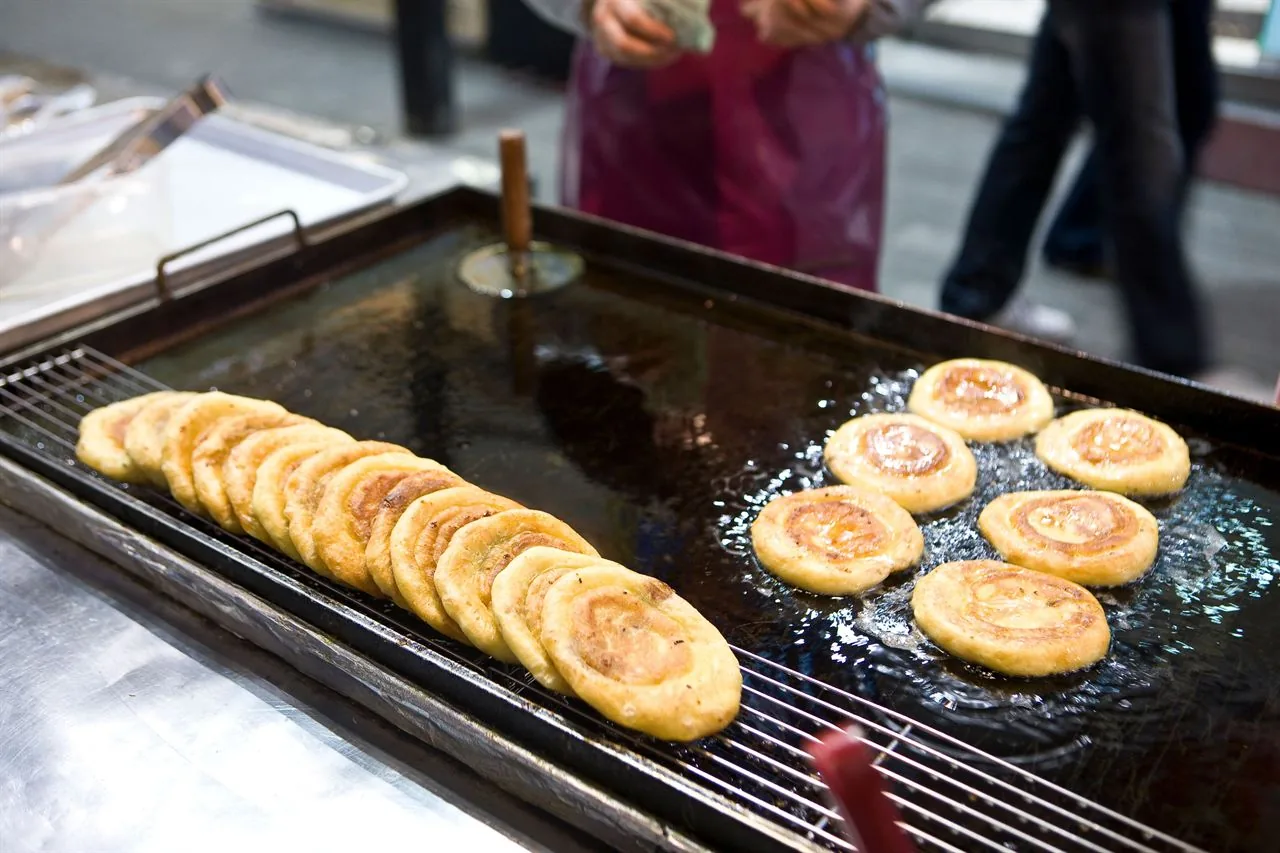 Photo © Korea Tourism Organization
Frequently Asked Questions
Q: Is Myeongdong street food a night market?
Not in the official sense. Jung-gu Office, which licenses the carts, treats them as geori-gage (거리가게), or street stalls: individual carts on the pavement, each with its own permit, rather than a market with a gate and a set opening hour. And the 2019 official timetable had weekend carts starting at 2 pm, well before dark.
Q: Are the stalls open on Christmas and New Year’s Eve?
Yes, but with fewer carts at the busiest corners. For December 24–27 and December 31–January 1 over the 2025 holidays, Jung-gu’s crowd-safety plan had operators near the Noon Square junction and the Myeongdong Theater crossroads cut back to free up walking space. Expect a similar squeeze on Halloween.
Q: Where do you throw away trash from the stalls?
Hand it back to the cart you bought from. Jung-gu runs a trash take-back campaign with the stall operators, one of the measures it lists alongside card payment and price display in its effort to protect Myeongdong’s reputation with visitors.
Q: Is Myeongdong street food safe to eat?
Street stalls sit in a regulatory gap: unlike restaurants, they aren’t licensed under Korea’s Food Sanitation Act, so penalties are hard to apply. Jung-gu fills part of that gap by requiring operators to submit a health certificate every year and recommending uniform hygiene aprons, and it announced random lab testing of stall food in March 2026; 10 popular items, from egg bread and chicken skewers to tteokbokki and tanghulu, were collected on April 15, and none showed E. coli or any of six food-poisoning bacteria.
Get off at exit 6 in the late afternoon, keep a few notes in your pocket, and let the smell of the fryers do the navigating.
Part of Korean Street Food