Startup Korea Fund: How Foreign Investors Can Join
On this page
- What Is the Startup Korea Fund, and How Big Is the $475M Figure Really?
- How Does Startup Korea Fund Foreign Investor Participation Actually Work?
- Who Were the First Overseas LPs, and Why Did They Join?
- How Is This Different from KVIC’s Global League Fund for Foreign VC Firms?
- What Should a Foreign Institution Actually Do to Get Involved?
- Frequently Asked Questions
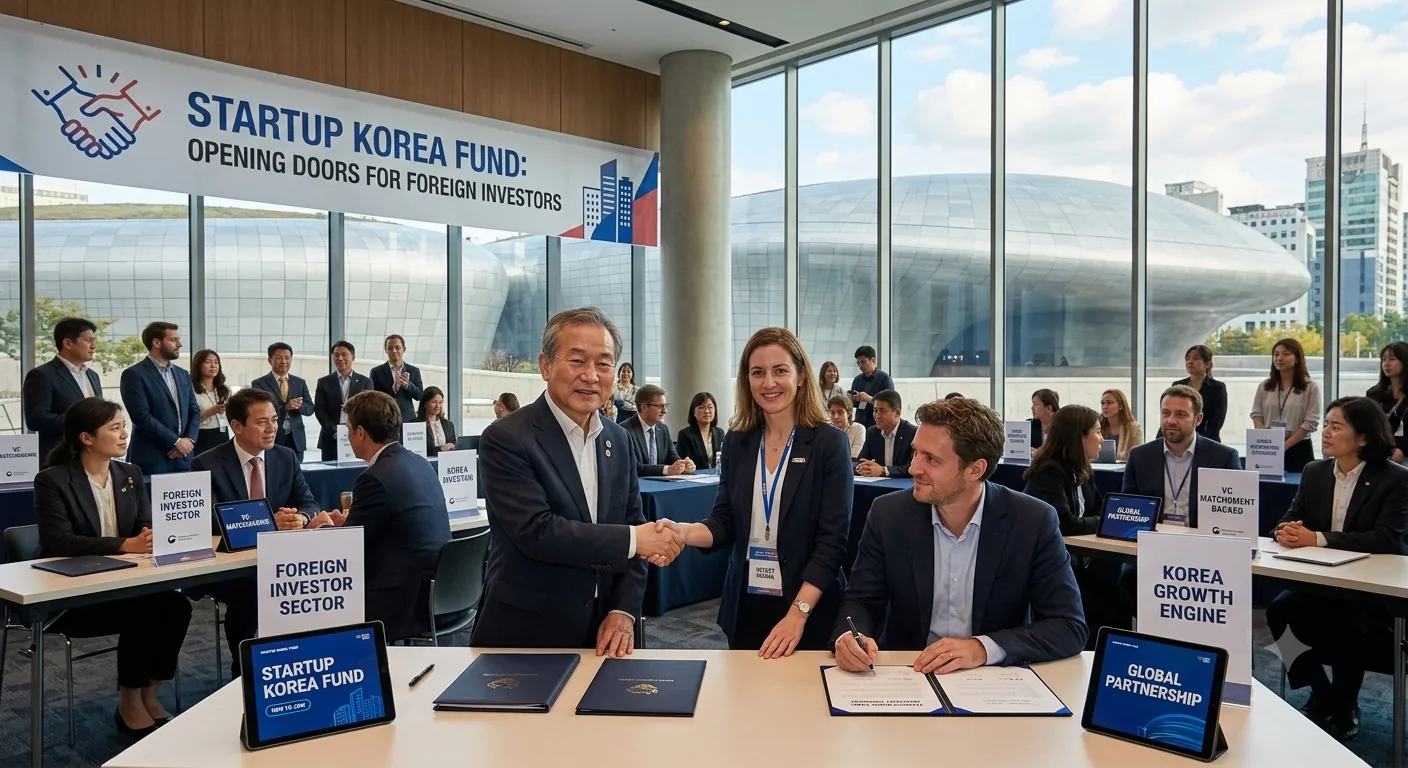
Startup Korea Fund foreign investor participation begins at the program level, months before any fund manager is chosen. In the 2025 round, Korea Venture Investment Corporation (KVIC) asked interested private companies to register through a survey that ran from January 24 to March 24, 2025. The Ministry of SMEs and Startups (MSS) then announced the pledged investors on April 24, and only after that did KVIC select the general partners (GPs) who would run the money. The program’s first overseas investors came in through that front door: CMIC, Japan’s largest contract research organization (CRO), and a coalition of Japan-based companies owned by ethnic Koreans or built on Korea-Japan business, including the Tokyo Segyeong Center. A second, narrower door opens later, when each selected GP raises the rest of its fund on its own.
Quick answers
- A would-be LP joins Startup Korea Fund at the program level: in 2025 KVIC collected investor surveys from January 24 to March 24, the Korea Fund of Funds matched the private money, and KVIC chose the GPs afterward.
- The final 2025 lineup pairs ₩248.8 billion (
$185M) from 27 private investors, the first overseas ones among them, with ₩171.6 billion ($128M) from the Korea Fund of Funds, anchoring 22 sub-funds worth ₩640.1 billion (~$475M).- KVIC’s Global League Fund moves capital the other way and only for culture and content: about ₩60 billion (~$40M) in 2026, roughly $10 million per offshore fund, for three to five funds.
What Is the Startup Korea Fund, and How Big Is the $475M Figure Really?
The Startup Korea Fund is a matching program rather than a single pool of money: private investors commit first, the state-run Korea Fund of Funds (administered by KVIC) matches them, and the combined money anchors a batch of independently managed sub-funds. According to MSS’s August 29, 2025 release, the 2025 round drew ₩248.8 billion from 27 private investors plus ₩171.6 billion from the Fund of Funds. That ₩420.4 billion anchored 22 sub-funds, each run by its own GP, which together reached ₩640.1 billion (about $475 million) once the GPs raised the remaining ₩219.7 billion themselves. Three tracks divide the total: deep-tech and global (₩262.5 billion across 10 funds), open innovation (₩217.0 billion across 9) and secondaries (₩160.6 billion across 3). The spring launch had looked slightly bigger, with 30 private investors pledging more than ₩250 billion in April; 27 of them made it into the final table.
How Does Startup Korea Fund Foreign Investor Participation Actually Work?
Foreign investor participation follows the same sequence as Korean participation: an institution commits at the program level before any GP is chosen, and the Fund of Funds matches that commitment. KVIC’s January 2025 notice asked interested companies to return a survey by March 24. The ministry announced the pledged investors in April, KVIC opened its fund-of-funds call for managers in May, and GP selection ran through the second half of the year. By the time the 22 GPs were confirmed on August 29, the anchor money, overseas commitments included, was already split by track. The second route is narrower. Beyond the anchor money, the GPs raised ₩219.7 billion on their own, and that slice is negotiated directly between an outside LP and a specific GP, with no ministry matching attached.
Who Were the First Overseas LPs, and Why Did They Join?
The first overseas LPs were CMIC and a coalition of Japan-based firms, and the ministry gave each its own reason for joining. CMIC, a CRO that runs clinical trials for drug developers, joined to work with Korean biotech ventures and to help them enter the Japanese market, per the April launch release. The coalition, made up of companies owned by Koreans living in Japan (the Zainichi community) and Korea-Japan partner firms, includes the Tokyo Segyeong Center, which MSS says joined to support startups in its home country and which made its first venture investment of any kind through the fund. MSS flagged the milestone itself: 2025 was the first year overseas companies appeared among Startup Korea Fund’s investors. Both overseas participants are Japan-based, and both gave Korea-specific reasons; the ministry’s releases name no overseas investor from any other country.
How Is This Different from KVIC’s Global League Fund for Foreign VC Firms?
The Global League Fund (GLF) moves capital in the opposite direction, and it is a culture-and-content program rather than a general startup fund. Instead of foreign institutions committing to Korean-managed sub-funds, KVIC becomes an LP in offshore funds (vehicles not organized under Korean law) run by foreign VC firms, Korean VC firms or Korean-foreign co-GPs. The 2026 GLF request for proposals budgets about ₩60 billion (~$40M) in 2026 for three to five funds at roughly $10 million each, capped at 40% of a fund’s minimum size. Each selected fund must invest at least 1.0x the GLF commitment in unlisted Korean companies in film, music, games, publishing, animation and similar content, rising to 1.5x when a Korean VC applies alone or as a co-GP. One rule matters most for a foreign manager: the fund’s non-Korean LPs must together commit at least as much as the GLF does, so KVIC’s money follows foreign capital instead of replacing it. The track record is short, since the culture ministry announced the program in January 2025.
What Should a Foreign Institution Actually Do to Get Involved?
The practical next step depends on which side of the table you sit. An institution that wants to be an anchor LP should watch KVIC’s venture portal early in the year for the Startup Korea Fund formation notice (the 2025 survey window lasted two months) and settle on a track before the ministry’s spring announcement. After the GPs are confirmed, the only route left is negotiating with one of them for the unmatched part of its fund. A foreign VC firm that wants KVIC as an LP should look past the GLF unless it invests in content. KVIC’s broader Global Fund, which by August 2025 counted 74 funds worth ₩12.3 trillion that had put ₩1.3 trillion into 652 Korean startups, is the general-purpose door, and the GLF request for proposals says it will not back a manager already taking part in that program. The 2026 GLF window closed on June 15, with selections due in September 2026 and six months to close each selected fund. Two background reads help frame any Korea allocation: whether the economy is really in trouble (not by the headline numbers) and how much of the current cycle rests on chips (the AI-driven semiconductor export surge).
Frequently Asked Questions
Q: Can a foreign venture capital firm directly become an LP in Startup Korea Fund?
Yes, by two routes. It can join as a program-level investor by answering KVIC’s formation survey early in the year, as CMIC did in 2025, or it can negotiate an LP stake with one of the selected GPs for the part of the fund the anchor money does not cover (₩219.7 billion across the 22 funds in 2025).
Q: What’s the difference between an LP and a GP in Korea’s fund-of-funds structure?
The GP (general partner) manages the fund day to day and makes the investment decisions; the LP (limited partner) commits capital but doesn’t run the fund. KVIC’s Korea Fund of Funds acts as an LP in the GP-run funds it backs, including the 22 Startup Korea Fund sub-funds of 2025.
Q: Is KVIC the same organization as the Startup Korea Fund?
No. KVIC (Korea Venture Investment Corporation) administers the Korea Fund of Funds, one of the two capital sources behind Startup Korea Fund 2025 alongside 27 private investors, and it also runs the investor survey and the GP selection. The Ministry of SMEs and Startups owns the policy and announced the final sub-fund lineup.
Q: Can a foreign investor commit to a Korean venture fund in US dollars?
Yes. Since August 5, 2025, foreign investors can commit to a Korean venture investment association in US dollars without converting to won first, a change the ministry listed in its January 2026 summary of venture-investment rule changes.
Startup Korea Fund’s 2025 round proved foreign LPs can get a seat at the table, but the seats were handed out in spring, months before anyone knew which 22 GPs would run the money.
Part of Startups & Venture Ecosystem