Korean Wedding Cash Gift Amount: How Much to Give in 2026
On this page
The Korean wedding cash gift amount in 2026 is ₩100,000 if you attend and sit down to the meal, and ₩50,000 if you barely know the couple or skip the meal. That second figure used to be the default for coworkers; now it is the floor. The money goes into a plain white envelope as 축의금 (chukuigeum, congratulatory money), and you hand it over at the 접수대 (jeopsudae, reception desk), a white-draped table with a guestbook and an ever-growing stack of envelopes, before you ever glimpse the couple. For foreign guests, that envelope is the one part that reliably triggers anxiety, so here is exactly how much goes inside, and why the number moved.
Quick answers
- If you attend and eat, ₩100,000 is the safe amount: 61.8% of office workers chose it for a coworker’s wedding in a May 2025 Incruit survey.
- If you skip the meal or can’t go, ₩50,000 is still polite, because your gift no longer has to cover a plate.
- Koreans favour 30,000 / 50,000 / 70,000 and the round 100,000, and avoid 40,000, because the number four sounds like the word for death.
How Much Is the Korean Wedding Cash Gift Amount in 2026?
The Korean wedding cash gift amount depends on two things: how close you are to the couple, and whether you will eat. For anyone you would sit down to a meal with, ₩100,000 is now the default, and ₩50,000 is reserved for looser ties or a quick congratulate-and-go visit.
| Your situation | Typical amount (2026) |
|---|---|
| Acquaintance, or skipping the meal / not attending | ₩50,000 |
| Coworker, attending with the meal | ₩100,000 |
| Close friend or close coworker | ₩100,000, up to ₩150,000–200,000 |
| Attending with a partner (two plates) | ₩150,000–200,000 |
| Family and relatives | ₩200,000 and up |
The shift is measurable. In Incruit’s survey of 844 office workers, run on 20–22 May 2025, 61.8% said ₩100,000 is the right gift for a coworker’s wedding when you attend and eat, against 32.8% for ₩50,000. Two years earlier, the same question about colleagues you only deal with at work had ₩50,000 on top at 65.1%. For personally close colleagues, more than a quarter of respondents went above ₩100,000 (₩200,000 at 14.3%, ₩150,000 at 12.7%).
Payment data points the same way. KakaoPay’s own tally of wedding gifts sent through its app rose from about ₩73,000 on average in 2021 to about ₩90,000 for January to September 2024, and the company’s year-end report said the 2025 average crossed ₩100,000 for the first time, roughly double the 2019 level. What surprises most first-timers is how little any of this depends on the couple’s wealth. The amount tracks your relationship and your plate, not their budget.
Why Do Koreans Tie the Amount to the Meal Cost?
Because a Korean wedding almost always comes with a full meal, and the polite baseline is that a guest should roughly cover their own plate. That single idea explains most of the numbers above, including why they rose.
The plates got more expensive. In the Korea Consumer Agency’s February 2026 price survey, published on 30 March 2026, wedding-hall buffets averaged ₩62,000 per guest, Korean-style set tables ₩55,000 and plated course meals ₩119,000 (Kyunghyang Shinmun’s report on the survey). Hand over ₩50,000 and then eat a ₩62,000 buffet, and the couple is quietly out of pocket. That arithmetic is why ₩100,000 becomes the default the moment you sit down, and why a course-meal venue or a plus-one pushes you higher. Regulars will tell you the mental math is simple: estimate the meal, then round up to the nearest respectable tier. If you’re only stopping by to congratulate the couple and skipping the meal entirely, ₩50,000 is perfectly acceptable and no one will think less of you.

Which Amounts Should You Avoid, and Why Odd Numbers?
Give odd multiples of ten thousand (30,000, 50,000, 70,000) or the round 100,000, and steer clear of 40,000. The preference is usually traced to old yin-yang thinking, where odd numbers carry auspicious, “yang” energy suited to a celebration.
The one hard taboo is anything built on the number four. Forty thousand won reads as unlucky because 4 (사, sa) is a homophone for 死, death, so it never appears in a wedding envelope. Above 100,000, guests tend to jump to 150,000 or 200,000 rather than 90,000 or 110,000, keeping the figures clean and easy to read. And 30,000, once a common gift, now mostly survives for distant acquaintances: in the Incruit survey, only 3.2% picked anything under ₩50,000 for a coworker’s wedding they would attend.
What If You Can’t Attend the Wedding?
Send the money anyway. Skipping the ceremony is fine, but a no-show and no gift from someone in the couple’s circle is what gets remembered. Absence is expected; silence is not.
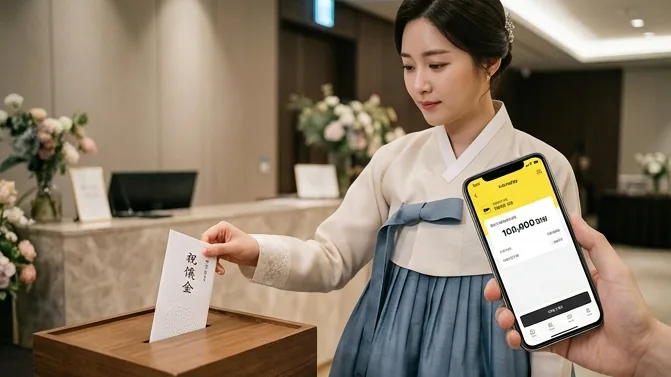
The cleanest option is a digital transfer: a bank transfer or a KakaoPay 송금 (songgeum, money transfer) sent directly to the bride, the groom, or a mutual friend who is attending and can drop your envelope at the desk. This has gone from awkward to routine. KakaoPay says the share of wedding gifts sent through its app grew 360% in the five years from 2019, and a short congratulatory message alongside the transfer carries the same warmth as a signed envelope. One catch for visitors: Kakao Pay needs a Korean bank account and, in practice, an ARC, so short-term guests usually can’t use it (our Naver Pay vs Kakao Pay guide for foreigners explains the gate). In that case, ask a friend who is going to deliver a filled envelope with your name on it, so you still appear in the guestbook.
How Do You Fill Out the Chukuigeum Envelope?
Put clean bills inside a white envelope and write your name on the back, lower-left. That’s the whole ritual, and the reception desk usually has blank 봉투 (bongtu, envelopes) if you arrived empty-handed.
A few practical details make you look like you’ve done this before. Use crisp, unfolded bills if you can; it signals care, though nobody will inspect them. The front of the envelope often carries a printed congratulatory phrase such as 祝結婚 (chuk gyeolhon, “congratulations on the marriage”), and you can leave that as is. Your job is the back: write your name clearly in the lower-left corner so the couple’s family can match your gift to the guestbook later. Then hand the envelope to the person at the reception desk, sign the 방명록 (bangmyeongnok, guestbook), and head in. Clothes are the easy part by comparison, since guests wear ordinary smart outfits; if you are family living abroad and want a hanbok for the day, see our guide to renting or buying hanbok outside Korea.
Frequently Asked Questions
Q: How much should a foreigner give at a Korean wedding?
The same as anyone else: ₩100,000 if you attend and eat, ₩50,000 if you’re a distant acquaintance or skip the meal. Being foreign doesn’t change the tiers, and Korean hosts don’t expect a different standard from you.
Q: Is 100,000 won too much for a coworker’s wedding?
No, it is now the most common choice. Even for colleagues you only work with, 60.1% of respondents in the May 2025 Incruit survey picked ₩100,000 when attending with the meal, and only 30.0% picked ₩50,000.
Q: Do younger guests give less?
On average, yes. KakaoPay’s January to September 2024 data put the average wedding transfer at about ₩60,000 for senders in their 20s, about ₩100,000 for those in their 30s and 40s, and about ₩120,000 for those in their 50s and 60s. A student giving ₩50,000 raises no eyebrows.
Q: Is it rude to send chukuigeum by KakaoPay instead of handing over cash?
No. A KakaoPay or bank transfer with a short congratulatory note is now a normal way to send a wedding gift, especially when you can’t attend in person. Physical cash at the desk is still the default when you show up, but digital is fully accepted otherwise.
Q: Do I still give chukuigeum if I skip the meal?
Yes, but you can give less. The meal-cost logic works both ways: if you drop by only to congratulate the couple and leave before the buffet, ₩50,000 is entirely appropriate.
Whatever number you land on, the envelope matters less than showing up for someone’s big day. Match the tier to your plate, keep it off the number four, and you’ll have handled it exactly like a local.