Jjimjilbang Tattoo Rules: Can You Enter With Ink in Korea?
On this page
In Japan, a coin-sized tattoo can still get you turned away at an onsen door. Cross to Korea and that dread mostly fades: the fully sleeved traveler soaking two feet away in a Seoul jjimjilbang is an ordinary Tuesday. The gap trips up first-timers, who arrive braced for a ban that Korean law never wrote down. The real jjimjilbang tattoo rules are set venue by venue, which makes them looser than the anxious forum threads suggest. They are not a total free-for-all, though, and one of Busan’s best-known spas prints a clause that a full back piece falls squarely inside.
Quick answers
- Yes, you can usually walk into a Korean jjimjilbang with tattoos, because the national bathhouse rules list whom operators must turn away (people with a contagious disease or too drunk to bathe safely) and tattoos are not on that list.
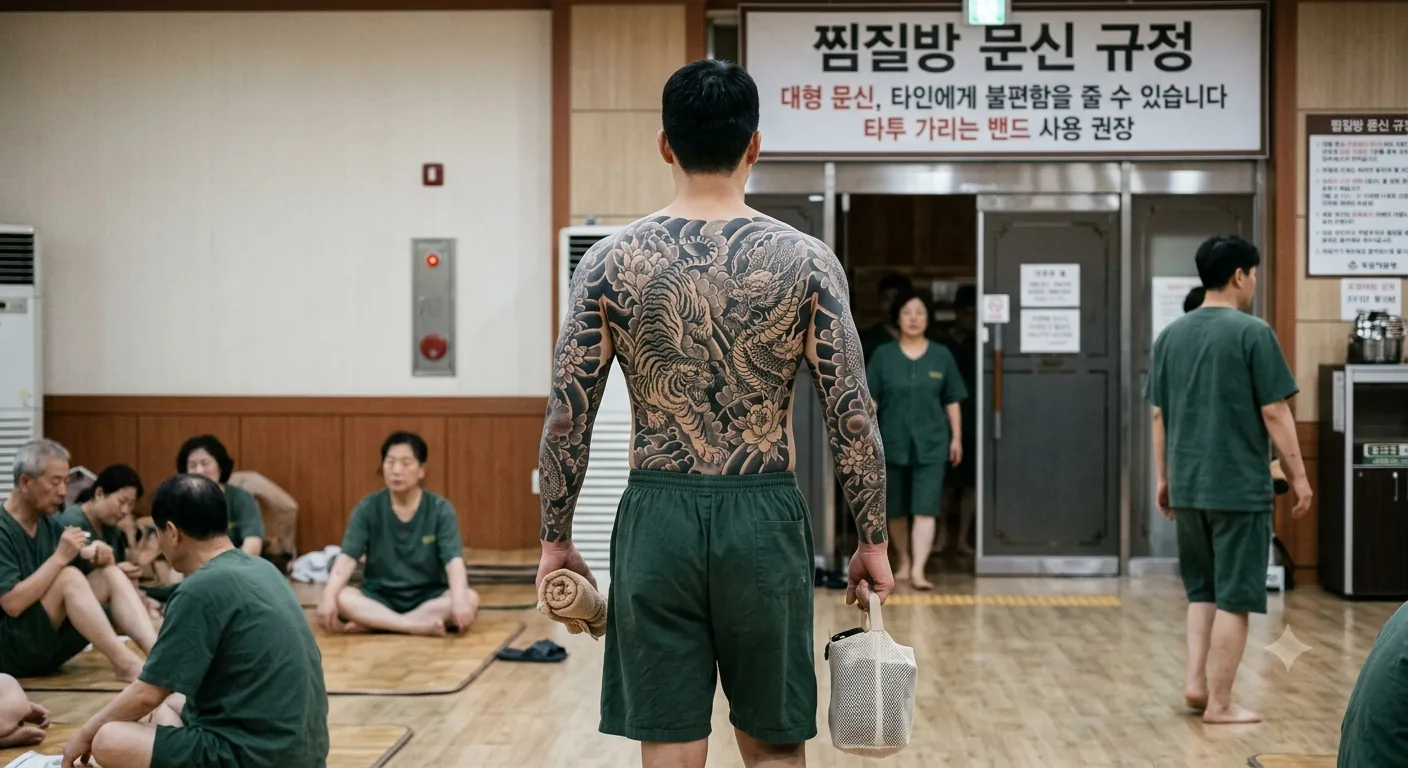
- Ink only shows in the nude, gender-separated baths; in the unisex heated-floor lounge everyone wears the cotton T-shirt and shorts handed out at the counter.
- Some venues write their own limits: Busan’s Spa Land warns that full-body, both-arm, both-leg or whole front-or-back tattoos may be refused, and Dragon Hill Spa, still listed in older guides, has not reopened since it closed in 2021.
Can You Go to a Jjimjilbang With Tattoos?
Yes, in most cases, because nothing in Korea’s national rulebook tells the front desk to stop you. You slide your shoes into a small cubby, trade that key at the counter for a clothes-locker key and a folded set of cotton shorts and T-shirt, and that is the whole checkpoint: no inspection, no form, no cover-up demand. The rules that do exist sit under the Public Health Control Act, which tells a bathhouse operator to refuse people with a contagious disease and people too drunk to use the baths normally. When the Ministry of Health and Welfare revised those bathhouse standards in June 2022, it took people with mental illness off the refusal list and lowered the age at which children must use their own sex’s bathing room from five to four. Tattoos are not on the list.
The old Korean unease about ink was social, a hangover from decades when big tattoos read as a gangster’s mark. Where the law did bite, it bit the artist rather than the customer: after a 1992 Supreme Court ruling, tattooing by anyone without a medical license was illegal, and the National Assembly only passed the Tattooist Act on September 25, 2025, opening a licensed route for non-medical tattoo artists two years after the law is promulgated. What surprises most first-timers is how completely the imagined checkpoint fails to appear. You are more likely to draw a look for skipping the pre-bath shower than for a sleeve, which is part of why so many visitors now build a whole evening around a jjimjilbang instead of another palace.
The Jjimjilbang Tattoo Rules That Actually Matter
The jjimjilbang tattoo rules that actually matter depend on which zone you’re standing in, not on a size chart. A jjimjilbang is really two spaces. The wet bathing area (tubs, showers, hot and cold pools) is nude and split by sex, and it’s the only place your tattoo is visible at all. The dry common area, with its heated ondol floors, snack bar and sleeping mats, is unisex and clothed in the uniform from the counter, so ink on your torso, back or thighs simply doesn’t come up there. No national size limit exists. Where a limit is written down it belongs to the venue, and the clauses on record aim at extensive work (whole limbs, a whole back) rather than a script tattoo on a wrist. The one rule everyone genuinely enforces has nothing to do with ink: scrub down at the seated showers before you get into any shared water.
Why Korea’s Sauna Tattoo Policy Isn’t Japan’s
Korea never built its bathhouse culture around a posted tattoo ban, while in Japan refusals became common enough that the government stepped in. When Japan’s tourism agency surveyed hotels and ryokan in 2015, 56% of the 581 that replied said they refused tattooed bathers, Nikkei reported. In March 2016 the agency wrote to the hotel, ryokan and hot-spring associations that refusing a guest solely for having a tattoo “is not appropriate,” and suggested cover stickers, quieter bathing hours or a private bath, with no special measures for a small, palm-sized piece. Korea’s discomfort stayed quieter and more local. The practical upshot is that korean sauna tattoo policy is set venue by venue, not by any law, so the “rule” is really how conservative a given owner and clientele happen to be.
Which Jjimjilbangs Have Their Own Tattoo Rules?
No jjimjilbang hands out a “tattoo-friendly” badge, so the useful check is whether a venue has written a clause of its own, and the clearest one belongs to a big-name spa rather than a back-alley bathhouse. In 2026, Spa Land, inside Shinsegae Centum City in Busan, charges adults ₩26,000 for up to four hours (₩5,000 for each extra hour) and runs 09:00 to 22:00 with last entry at 21:00. The ticket terms on its Korean booking listings add that guests with tattoos across the full body, both arms, both legs, or the whole front or back may be refused entry. Visitor reports say enforcement varies, but a full back piece is exactly what that sentence describes, so ask at the counter before you pay. Spa Land sits in the same Centum City district as the Busan Cinema Center, which makes it an easy soak between screenings if you’re in town for the Busan film festival.
In Seoul, check that a recommendation still exists before you plan around it. Dragon Hill Spa by Yongsan Station, still named in many English-language guides, shut during COVID-19 in 2021 and had not reopened when Korean media checked in August 2024. A 24-hour alternative with posted prices is Riverside Spa Land, 400 m from Exit 4 of Gangbyeon Station on Line 2: Seoul’s official tourism listing, last edited in May 2026, gives ₩15,000 for a daytime jjimjilbang ticket and ₩17,000 at night and mentions no tattoo rule. Regulars will tell you the pattern that holds everywhere: the smaller and older the neighborhood 목욕탕 (mogyoktang), the older the crowd, and the more a big piece may draw a stare. A stare is not a rule.
Frequently Asked Questions
Q: Do I need to cover my tattoo at a jjimjilbang?
Usually not. Tattoos only show in the nude bathing zone, and no national rule asks you to cover them. The exception is a venue with its own clause, such as Spa Land in Busan for extensive work, so a skin-tone patch is optional peace of mind rather than a requirement.
Q: Are tattoos banned at Korean water parks?
Not by any national rule. Caribbean Bay’s own visitor guide (2023 edition) lists rules on contagious illness, earrings and hairpins, and swimwear, with no tattoo ban. Pools are where complaints about exposed ink cluster, though, so a rash guard is the low-friction choice.
Q: What should I do if staff ask me to cover a tattoo?
Cover it, or ask for your money back before you go past the lockers: each venue sets its own rule, and the national bathhouse standards give you nothing to appeal to. At a place with a written clause, asking at the counter before you pay avoids the question entirely.
Q: Can foreign visitors with tattoos stay overnight at a jjimjilbang?
Yes. Overnight stays happen in the clothed unisex lounge, so tattoos aren’t even on display. At a 24-hour venue like Riverside Spa Land the night jjimjilbang ticket is ₩17,000 on Seoul’s tourism listing, which is why travelers use jjimjilbangs as cheap late-night lodging.
Pack a change of clothes, shower before you soak, and read the counter sign if your ink covers a whole back. In a country that only voted in 2025 to license tattoo artists, the bathhouse door turns out to be one of the easier ones to walk through.
Part of Korean Etiquette & Manners