Yaksok in Korean: The Same Word as Japanese Yakusoku
On this page
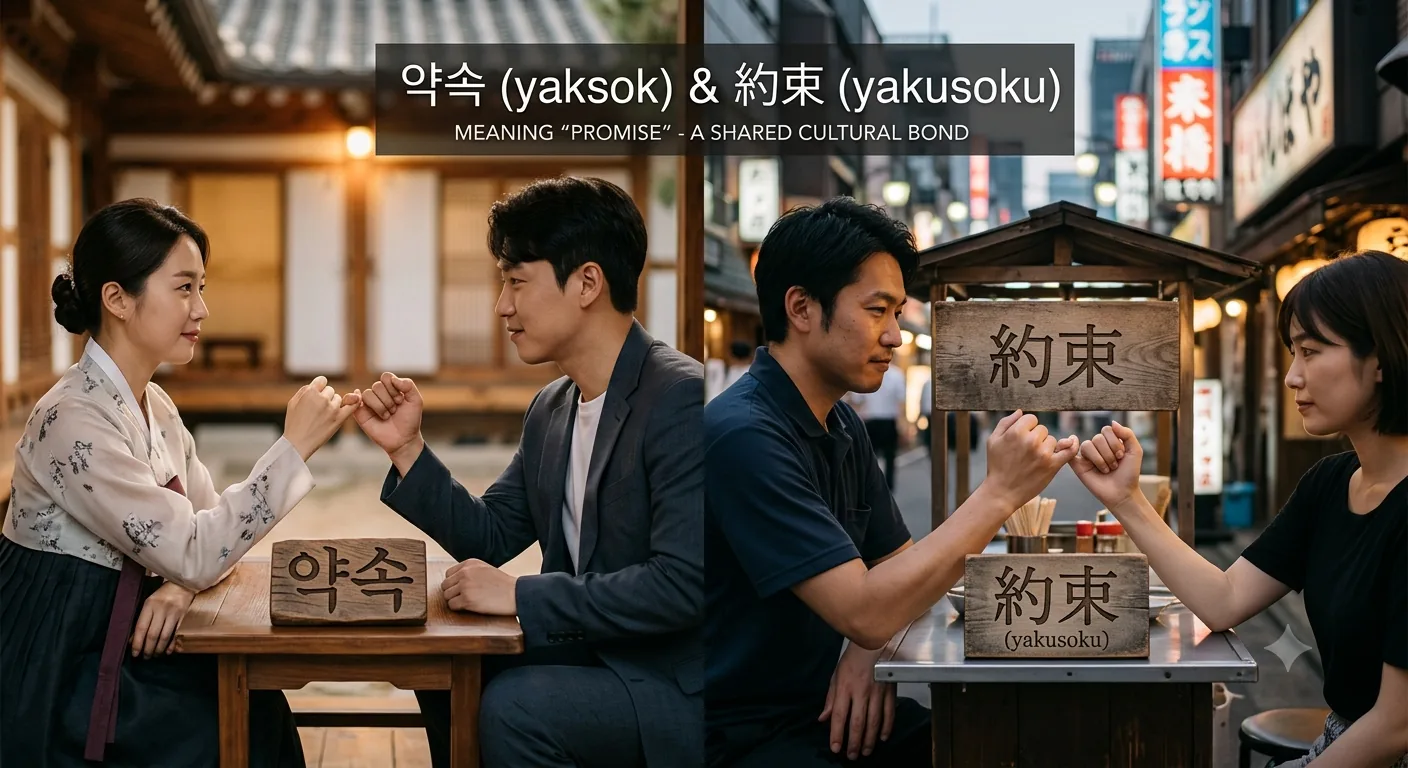
Yaksok in Korean is written 약속, and anyone who speaks a little Japanese has effectively known it for years. It is the same word as 約束 (yakusoku): the same two Chinese characters, read almost the same way, meaning exactly the same thing. The moment a Japanese speaker notices, the questions start pouring in, and the word resurfaces in language-learning threads every few months, usually captioned “wait, why do I already know this?” The short answer is that Korean and Japanese quietly share hundreds of these near-twins, and almost none of them are coincidence. Let’s start with that one word and widen out, no pressure. You are about to recognize far more Korean than you expected.
Quick answers
- 약속 (yaksok) and 約束 (yakusoku) match because both languages read the same two Chinese characters, which the Standard Korean Dictionary lists for 약속 as 約束, meaning “promise.”
- Chinese-rooted words are the biggest layer of Korean vocabulary: the National Institute of Korean Language counts 193,809 Sino-Korean headwords against 76,072 native-Korean ones, and Japanese borrowed from that same Chinese source.
- Not every word matches. Native Korean and native Japanese words (like each language’s word for “water”) are completely different, so the overlap sits almost entirely in the Chinese-derived layer.
Why does yaksok in Korean sound exactly like Japanese yakusoku?
Because both words are read straight off the very same pair of Chinese characters, 約束, and Korean and Japanese each borrowed their pronunciations from Chinese at overlapping points in history. In Korean, 約 is read yak and 束 is read sok, giving 약속 (yak-sok). Japan’s official jōyō kanji table, the government list of characters for everyday use, gives those same two characters the “Chinese-style” readings yaku and soku, producing やくそく (ya-ku-so-ku). Say them back to back and the resemblance is obvious: the Korean version simply compresses the syllables a Japanese speaker stretches out. Neither language invented the word. They inherited it from the same place, like two cousins who both got their grandmother’s nose. Once you hear that, 약속 stops being a fluke and starts being a preview of a whole pattern.
Where does the Korean Japanese same word for promise come from?
Both languages drew vocabulary from Classical Chinese for well over a thousand years. Korea calls those borrowed characters hanja (한자), Japan calls them kanji (漢字), and they are the same characters. Each language attached its own “Sino” reading to them: Sino-Korean readings on one side, the Japanese on’yomi (音読み, the Chinese-derived reading) on the other. Because both sets of readings trace back to earlier stages of Chinese, they frequently echo each other. The scale is easy to underestimate. In the National Institute of Korean Language’s own breakdown by word origin, 193,809 of the dictionary’s 425,280 headwords are Sino-Korean, more than double the 76,072 native-Korean entries, with another 74,843 hybrids that mix the two. Sino-Korean is not a fringe corner of the language, then. It is the single largest layer, and it forms the backbone of the formal, academic, and technical vocabulary you meet every day.
There is a second wave worth knowing about. In the late 1800s and early 1900s, Japanese scholars coined thousands of new compounds out of Chinese characters to translate Western ideas, giving the region its words for “economy,” “society,” “telephone,” and “philosophy,” and those coinages then traveled into Korean and Chinese. The Encyclopedia of Korean Culture makes this a formal category, listing “words created in Japan” alongside Chinese-origin and Korean-coined vocabulary, with everyday examples like 입구 (ipgu, “entrance”) and 상담 (sangdam, “consultation”). That is why 사회 (sahoe) and 社会 (shakai) both mean “society” off the identical characters, even though the sounds have drifted further apart than 약속 did. The lesson: shared characters almost always guarantee a shared meaning, but only sometimes a shared sound.
Korean Words That Sound Like Japanese: A Starter List
Here are the cognates that tend to stop learners in their tracks first, each with its Hangul, how it’s read, its meaning, and its Japanese twin. What surprises most Japanese learners of Korean is how many of these they can guess correctly on the very first try.
- 무리 (muri): “too much / can’t be done.” Japanese 無理 (muri). Practically identical, including the shrug it comes with.
- 준비 (junbi): “preparation.” Japanese 準備 (junbi). Same sound, same meaning.
- 온도 (ondo): “temperature.” Japanese 温度 (ondo). A perfect match.
- 무료 (muryo): “free of charge.” Japanese 無料 (muryō). Only the long vowel differs.
- 기분 (gibun): “mood, feeling.” Japanese 気分 (kibun). Swap one soft consonant and you’re there.
- 가족 (gajok): “family.” Japanese 家族 (kazoku). Clearly the same word wearing two accents.
- 도서관 (doseogwan): “library.” Japanese 図書館 (toshokan). Longer, but the rhythm lines up.
- 감사 (gamsa): “gratitude, thanks.” Japanese 感謝 (kansha). The 감/kan pairing is a giveaway.
- 기억 (gieok): “memory.” Japanese 記憶 (kioku). Close cousins.
- 만족 (manjok): “satisfaction.” Japanese 満足 (manzoku). Same characters, same idea.
Read that list out loud and you’ll notice the shape of the correspondence. Korean often keeps a crisp final consonant where Japanese adds a trailing vowel (sok versus soku), and a few consonants shift predictably, with Korean g lining up with Japanese k. Spot those two habits and you can start predicting the twin instead of memorizing it. The same instinct pays off beyond cognates: once you know how to read Korean words faster, the sound changes that reshape a word between spelling and speech stop feeling random. Surnames are the clearest proof that this layer is everywhere, since Kim, Lee, and Park are all hanja names, and pronouncing Korean surnames is mostly a matter of hearing which reading survived.
Why don’t all Korean and Japanese words match, then?
Because each language also has a deep well of native vocabulary that owes nothing to Chinese, and those words sound nothing alike. The everyday word for “water” is 물 (mul) in Korean and みず (mizu) in Japanese; the native numbers (하나, 둘, 셋 versus ひとつ, ふたつ, みっつ) share no common root at all. This is the giveaway that Korean and Japanese are not simply the same language in disguise. Their core, oldest words are unrelated, and the resemblance lives almost entirely in the imported Chinese layer stacked on top.
A gentle warning for confident guessers: a handful of shared characters have quietly drifted in meaning, so treat them as “usually safe, occasionally sneaky.” The classic trap is 愛人. Read 애인 (aein) in Korean it means a sweetheart or partner, but the same characters read aijin in Japanese lean toward “a secret lover.” You won’t hit many of these, but when you do, they’re memorable. Mistakes here are how everyone learns, so don’t let the rare false friend scare you off a pattern that’s right far more often than it’s wrong.
Frequently Asked Questions
Q: What does yaksok (약속) mean in Korean, and how do you use it?
It means a promise, an appointment, or plans you’ve agreed on with someone, and the dictionary definition covers both senses at once: deciding in advance with another person how something will go. Korean uses it for the casual and the serious alike, so 약속 있어요 (“I have plans”) and 약속을 지키다 (“keep a promise”) both sit comfortably in the same word, exactly as やくそく does in Japanese.
Q: Are Korean and Japanese related languages?
They share a huge amount of vocabulary but their native cores are unrelated, so most linguists as of 2026 do not treat them as proven relatives. The overlap you notice comes from both borrowing heavily from Chinese, plus similar grammar structure, not from a shared ancestor for their basic words like “water” or “one.”
Q: Why do Korean and Japanese share so many words?
Because both languages imported vocabulary from Classical Chinese for over a thousand years, and later absorbed the same batch of modern compounds coined in Japan around 1900. Those Chinese-rooted words, Sino-Korean and Sino-Japanese, are read with related pronunciations, which is why 약속 and 約束 land so close.
Q: Is 무리 (muri) really the same in Korean and Japanese?
Yes. 무리 in Korean and 無理 in Japanese are both read muri and both mean “impossible” or “too much,” down to the exasperated tone people use them in. It’s one of the cleanest one-to-one matches in the whole shared vocabulary.
Q: Did Korean borrow these words from Japanese?
Mostly no. The bulk of the overlap comes from both languages independently borrowing from Chinese, not from each other. A specific slice of modern terms (things like “society” or “economy”) really did spread from Japan into Korean in the early 20th century, but everyday cognates like 약속 predate that by centuries.
Q: Can I learn Korean faster if I already speak Japanese?
Absolutely. The shared Sino vocabulary gives Japanese speakers a running start on thousands of words and on how compounds are built. You’ll still need to learn Hangul and Korean grammar from scratch, but the vocabulary head start is real and it’s one of the most encouraging things about crossing over.
Start with 약속 and let the pattern pull you along. Every cognate you recognize is proof you already know more Korean than you thought.