Crown Prince Sado Rice Chest Death: Why Yeongjo Did It
On this page
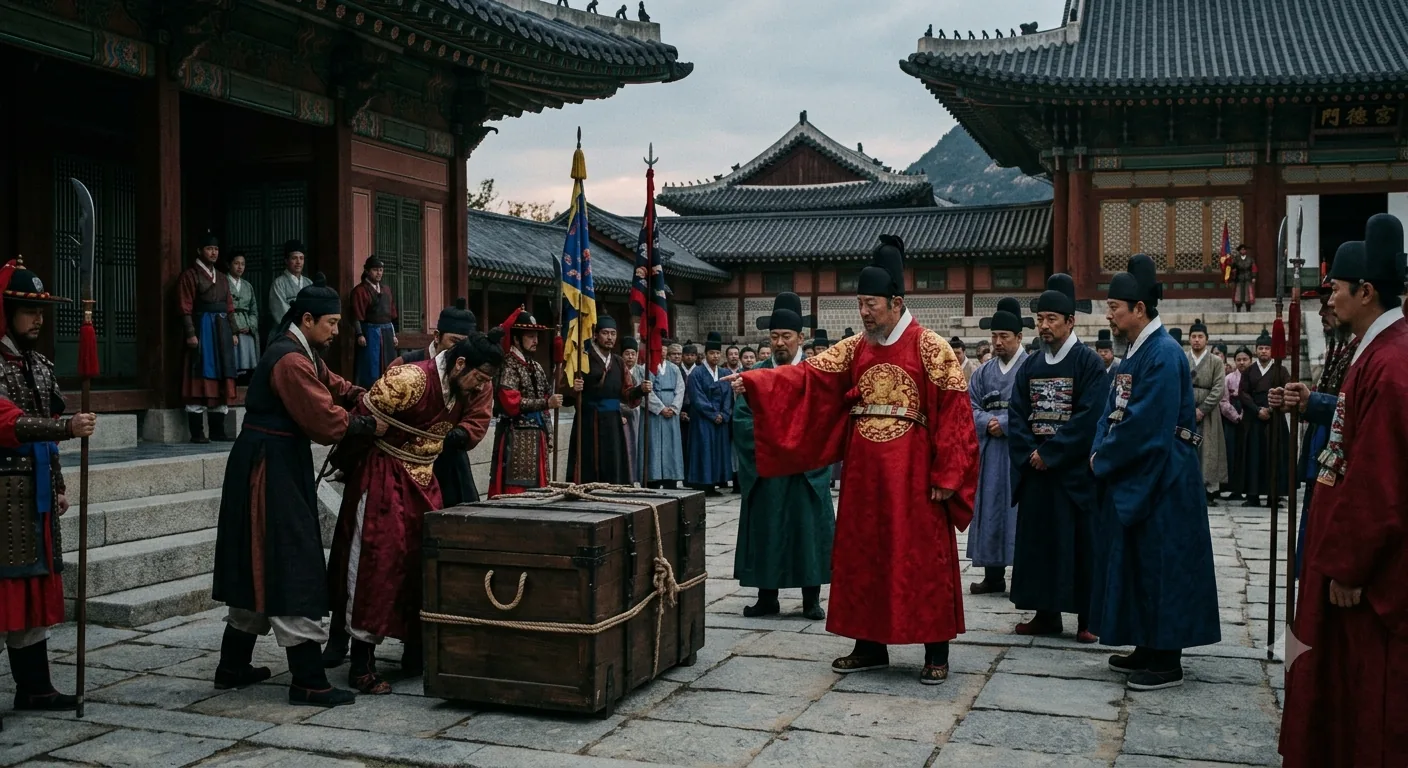
On a sweltering July day in 1762, King Yeongjo ordered his only surviving son to climb into a wooden rice chest, then had the lid nailed down and lashed with rope. Crown Prince Sado died inside eight days later, starved and suffocating in the summer heat, twenty-seven years old and next in line to rule Joseon. Most English retellings stop at that grisly image, or flatten the reason behind it into one tidy cause: either Sado was simply insane, or scheming courtiers simply wanted him dead. Neither version survives a close look, and the reason historians still argue is that our one detailed eyewitness account was written by someone with every motive to shape how the story would be remembered.
Quick answers
- In 1762, King Yeongjo had his 27-year-old heir, Crown Prince Sado, sealed inside a large wooden rice chest called a dwiju, where he died of starvation and heat after eight days.
- The dates are exact: Sado was shut in on the 13th day of the intercalary fifth month, 4 July 1762, and died on the 21st, 12 July 1762. Korean sources usually say nine days because they count both the first day and the last.
- The three leading explanations (Sado’s documented mental illness and violence, the Noron–Soron factional war at court, and Yeongjo’s own harshness toward his son) are best read together, not as rival single causes.
- The rice chest was chosen precisely because a formal treason execution would have legally disqualified Sado’s son, the future King Jeongjo, from the throne, so the chest let Yeongjo kill him without a death sentence that tainted the bloodline.
”Crown Prince Sado Was Simply Insane”
The madness was real, but calling it the whole explanation does the history a disservice. The main source for Sado’s mental state is the Hanjungnok, the memoir written by his wife, Lady Hyegyeong, beginning in 1795, more than three decades after his death. She describes a prince gripped by what the record calls uidaejeung, a terror of getting dressed so severe that servants who helped him could be beaten or killed if a robe felt wrong; she also records that he killed eunuchs and palace staff during fits of rage. Modern readers reach for words like psychosis, and the symptoms are striking. But Lady Hyegyeong came from the powerful Pungsan Hong family, aligned with the very faction that gained from Sado’s fall, and painting him as mad, rather than as a political victim, protected both her clan and her son’s claim to the throne. The illness was real; whether it was the cause or the cover is the open question.
”It Was Really Just Court Politics”
Factional warfare shaped every step of the tragedy, yet politics alone can’t carry the full weight. Yeongjo had taken the throne in 1724 on the backs of the Noron faction, and the rival Soron never fully accepted him. When Sado was made prince-regent in 1749 at fifteen, handling state affairs on his father’s behalf from the East Palace, the walled compound Joseon reserved for its crown princes, his instincts leaned toward the Soron and toward a leniency the Noron read as a threat. Every misstep the young regent made was reported straight to a father primed to see betrayal. The whispering turned formal in the fifth month of 1762, when a man named Na Gyeong-eon, the brother of a palace attendant, filed an indictment against the prince: the National Institute of Korean History lists more than ten counts in it, from beating a royal grandson’s mother to death to unauthorized journeys out of the capital. So yes, a court full of men who wanted Sado gone amplified his every failing and starved him of any ally who might have cooled the crisis. But factional pressure explains the climate, not why a father personally condemned his own heir to eight days in a box.
”Yeongjo Was a Loving Father Trapped by Duty”
The dramatized version of a heartbroken king forced into an impossible choice softens a relationship the records show was corrosive for years. Yeongjo was Joseon’s longest-reigning monarch, brilliant and relentless, and he was born to a low-status palace servant, a background that left him permanently insecure and dogged by rumors that he had a hand in the death of his half-brother, the previous king. He poured that anxiety onto Sado, alternating cold neglect with public humiliation, quizzing the boy in front of assembled officials and berating him when he faltered. What surprises many readers who arrive through the 2015 film is how much of the cruelty predates any sign of Sado’s violence: the resentment came first, the breakdown after. A loving father wasn’t cornered by fate here; a punishing one helped manufacture the son he then destroyed.
”King Sado Was Deposed From the Throne”
He never sat on it. Sado was a crown prince and, from 1749, his father’s regent, but Yeongjo outlived him by fourteen years and the crown passed straight to Sado’s son. The royal title that English readers search for arrived only after the chest, in stages: Yeongjo restored his dead son’s princely standing and granted him the name Sado, whose two characters carry the sense of remembering with grief; Jeongjo raised that to Jangheon in 1776; and in November 1899, well over a century later, he was finally enshrined in the royal ancestral temple with a monarch’s honors, which is why Korean sources call him Jangjo. The Annals of King Yeongjo enter the decisive day under a single heading: the crown prince deposed to commoner status, then strictly confined. That legal sequence, rank stripped first and the lid nailed second, is the hinge the whole story turns on.
What Caused the Crown Prince Sado Rice Chest Death?
All three forces at once, plus a piece of cold Confucian legal logic that explains the chest itself. By the summer of 1762, Sado’s violence had become impossible to hide, the Noron had every incentive to press the point, and Yeongjo’s patience, never generous, had run out. The final push came from inside the family rather than from the factions. Sado’s own birth mother, Lady Yeongbin Yi, went to the king and denounced her son, telling him the prince had killed close to a hundred palace women and eunuchs and had prepared a grave in the palace’s rear garden in which to bury the king he meant to kill. The National Institute of Korean History treats her testimony, not the illness, as the largest justification Yeongjo actually put on the record. Then came the trap of his own making: under Joseon law, executing Sado as a traitor would have branded his descendants criminals and knocked ten-year-old Grand Heir Jeongjo out of the line of succession. Spilling royal blood was taboo, too. The rice chest solved both problems at once. It let Yeongjo end his son’s life without a formal treason sentence and without drawing a drop of blood, preserving the legal fiction that the crown prince had died rather than been executed, and keeping the path to the throne open for the grandson he still meant to keep. The horror wasn’t chaos; it was a solution.
Frequently Asked Questions
Q: Why did King Yeongjo kill his son?
There is no single reason. The most careful answer is that three forces converged in 1762: Crown Prince Sado’s escalating mental illness and violence, the Noron faction’s interest in removing a regent they distrusted, and years of a corrosive father-son relationship in which Yeongjo humiliated and isolated Sado. A formal accusation of treasonous conduct, pressed home at the end by Sado’s own mother, gave Yeongjo the trigger to act.
Q: How long did Crown Prince Sado survive in the rice chest?
He was shut in on the 13th day of the intercalary fifth month of 1762, which falls on 4 July, and he died on the 21st, 12 July. That is eight days on the calendar, though Korean sources usually say nine because they count the first and last days together. He was twenty-seven, and the cause was starvation, dehydration, and heat in high summer.
Q: What exactly is a dwiju, the rice chest Sado died in?
Ordinary household furniture, not an instrument of execution. A dwiju is a squat wooden grain bin, built by fitting thick planks between four corner posts and closing it with a top board, used to keep hulled rice and beans dry, ventilated, and safe from insects. Most Joseon households of any means owned one. Part of what makes the story so unsettling is that the heir to the throne was killed inside a piece of kitchen furniture, nailed and roped shut in the July heat.
Q: Why was he killed in a rice chest instead of a normal execution?
Because a formal treason execution would have legally tainted Sado’s bloodline and disqualified his son, the future King Jeongjo, from ever taking the throne. Confucian custom also forbade spilling royal blood. Confining Sado in a dwiju let Yeongjo end his life without a death sentence and without bloodshed, protecting his grandson’s succession.
Q: Why is Prince Sado sometimes called King Sado or King Jangjo?
Because those titles were awarded after his death, never during his life. He was never enthroned: he served as regent from 1749 until his father deposed him to commoner status in 1762, and the throne went to his son in 1776. Yeongjo restored his princely rank posthumously and gave him the name Sado, Jeongjo upgraded that to Jangheon in 1776, and in November 1899 he entered the royal ancestral temple as Jangjo. Anyone writing “King Sado” is using a rank he received 137 years after he died.
Q: Was Crown Prince Sado really mentally ill?
Probably, though the evidence is complicated. The detailed accounts of his symptoms come mainly from his wife’s memoir, written decades later by someone whose family gained from his fall, so many historians accept that Sado suffered a genuine and worsening illness while treating the most lurid specific episodes with caution.
Q: What happened to Sado’s son after the rice chest death?
His son became King Jeongjo, one of Joseon’s most admired rulers, reigning from 1776 to 1800. Jeongjo spent his reign rehabilitating his father’s memory. In 1789 he had the grave moved south to Hwasan, in what is now Hwaseong city, and renamed it Hyeollyungwon; between 1794 and 1796 he raised the great Hwaseong Fortress in neighboring Suwon. The National Research Institute of Cultural Heritage records that the tomb itself was only promoted to full royal rank, and renamed Yungneung, in 1899.
Visit Yungneung today, in Hwaseong just south of Suwon, and you’ll find something quietly staggering: the tomb of a man condemned as a criminal, laid out with the full honors of a king. That contradiction — grave of a traitor, dignity of a monarch — is the closest thing Joseon ever offered to an answer. It is also why Sado keeps returning to Korean screens, from the 2015 film The Throne to the palace dramas streaming in 2026, and why he stands beside Empress Myeongseong as a royal the drama and the archive still cannot agree on.