Gimbap vs Sushi Difference: What Koreans Actually Eat
On this page
- 1. The Rice Tells You the Gimbap vs Sushi Difference Instantly
- 2. The Fillings Are Cooked or Pickled, Never Raw
- 3. The Seaweed Is the Same Plant, Not the Same Product
- 4. Gimbap Travels; Sushi Waits for You
- 5. You Buy Gimbap at a Bunsik Shop, Not a Sushi Counter
- 6. The Gimbap Menu in Korea Is Longer Than You Think
- 7. Why “Korean Sushi” Is the Wrong Name
- Frequently Asked Questions
Call gimbap “Korean sushi” in front of someone from Seoul and you’ll usually get a polite pause before the correction arrives. The two rolls look like cousins: rice, dark seaweed, a knife-cut spiral. But they part ways at the very first bite, and they live in different shops, different meals, and different price brackets entirely. Below are the seven differences that actually change what you order in Korea, ranked by how quickly you’ll notice them. Rice comes first, because that’s where the whole thing splits. The naming argument comes last, because it’s the one that deserves the most care.
Quick answers
- Gimbap rice is seasoned with sesame oil and salt, sushi rice with vinegar, sugar, and salt. That one swap changes the aroma of the entire roll.
- Gimbap fillings are cooked or pickled almost without exception, so raw fish isn’t part of the dish, and “tuna gimbap” means canned tuna with mayonnaise.
- Sushi in Korean is chobap (초밥), a different word from gimbap: Korea’s national encyclopedia traces the modern rolled gimbap to Japanese kimchobap brought over during the colonial period (1910–1945).
1. The Rice Tells You the Gimbap vs Sushi Difference Instantly
Sesame oil and salt go into gimbap rice; rice vinegar, sugar, and salt go into sushi rice, and that one choice is why the two don’t even smell alike. Lean over a freshly cut roll of gimbap and you get warm, nutty, toasted sesame. Lean over a sushi counter and you get something cleaner and sharper, a faint sweet-sour lift that’s designed to cut fish. Neither seasoning is a garnish; both are the structural decision the rest of the dish is built around.
There’s a temperature difference too. Gimbap is happiest at room temperature, packed hours earlier and eaten wherever you happen to be. Good nigiri is assembled to order and meant to hit your mouth while the rice is still slightly warm.
2. The Fillings Are Cooked or Pickled, Never Raw
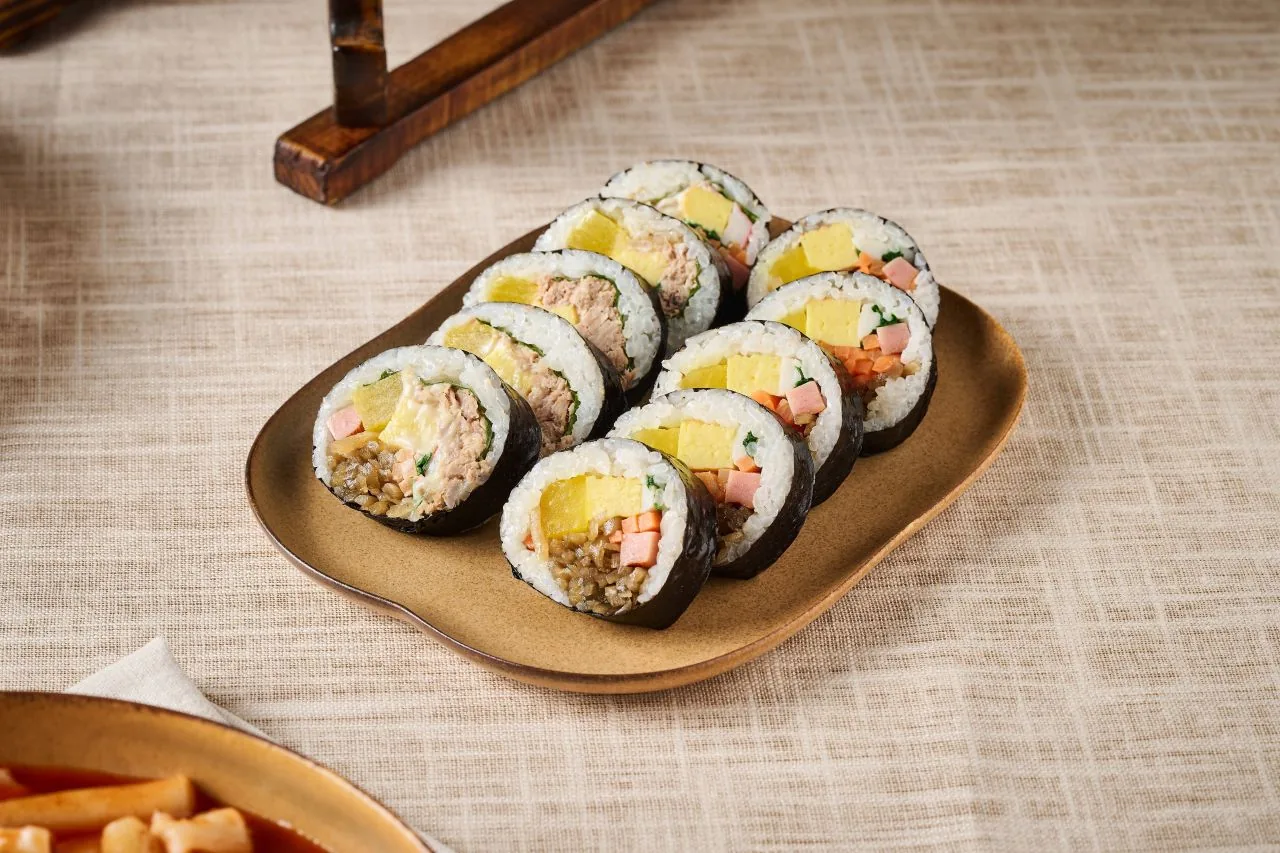
Unroll a standard gimbap and you’ll find danmuji (the yellow pickled radish that does most of the flavor work), egg strips, blanched spinach, sautéed carrot, seasoned burdock root, and either ham or an imitation crab stick. Every one of those has been cooked, pickled, or seasoned before it ever touched the rice. Raw fish simply isn’t in the vocabulary.
This is where the “Korean sushi” label does real damage, because it sets people up to expect sashimi and then confuses them when it doesn’t show. Order chamchi gimbap and you’ll get canned tuna bound with mayonnaise: genuinely delicious, and completely unrelated to a tuna nigiri. What surprises most first-timers is how savory and homey the whole thing tastes compared to the clean minimalism they were braced for.
3. The Seaweed Is the Same Plant, Not the Same Product
Both rolls are wrapped in dried laver, but Korea treats gim as a staple food in its own right rather than as packaging. Korean gim holds about 70% of the global laver market and has been the country’s number-one seafood export since 2019, according to the Ministry of Oceans and Fisheries. This is not a country that borrowed the habit of eating seaweed.
You can taste the difference in the finishing. After a roll is assembled, the outside gets brushed with sesame oil and dusted with sesame seeds, so the sheen you see on a cut gimbap is flavor, not gloss. Sushi nori is left dry and crisp on purpose, because moisture is the enemy of a hand roll.
4. Gimbap Travels; Sushi Waits for You
Portability isn’t a side effect of gimbap. It’s close to the point of it. School picnics, hiking trailheads, KTX seat trays, night-shift lunch boxes: the roll goes wherever the day goes, which is exactly why it’s cut into bite-size coins and needs no soy sauce, no wasabi, and no chopsticks if you’re in a hurry.
The clearest proof is Chungmu gimbap, from the port city of Tongyeong (once called Chungmu). The Encyclopedia of Korean Culture describes it as a fix for a practical problem: fishermen carried gimbap to sea, but in summer the filled rolls spoiled, so cooks started rolling rice alone and packing the radish kimchi and the spicy seasoned squid on the side. That’s a dish designed by logistics. Sushi, by contrast, evolved toward the counter — toward a chef, a moment, and a price that reflects both.
5. You Buy Gimbap at a Bunsik Shop, Not a Sushi Counter
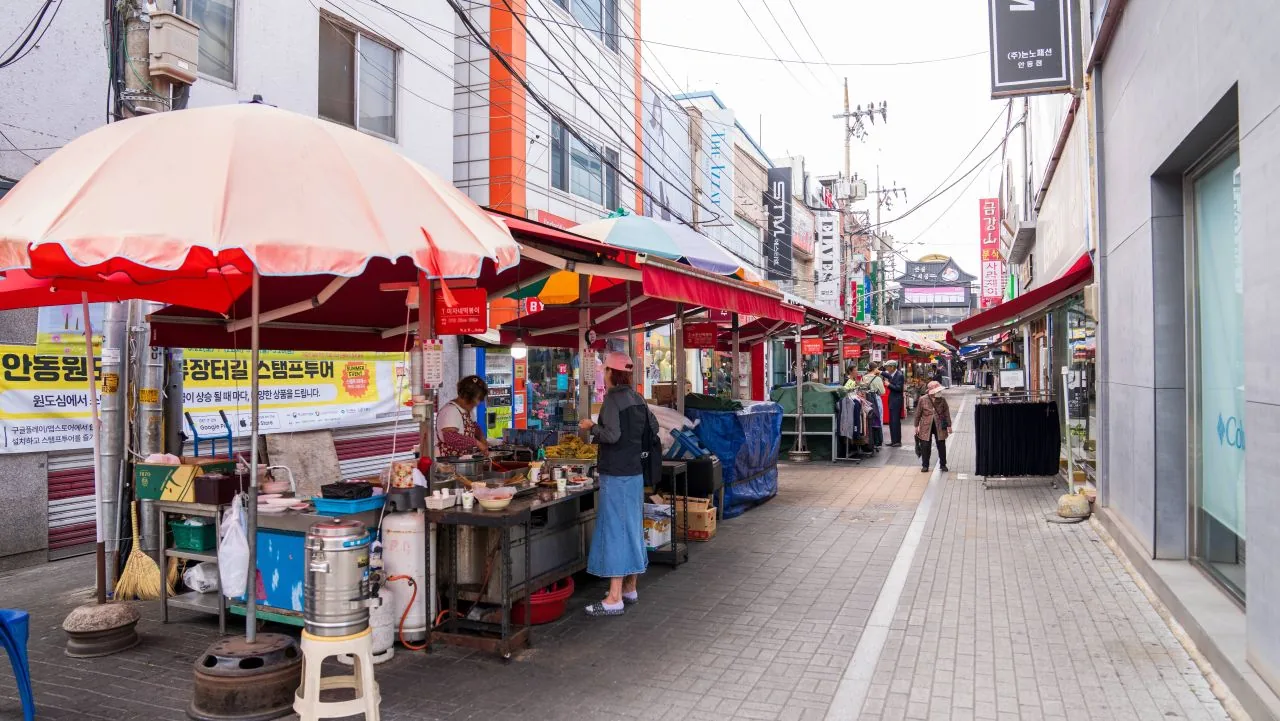
Gimbap lives in bunsik joints, dedicated gimbap chains, market stalls, and convenience-store chillers, and not one of those has a chef standing behind a counter watching you eat. A plain roll is among the cheapest full meals you can buy in Korea, still under ₩4,000 at a typical bunsik counter, and it’s priced as a lunch rather than as an occasion. Convenience stores keep it stocked around the clock as of 2026, which makes it the default answer to arriving somewhere hungry at an awkward hour.
Many of these shops now take orders through a touchscreen instead of a person, so it pays to know how to order at a Korean restaurant kiosk before you’re the one holding up the queue. And order it the way regulars do — one roll plus a portion of tteokbokki, so you can dip the end pieces into the sauce.
6. The Gimbap Menu in Korea Is Longer Than You Think
A Korean gimbap shop menu routinely runs a dozen varieties deep, and almost none of them make it into English-language explainers. As of 2026 the standard bunsik lineup still leads with tuna, cheese, kimchi, bulgogi, and plain vegetable, with the rest of the board built out from there.
| Variety | What’s in it | Where you’ll meet it |
|---|---|---|
| Chamchi (참치) | Canned tuna and mayonnaise | Every gimbap chain |
| Cheese (치즈) | Melted processed cheese, often with ham | Bunsik shops, kid-friendly menus |
| Nude (누드) | Rice on the outside, laver hidden inside | Gimbap chains, cafes |
| Mayak (마약) | Tiny rolls, no filling, mustard-soy dip | Traditional markets |
| Kkoma (꼬마) | Mini rolls, sold by the handful | Street stalls, snack counters |
| Chungmu (충무) | Rice-only rolls, squid and radish kimchi on the side | Tongyeong, and Chungmu specialists elsewhere |
| Samgak (삼각) | Triangle rice parcel, laver kept dry until you pull the tab | Convenience stores |
Mayak gimbap is the one to hunt down first — small, filling-free, dangerously repeatable, and best eaten standing at a market stall like the night arcade in Jeonju’s Nambu Market. Samgak gimbap deserves its own note, because it’s the variety Koreans will openly tell you is borrowed: it’s the convenience-store triangle, and nobody in Korea pretends otherwise.
7. Why “Korean Sushi” Is the Wrong Name
The label fails because it makes gimbap a derivative of something else, and the documented history is both messier and more interesting than that. Here’s what can actually be sourced, and where the argument genuinely remains open.
Korea’s two national reference works are candid on the point. The Encyclopedia of Korean Culture, published by the Academy of Korean Studies, and the Encyclopedia of Korean Folk Culture, published by the National Folk Museum of Korea, both describe today’s mat-rolled gimbap as Japanese norimaki (kimchobap in Korean) transmitted during the colonial period (1910–1945) and then localized into a Korean dish. That is the Korean state’s own scholarship, and it does not claim the roll was invented in Korea.
That older Korean name is the fastest way to settle what sushi is called in Korean, which is a question the “Korean sushi” habit tends to leave hanging. The standard word is chobap (초밥), which the National Institute of Korean Language’s Standard Korean Dictionary defines as a Japanese dish of vinegared, salted rice pressed into an oblong and topped with wasabi and slices of fish. Seusi (스시), lifted straight from Japanese, is what you’ll actually hear spoken and see on restaurant signs, but it never became a dictionary headword. Kimchobap, the encyclopedia’s term, is literally “laver chobap”: laver sushi. So the name Koreans dropped for this dish is the one that still had sushi in it, and the name they kept, gimbap, does not.
Set against it is a separate Korean habit of wrapping rice in laver that owes nothing to sushi. Bokssam (“wrapped fortune”) was eaten at Daeboreum, the first full moon of the lunar year, and in its original form was simply rice wrapped in gim. Gimssam, seasoned laver treated as a dish in its own right, turns up in the 1936 cookbook Joseon Musang Sinsik Yorijebeop as laver brushed with oil, dusted with salt and sugar, and grilled, with nothing rolled on a mat anywhere in sight.
What remains unsettled is the relationship between those two threads: whether the older wrapping custom fed into the modern roll or ran parallel to it. Anyone who tells you the question is closed, in either direction, is offering a tidier story than the sources support. What isn’t in dispute is where the dish ended up — through the 1950s and 1960s the fillings that define gimbap today settled into place, and it went its own way.
It’s the same trap as calling a gisaeng a “Korean geisha,” which the shorthand gets wrong for very similar reasons: it imports another country’s institution to explain something that has its own line of descent. The fix is easy. Call it gimbap. You’ll also see it spelled kimbap — same word, same dish, with gimbap following the government’s Revised Romanization.
Frequently Asked Questions
Q: Is gimbap just Korean sushi?
No. The rice seasoning is different (sesame oil and salt rather than vinegar and sugar), the fillings are cooked or pickled rather than raw, and the two are eaten in completely different settings. They’re separate dishes with overlapping ingredients.
Q: What is the difference between kimbap and sushi rice?
Kimbap rice is dressed with sesame oil and salt, giving it a warm, nutty aroma. Sushi rice is dressed with rice vinegar, sugar, and salt, giving it a clean, slightly sweet-sour edge meant to complement raw fish.
Q: Is it spelled kimbap or gimbap?
Both spellings refer to the identical dish (김밥). “Gimbap” follows Korea’s Revised Romanization system, which is why you’ll see it on official signage, while “kimbap” is the older transliteration still common in English menus.
Q: What is sushi called in Korean, chobap or seusi?
Chobap (초밥) is the standard word and the one the National Institute of Korean Language lists; seusi (스시), borrowed straight from Japanese, is what you’ll hear spoken and see on signage but never entered the dictionary as a headword. Neither word means gimbap, which is precisely why “Korean sushi” lands wrong.
Q: Does gimbap have raw fish in it?
Essentially never. Tuna gimbap uses canned tuna mixed with mayonnaise, and other seafood versions use cooked or seasoned ingredients — if you’re avoiding raw fish, gimbap is a safe order.
Q: Which gimbap should I try first in Korea?
Start with a plain vegetable roll to learn the baseline, then try chamchi (tuna) for the most popular filling and mayak gimbap at a traditional market for the version people get addicted to.
Start where the list starts: buy one plain roll from the nearest bunsik shop, and smell the sesame oil before you take a bite. That’s the whole argument, settled in about two seconds.
Part of Korean Cuisine Fundamentals