Why Was Tripitaka Koreana Carved? War, Not Just Prayer
On this page
The Tripitaka Koreana was carved twice, and the second cut is the one that matters. Ash was all that remained of Korea’s first Buddhist canon after 1232, when Mongol troops burned the woodblocks kept at Buinsa temple on Palgongsan, outside present-day Daegu. Seventy-six years of carving, begun under King Hyeonjong in 1011 and finished in 1087, gone in a single raid. Four years later, with the court evacuated to Ganghwa Island and Mongol cavalry ranging over the mainland, Goryeo’s answer was not a new army. It was a government bureau, a timber supply chain, and a decision to cut the entire canon a second time while the war was still running. Ask why, and nearly every page you land on gives the same throwaway line — to invoke the Buddha’s protection. That line is genuinely in the record. It is also about a third of the answer.
Quick answers
- Goryeo started recarving the canon in 1236, four years after Mongol troops burned the first set, and finished in 1251, during the invasions rather than after them.
- The stated motive was a vow to drive the Mongols out by Buddhist power, citing the precedent of 1011, when a canon was begun against a Khitan invasion and the Khitan withdrew.
- The Korean name, Palman Daejanggyeong or “Eighty-Thousand Tripitaka”, counts blocks rather than books: 81,258 of them, carrying 1,496 titles in 6,568 volumes.
- The vow repelled nobody. Goryeo settled with the Mongols in 1259, yet as of 2026 all 81,258 blocks are still stacked at Haeinsa.
Myth: a few monks carved it quietly up in the mountains
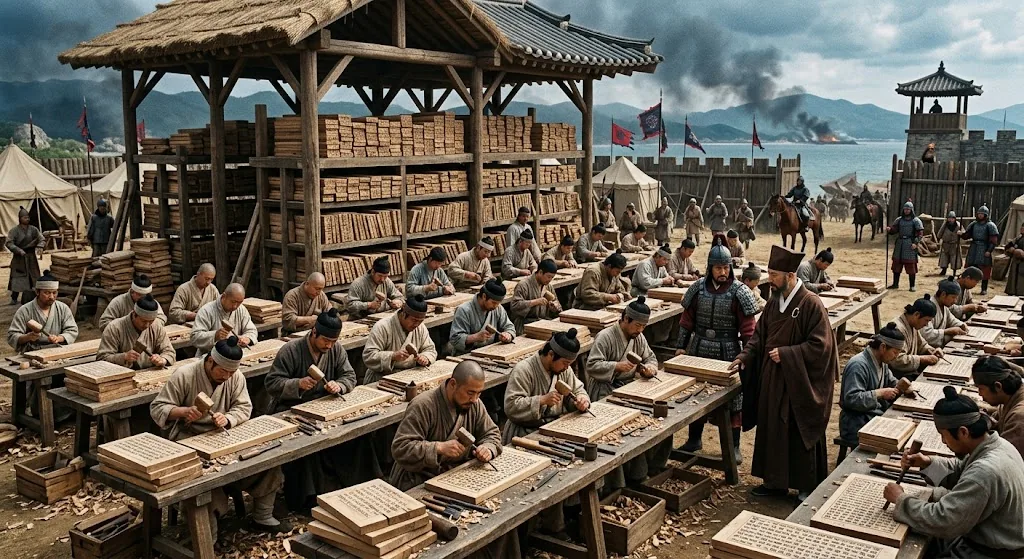
This was a government programme run out of a wartime capital, not a monastery side project. The court had moved to Ganghwa Island in 1232 and would hold it as the capital for nearly forty years; there, in 1236, it set up a dedicated bureau, the Daejang Dogam, to run the carving, with branch offices working out of the southern provinces, Jinju and Namhae among them. By the time the scholar-official Yi Gyu-bo drafted the royal vow in 1237, the office already existed and the knives were already moving — two texts came off the blocks that first year. Monks supplied the scholarship and a great deal of the cutting. The state supplied the budget, the wood and the ships.
Myth: “eighty thousand” is a count somebody actually made
The number in the Korean name is half arithmetic and half theology. Koreans call the canon the Palman Daejanggyeong, the “Eighty-Thousand Tripitaka”, and the Korea Heritage Service explains the name plainly: the woodblocks came to more than eighty thousand, so eighty thousand is what the canon got called. Buddhist tradition supplies the echo, counting 84,000 dharma teachings for 84,000 afflictions. The National Treasure record puts the tally at 81,258 blocks; UNESCO’s World Heritage listing rounds the same collection down to 80,000. Even the official figure has a history. It was first counted in 1915, by the Japanese colonial Government-General, and the digital imaging project that began in 2000 with the surveys that followed it have since put the physical count a little higher, partly because blocks cut during the colonial period sit among the Goryeo ones. Round numbers are not always laziness. Sometimes they are the honest option.
Myth: the blocks were cut from birch
Microscope analysis says otherwise, and the correction is one of the better stories in Korean conservation. Old accounts described the material as hwamok, read for centuries as birch, so birch is what generations of guidebooks reported. A wood-anatomy survey led by Park Sang-jin of Kyungpook National University sampled 208 blocks and found something else: 64% wild cherry and 15% wild pear, with dogwood, painted maple, Betula costata and Machilus thunbergii sharing the remainder. The white birch of the guidebooks never turned up. That fits the war, because white birch grows in the high plateaus of what is now North Korea, country a besieged Goryeo could not have logged. Laboratory work keeps rewriting Korean artefact stories this way, as it did for the Baekje armour found under a Japanese temple. The minor species carry more weight than their share suggests, because Machilus thunbergii grows on the southern coastal islands, which points straight back at those provincial branch bureaus.
Myth: a devotional object didn’t have to be accurate
This is where the common assumption flips hardest. Rather than simply recopying what had burned, the monk Sugi ran a full scholarly collation, setting the lost Goryeo first edition against the Northern Song canon, the Khitan canon and every catalogue he could reach, correcting garbled characters, dropped lines, wrong titles and wrong attributions. His record of that work, the Goryeoguk sinjo daejang gyojeong byeollok, runs to 30 volumes and was completed in 1247; the Korea Heritage Service calls it the only surviving record anywhere of how East Asian scholars collated a canon at that scale. The finished set holds 1,496 titles in 6,568 volumes, roughly 52 million characters by the heritage authority’s count, cut with a consistency that still lets the blocks print cleanly.
So why was Tripitaka Koreana carved? Three motives at once
Three motives sat stacked on top of each other, and only the first one usually gets quoted.
The vow. It is real and it is documented. Yi Gyu-bo’s 1237 text, the vow of king and ministers on the carving of the canon, asks the buddhas to drive the invaders out — and its argument is oddly precise for a devotional document. In 1011, with Khitan troops inside the country and the capital about to fall, King Hyeonjong had sworn to carve a canon, and the Khitan withdrew. Goryeo was not improvising a prayer. It was citing a precedent.
The restoration. Losing the first canon was not only a spiritual wound. Seventy-six years of labour, the largest publishing asset the kingdom had ever assembled, was reduced to ash in one raid, and unlike a lost battle or a burned granary, it could be rebuilt exactly. Recarving reversed the one defeat that was actually reversible.
The project a losing state could win. Goryeo’s field armies could not beat Mongol cavalry, and everyone on Ganghwa knew it. A carving programme, by contrast, needed precisely what an exiled court still controlled: mountain stands of cherry and pear, coastal shipping, a literate clergy, southern tax revenue and patience. It delivered a countable result on a schedule — twelve years of cutting from 1237 to 1248, sixteen counting preparation — and kept court, clergy and provinces yoked to a single undertaking through the worst of the war. Whether or not the buddhas were listening, the mobilisation was real, and visible to everyone who floated a log or fed a carver.
Did it work? Not on the terms of the vow. Goryeo’s crown prince went to the Mongol court to make peace in 1259, and the government returned from its island to Gaegyeong in 1270. The blocks outlasted the dynasty that made them, the empire they were aimed at, and the dynasty that came next.
Frequently Asked Questions
Q: What does the name Tripitaka Koreana actually mean?
Tripitaka is Sanskrit for “three baskets”, the sutras, the monastic rules and the commentaries that together make up the Buddhist canon, and Koreana marks this as the Korean edition of it. The Korean name works on a different logic: Palman Daejanggyeong, “Eighty-Thousand Tripitaka”, counts the woodblocks rather than the scriptures printed from them.
Q: Why was the Tripitaka Koreana carved on wood instead of written on paper?
Woodblocks were the mass-production technology of the age. One carved block prints indefinitely, so a canon could be reproduced and distributed rather than hand-copied volume by volume. The carving was also the offering itself, which is why the labour mattered as much as the result.
Q: How long did the Tripitaka Koreana take to carve?
Twelve years of cutting, from 1237 to 1248, or sixteen years counting the preparation that began in 1236 and the completion ceremony in 1251. The whole span falls inside the Mongol wars.
Q: Did carving the Tripitaka Koreana actually stop the Mongol invasions?
No. Goryeo’s crown prince submitted to the Mongol court in 1259, eight years after the canon was finished, and the capital moved back to Gaegyeong in 1270. The vow’s stated goal failed; the object it produced is what survived.
Q: Why are the woodblocks kept at Haeinsa and not where they were carved?
They were stored on Ganghwa Island after completion and moved to Haeinsa in Hapcheon in 1398, early in the Confucian Joseon dynasty that replaced Goryeo, once Japanese pirate raids had made the coast unsafe.
The four halls that hold the blocks, the Janggyeong Panjeon, went up in the fifteenth century, and they are the reason any of this is still readable. What surprises most first-time visitors is how ordinary they look from the courtyard — no glass, no vault, no machinery, just plain wooden buildings on a slope above the main temple, designed so that ventilation, temperature and humidity regulate themselves. Nothing about them announces itself the way the painted Joseon palaces in Seoul do. UNESCO inscribed those depositories on the World Heritage List in 1995 and in 2007 added the woodblocks to the Memory of the World register, alongside the 5,987 miscellaneous Buddhist blocks the temple also holds. As of 2026 all 81,258 blocks are still sitting where a losing government sent them.