Best Apps for a Korea Trip: Maps, Taxis, Payments, Delivery
On this page
Google applied to the Korean government in February 2025 for permission to take 1:5,000-scale map data out of the country, and on 27 February 2026 it received a conditional yes. The app on your phone has not caught up. Google Maps in Korea will still sketch a subway route, but the walk from the station to your door is a dotted line with no guidance, and that single gap reorders the list of best apps for a Korea trip. The Korean apps that fill it were built around local phone numbers and bank accounts, so the useful question is less which app is best than which one lets a visitor in. Four jobs cover most of a first trip: finding the way, getting a taxi, paying, and ordering food to your room. Each now has at least one app that works with an overseas number, an overseas card or a passport.
Quick answers
- Four installs cover a first trip, one per job: Naver Map for directions, k.ride or Uber for taxis, Naver’s passport verification for paying and booking, and Baemin for delivery.
- Google Maps still gives no turn-by-turn walking or driving directions in Korea; the conditional approval of 27 February 2026 lets map data leave only after the government confirms Google has met its security conditions, and Google has named no launch date.
- Kakao Pay builds its foreigner features for people living in Korea, so a visitor’s realistic payment kit is a card issued abroad, Naver Pay, and a physical transit card that pays Seoul’s ₩1,550 base subway fare in 2026.
Which Are the Best Apps for a Korea Trip, Job by Job?
Four apps and one plastic transit card do the work that longer lists spread across many more installs. The table below applies a single test: can a short-stay visitor holding an overseas phone number and an overseas card finish the task without a resident’s help?
| Job | Install first | Without a Korean number? | Optional or skip |
|---|---|---|---|
| Directions | Naver Map | Yes, for maps and routes | KakaoMap (English and Korean only); Google Maps for saved pins, not walking |
| Taxis | k.ride or Uber | Yes | Kakao T, if you already hold a Kakao account |
| Paying | A card issued abroad, Naver Pay, a T-money or WOWPASS card | Yes, with passport verification in Naver | Kakao Pay, whose foreigner features are built for residents |
| Delivery | Baemin | Yes, through a text code sent to an overseas number | Coupang Eats and Yogiyo (no visitor route confirmed here) |
| Translation | Papago and Google Translate | Yes | None needed |
The pattern behind the table is cause and effect, not taste. Many Korean consumer apps confirm who you are through a phone number registered in Korea, and the apps in the second column are the ones that have opened a second door (a passport, an overseas number, a social login) for people who do not have one. Translation sits outside that problem, and the reason to carry two translators rather than one is laid out in our guide to setting up a Korean translation app for travel. Connectivity sits underneath all of it. Every route, ride and order below needs live data, which is why the eSIM or pocket WiFi decision comes before any of these downloads.
Why Can’t Google Maps Give Walking Directions in Korea?
Because Korea did not let Google take its detailed map data abroad until 2026, and the approval that finally came attaches conditions that stand between the decision and a working feature. Korean law sends requests to export survey maps abroad to a consultative body of ministries and agencies, and on 27 February 2026 that body approved Google’s February 2025 application for 1:5,000-scale data on strict terms. Google must blur military and security facilities in its satellite imagery, in Street View and in historical Google Earth images. A Korean partner must process the raw data on servers inside Korea. Only what navigation needs may leave, meaning the base map and the road and traffic network, with contour lines excluded. Finally, the government has to confirm all of that before any data is actually exported.
The approval started a compliance process, not a product launch. When The Korea Herald reported in August 2026 that Google was building a Korea team for a full-featured service, Google Maps still offered no turn-by-turn walking or driving navigation in the country, and Google gave no launch date. No launch had been announced when this guide was written in October 2026. Google Maps stays useful for the places you saved while planning at home, but the final walk needs a Korean map.
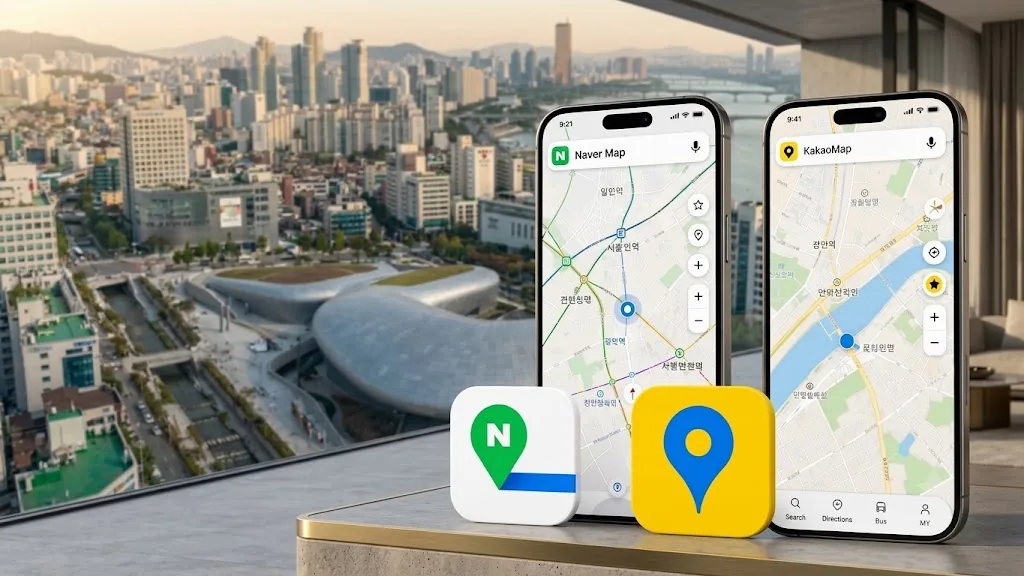
Naver Map is that map for most visitors. Naver introduced English, Chinese and Japanese versions in 2018, and in June 2026 it reported that Naver Map users with a non-Korean language setting had grown 16.4% from September 2025. KakaoMap, the main alternative, lists only English and Korean on its App Store page, which makes Naver the stronger default for Japanese and Chinese speakers in particular. Whichever map you open, the walk usually begins at a numbered subway exit, and choosing the right exit saves more time than any app setting.
Which Taxi App Works Without a Korean Phone Number?
k.ride and Uber both do, while Kakao T, the default for most Koreans, starts with a step a visitor may not want to take: it requires a Kakao account. Kakao Mobility launched k.ride in June 2024 to close that gap. Its App Store listing describes sign-up by verifying your phone or linking a social account, payment by credit or debit card, PayPal, WeChat Pay or Alipay+ wallets such as GCash and Touch ‘n Go, an interface in English, Japanese and both forms of Chinese, and destination search and driver chat in 133 languages.
The trade-off is price. Kakao’s October 2025 travel campaign describes k.ride as booking Kakao T Blue, Venti, Black and deluxe “mobeom” taxis, which are the branded and premium tiers. Kakao T’s cheapest option, the general taxi with no service or cancellation fee and direct payment to the driver, is not offered on k.ride, so the same trip costs a bit more there than it would through Kakao T.
Uber is the zero-setup option if the app already lives on your phone. Its Seoul page states that every ride is operated by a licensed taxi driver, lists a standard midsize taxi alongside faster and premium options, and lets you pay in the app or by cash or card at the end of the ride. Chinese visitors have a third route: Kakao Mobility connected its taxis to the Alipay app in October 2023, so a Kakao T cab can be called from inside Alipay without a new install. Kakao T on its own does accept cards issued abroad (Kakao Mobility names Visa, Mastercard, American Express and JCB), but the account step still comes first.
How Do Visitors Pay by App in Korea?
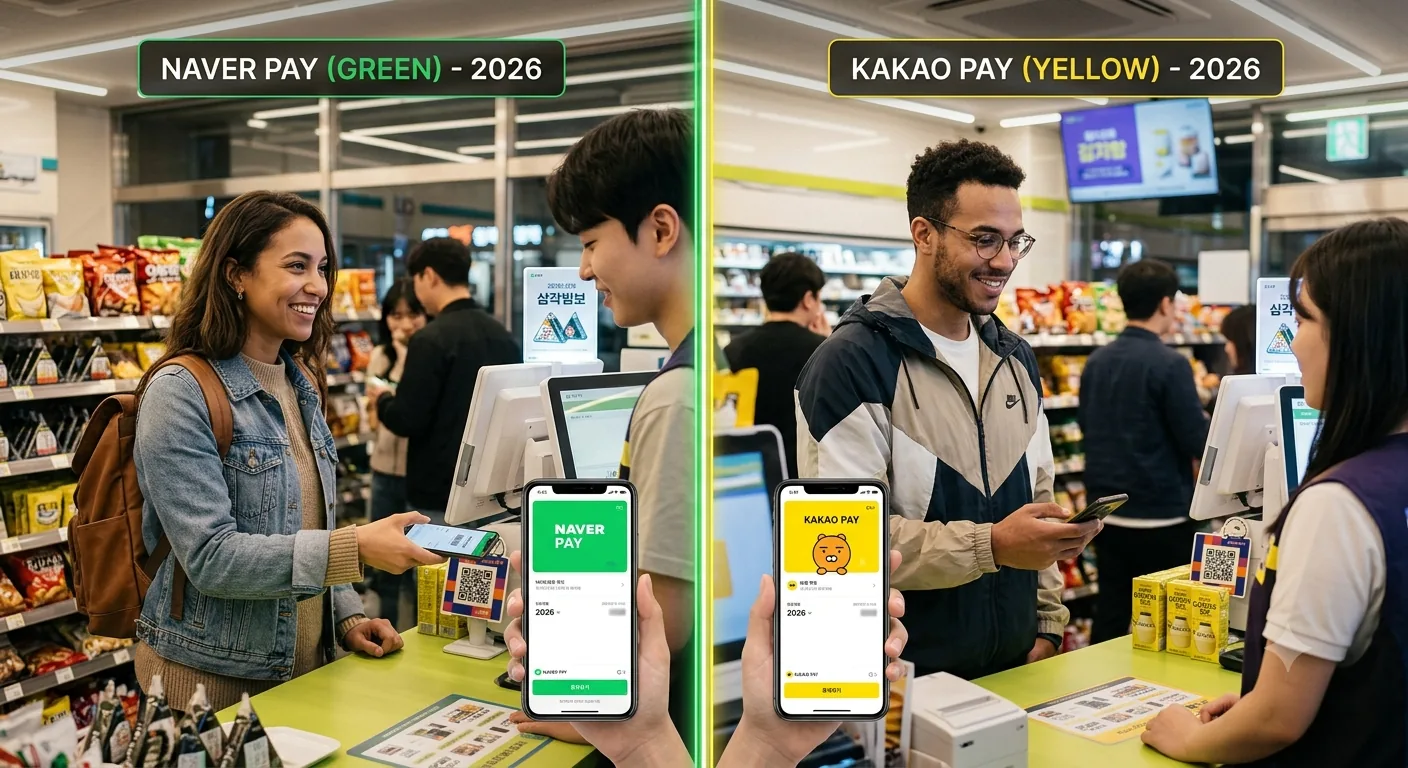
Through Naver for anything booked or ordered online, plus a physical transit card for subways and buses. Since 4 June 2026, Naver has let anyone holding a passport issued outside Korea verify their identity on a smartphone, with no Korean mobile number and no call to customer support, and then use Naver Booking, Naver Order and payments through Naver Map. Bookings and payments made through Naver Map can also be charged to a card issued abroad, although each merchant decides whether to accept one. The setup steps and the friction that remains are in our comparison of Naver Pay and Kakao Pay for foreigners.
Kakao Pay is the opposite case. Its foreigner features are built for people living in Korea. The merchant side is more open to visitors: Kakao Pay’s own merchant page tells shops that, through its link with Alipay+, foreign tourists can complete payment there as well. That matters to visitors who already carry an Alipay+ partner wallet from home.
WOWPASS covers the visitor who wants no Korean wallet at all. It is a prepaid card built for foreign travelers, its app tops up the balance with an overseas card or mobile wallet, and the same card works as a T-money transit card. The two balances are separate, though. The app can move money from the WOWPASS side to the T-money side, while a station machine or convenience store will top up the T-money side only with Korean won in cash.
Some form of tap card is worth carrying. In 2026 a Seoul subway ride costs a ₩1,550 base fare on a transit card for the first 10 km, and a physical card is the simplest way for a visitor to get through the gate. A small leftover balance (up to ₩20,000, or ₩30,000 at CU and emart24) can be cashed out at a convenience store, minus a ₩500 fee, as our guide to refunding a T-money card explains.
Can Foreigners Order Food Delivery on Baemin?
Yes. Baemin (배달의민족, Baedal Minjok), Korea’s largest delivery app, has lowered the three barriers that used to stop visitors at the sign-up screen: language, payment and the Korean phone number.
- Language. In February 2026 Woowa Brothers, the company behind Baemin, opened English, Japanese and Chinese versions covering search, restaurant and menu choice, payment and delivery tracking. The translation stops at your screen, since order intake and rider dispatch run exactly as before.
- Payment. By then Baemin already took cards issued abroad, WeChat Pay and Alipay+. From 2 June 2026 it added Apple Pay with Visa, Mastercard, JCB and American Express cards issued abroad, which the company presented as a first among Korean delivery platforms.
- Phone number. In July 2026 the Seoul city government, announcing a partnership with Baemin, said visitors can now order without signing up by entering an overseas number and typing in the verification code it receives.
Two gaps remain. A rider may need to reach you about the handoff point, so the number on the order should be one that can take calls while you travel. And this guide could not confirm an overseas-number route for Coupang Eats or Yogiyo, so check their sign-up screens before relying on either.
Frequently Asked Questions
Q: Do I need a Korean phone number for any of these apps?
Not for the core set. k.ride verifies the phone you already have, Baemin sends its code to an overseas number, and Naver accepts a passport. A Korean number still helps with smaller booking apps that text a code; LG U+ says its voice eSIM receives those verification texts, but it cannot pass the identity check that banking apps require.
Q: Is k.ride more expensive than a regular Korean taxi?
Usually a little, because it dispatches only Kakao’s branded and premium tiers and leaves out the general taxi. For the plainest metered fare, take a cab from a taxi rank and pay the driver directly; use k.ride when English chat and overseas payment are worth a small premium.
Q: What address should I give a delivery app at my hotel?
Use the Korean road-name address from your booking confirmation and add your room number. Ask at check-in whether riders may come up to rooms or must hand orders over in the lobby.
Q: Which Korean apps can a short-stay tourist skip?
Kakao Pay, whose foreigner features are built for residents; KakaoBank, whose standard account is open only to Korean nationals; and any second map once Naver Map is set up. KakaoTalk is optional unless a guesthouse or tour operator wants to message you there.
Set up Naver with your passport and a card in one taxi app before your first night, and leave every other install until a specific job calls for it.
Part of IT Platforms & Digital Economy