Are Kia and Hyundai the Same Company? Who Owns What in 2026
On this page
Kia and Hyundai are not the same company, and the precise answer is a number: 35.17%. That is the share of Kia that Hyundai Motor Company held on June 30, 2026, according to Hyundai’s own interim financial statements, which carry Kia as an associate rather than a subsidiary. The two are listed separately in Seoul, each has its own president and CEO, and each sells in the US through its own distributor and dealers. Underneath, they share platforms, engines, a chairman and a loop of cross-shareholdings that makes them one industrial group in all but the legal sense. For a car buyer, the badge decision comes down to design, warranty fine print and the dealer nearest you, not to two separate engineering lineages.
Quick answers
- Kia and Hyundai Motor are separately listed companies, but Hyundai took over Kia in 1998 and held 35.17% of it on June 30, 2026, which makes it Kia’s largest shareholder.
- Ownership runs in a loop: in mid-2026 Hyundai Mobis owned 22.36% of Hyundai Motor, Hyundai Motor owned 35.17% of Kia, and Kia owned 18.10% of Hyundai Mobis.
- For 2026 models sold in the US, both brands give 5 years/60,000 miles of basic cover and 10 years/100,000 miles on the powertrain, but Hyundai’s roadside assistance has no mileage cap while Kia’s ends at 60,000 miles.
Are Kia and Hyundai the Same Company? The Ownership Answer
No. They are two companies tied together by one controlling stake, and the paperwork says so plainly. Kia traces itself to Kyungsung Precision Industry, a bicycle-parts maker founded in December 1944, and its shares have been listed since July 1973. Hyundai Motor Company was incorporated in December 1967 and listed in June 1974. Kia defaulted in 1997, and Kia’s own company history records that “Hyundai Motor takes over Kia Motors” in 1998. In August 2000, when Chung Mong-koo, a son of Hyundai founder Chung Ju-yung, split the car business away from the wider Hyundai Group with 10 affiliates, Kia went with him into what is now Hyundai Motor Group, according to the Encyclopedia of Korean Culture. Kia dropped “Motors” from its name in January 2021.
So does Hyundai own Kia? In part. At the end of 2025 Hyundai Motor held 137,318,251 Kia shares, which Kia’s shareholder table puts at 35.17%, and Hyundai’s June 2026 statements give the same figure. Kia’s issued share count fell from 405.4 million at the end of 2022 to 390.4 million at the end of 2025. Measured against the end-2022 count, 137.3 million shares would be 33.9%, so an answer of “about a third” is dated rather than wrong.
Management is separate at the top and shared at the very top. Ho Sung Song is Kia’s president and CEO; José Muñoz is Hyundai’s. Chung Eui-sun, who became the group’s third-generation chairman in October 2020, is Hyundai Motor’s executive chair and CEO and also sits on Kia’s board as executive chair of Hyundai Motor Group. It is the familiar chaebol pattern of a founding family steering a set of separately listed companies, the same structure that Korean dramas about chaebol heirs like to dramatise.
How the Hyundai, Kia and Mobis Ownership Loop Works
The loop runs through three companies, and each owns a large slice of the next. Its third member, Hyundai Mobis, was among the 10 affiliates, alongside Hyundai Motor and Kia, that Chung Mong-koo took out of Hyundai Group in 2000, according to the Encyclopedia of Korean Culture.
| Shareholder | Company owned | Stake | Date |
|---|---|---|---|
| Hyundai Mobis | Hyundai Motor | 22.36% | June 30, 2026 |
| Hyundai Motor | Kia | 35.17% | June 30, 2026 |
| Kia | Hyundai Mobis | 18.10% | June 30, 2026 |
| Chung Mong-koo | Hyundai Motor | 5.57% | June 30, 2026 |
| Chung Mong-koo | Hyundai Mobis | 7.47% | June 30, 2026 |
| Chung Eui-sun | Kia | 1.81% | End of 2025 |
These figures come from Hyundai Motor’s June 2026 interim statements, Hyundai Mobis’s shareholder disclosure dated June 30, 2026, and Kia’s year-end 2025 shareholder table. Follow the arrows and every company in the loop is partly owned by another company inside it. The family’s direct stakes are small (Chung Eui-sun held 0.33% of Mobis at mid-2026), yet the loop keeps all three under one controlling block. Mobis is the hinge. Its own disclosure put affiliated holders, Kia included, at 32.70% of its shares on June 30, 2026, and Mobis in turn is Hyundai Motor’s largest shareholder.
For a car buyer, none of this changes what is in the showroom. For a shareholder it matters more: Kia’s earnings flow partly into Hyundai’s results through the equity stake, so a bet on Hyundai Motor stock is also, at one remove, a bet on Kia.
Hyundai vs Kia: What the Two Brands Actually Share
They share the expensive parts underneath: platforms, engines and factories. Hyundai Motor Group unveiled its dedicated electric platform, E-GMP, in December 2020, and the group says the Hyundai IONIQ 5, Kia EV6 and Genesis GV60 are all built on it. On the combustion side, the group’s third-generation platform started with the eighth-generation Hyundai Sonata and has since been applied to other Hyundai and Kia models, the Kia K5 sedan among them.
Shared engines also mean shared problems. In 2017 the US National Highway Traffic Safety Administration (NHTSA) opened two recall queries after Hyundai and Kia each recalled vehicles with Theta II engines; Kia’s 2017 recall alone covered 618,160 Optima, Sorento and Sportage models from the 2011 to 2014 model years. Both companies signed consent orders with the agency in November 2020. When NHTSA opened an engine-fire investigation in December 2021, it treated an estimated 3 million 2011 to 2016 Hyundai and Kia models as one population in a single file.
Factories are increasingly shared as well. Hyundai Motor Group Metaplant America in Ellabell, Georgia, the group’s third US production hub after Hyundai’s Alabama plant (completed in 2005) and Kia Autoland Georgia (completed in 2010), was built to make electric and hybrid vehicles for all three Hyundai Motor Group brands: Hyundai, Kia and Genesis. When it opened in March 2025, Kia said the first Kia model would join production there in 2026. The overlap already shows in Hyundai’s paperwork: its 2026 US new-vehicle warranty covers components made or installed not only by Hyundai Motor Company and its Alabama plant but also by Kia Motors Manufacturing Georgia and Kia Manufacturing Mexico.
Design and brand positioning are where the two split. After Chung Eui-sun became Kia’s president in 2005, Kia hired Peter Schreyer as chief design officer to make it a design-led brand, in Kia’s own account of its history. The luxury badge belongs to only one side: Genesis Motor America and Genesis Motor Europe appear on Hyundai Motor’s list of wholly owned subsidiaries.
Kia vs Hyundai Warranty and Dealers, Side by Side
On the headline numbers the two US warranties are identical. The gaps are in roadside assistance, rust-through cover and who carries out the work.
| US coverage, 2026 | Hyundai | Kia |
|---|---|---|
| New-vehicle (basic) limited warranty | 5 years/60,000 miles | 5 years/60,000 miles |
| Powertrain, original owner | 10 years/100,000 miles | 10 years/100,000 miles |
| Powertrain, second and later owners | 5 years/60,000 miles | 5 years/60,000 miles (2020 warranty manual; check your model year) |
| Roadside assistance | 5 years, unlimited miles | 5 years/60,000 miles |
| Anti-perforation (rust-through) | 7 years, unlimited miles | 5 years/100,000 miles |
| Warrantor | Hyundai Motor America | Kia America |
| Where warranty work is done | Hyundai dealers and authorized service facilities | Authorized Kia dealers (Kia counted nearly 800 US dealers in January 2026) |
Hyundai’s terms come from its 2026 Owner’s Handbook and Warranty Information. Kia’s come from its US owners site, with the second-owner rule taken from Kia’s warranty manual; the 2020 edition sets 120 months/100,000 miles for the original owner and 60 months/60,000 miles for second and subsequent owners. Each warranty is a contract with that brand’s US distributor, and Kia’s manual defines an authorized Kia dealer as one appointed by Kia’s US arm to perform repairs under its warranties. A Kia’s warranty claim therefore goes to a Kia dealer, even when the car shares its platform with a Hyundai.
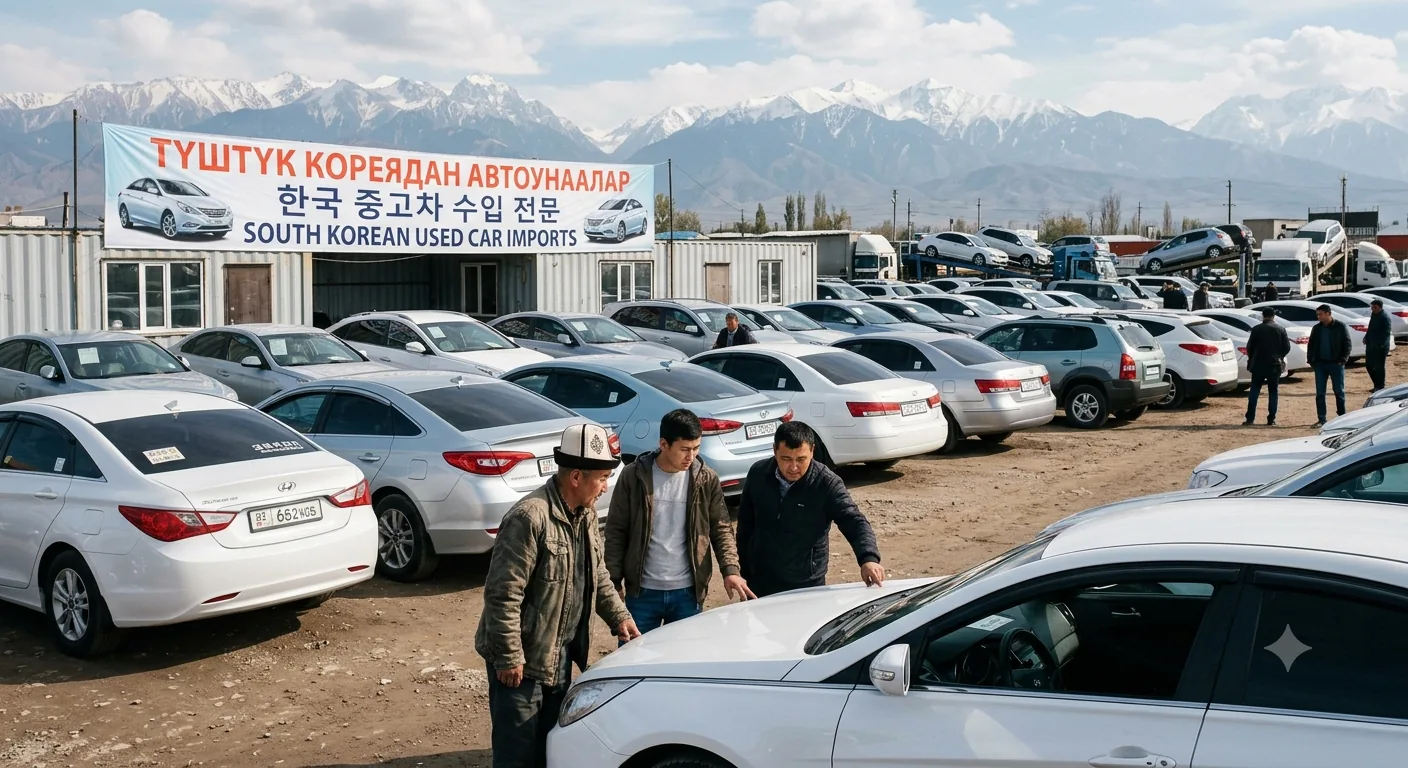
Terms are also written market by market. Hyundai’s 2026 handbook applies only to US-specification vehicles distributed by Hyundai Motor America and registered in the 50 states and Washington, D.C.; a car distributed elsewhere gets that country’s warranty. Kia’s history notes that in 2010 it extended a seven-year warranty to every vehicle sold and registered in Europe, so a European comparison of the two brands can come out differently from an American one. Further from either home market, both badges also turn up side by side in Korea’s used-car exports to Central Asia.
Hyundai or Kia: Which Badge Suits Which Buyer
Pick on the car and the dealer, because the engineering family is the same. A few cases where the badge does make a measurable difference:
- High-mileage drivers and road-salt states: Hyundai’s roadside assistance has no mileage limit for five years, and its rust-through cover runs seven years with no mileage cap, against Kia’s 60,000 and 100,000 miles.
- Buyers who may want to trade up to luxury: Genesis sits inside Hyundai Motor, so the step up stays within the same company.
- EV shoppers: the IONIQ 5 and EV6 share E-GMP, so compare price, cabin and the local dealer rather than platform claims.
- Used-car buyers: Hyundai’s 2026 terms and Kia’s warranty manual (2020 edition) both cut the powertrain term to 5 years/60,000 miles for second owners, so the “10-year warranty” line in a listing is the first owner’s benefit, not yours.
For everyone else, the deciding factors are the ones no ownership table captures: which design you prefer, what each dealer quotes, and how far you live from its service bay.
Frequently Asked Questions
Q: Is Genesis owned by Hyundai or Kia?
Hyundai. Genesis Motor America and Genesis Motor Europe are listed among Hyundai Motor’s wholly owned subsidiaries in its June 2026 interim statements. The Genesis GV60 does share Hyundai Motor Group’s E-GMP electric platform with Kia’s EV6.
Q: Which sells more cars, Hyundai or Kia?
Hyundai, by about a million vehicles. In 2025 Hyundai Motor sold 4,138,389 vehicles worldwide (wholesale) and Kia 3,135,873, roughly 7.27 million combined. Kia was the more profitable: its ₩9.08 trillion operating profit on ₩114.1 trillion of revenue works out to about 8.0%, against Hyundai’s 6.2% (₩11.47 trillion on ₩186.3 trillion).
Q: Is Hyundai Heavy Industries part of Hyundai Motor Group?
No. Hyundai Heavy Industries formally left the old Hyundai Group in 2002 under Chung Mong-joon, two years after the car companies split off. Its successor group, HD Hyundai, now makes the Develon excavators once sold as Doosan, and it sits outside the Hyundai, Kia and Mobis loop.
Q: Did Hyundai buy all of Kia in 1998?
No. Hyundai Motor signed a contract in December 1998 to buy 51% of Kia’s shares, according to the Encyclopedia of Korean Culture. Its stake on June 30, 2026 was 35.17%.
Two listed companies, one controlling family, one set of platforms: that is the short version, and 35.17% is the number that holds it together.
Part of Automotive & Mobility