Seoul Subway Exit Numbers: Pick the Right One, Fix It Free
On this page
- What Seoul Subway Exit Numbers Actually Encode
- What to Check Before You Tap In
- Step 1: Take the Exit Number From the Venue, Not the Address
- Step 2: Confirm the Number Before You Tap Out
- Step 3: If the Right Exit Is Across the Road, Stay Underground
- Step 4: Fix a Wrong Exit With the 15-Minute Re-Entry Rule
- Common Mistakes at the Gate
- Frequently Asked Questions
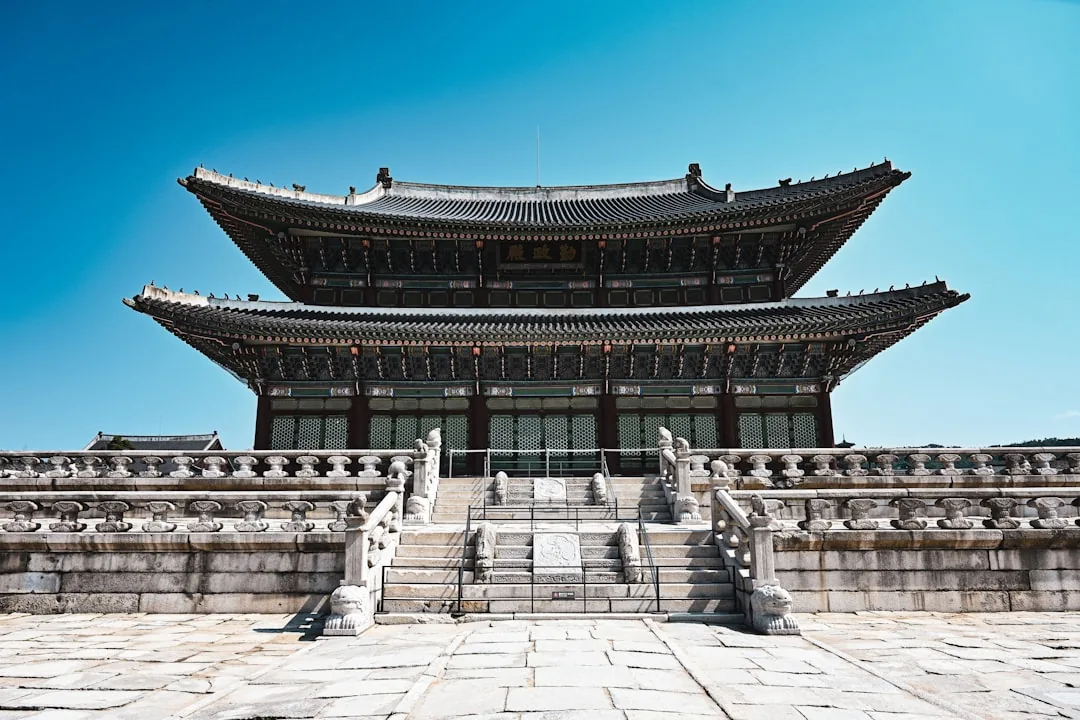
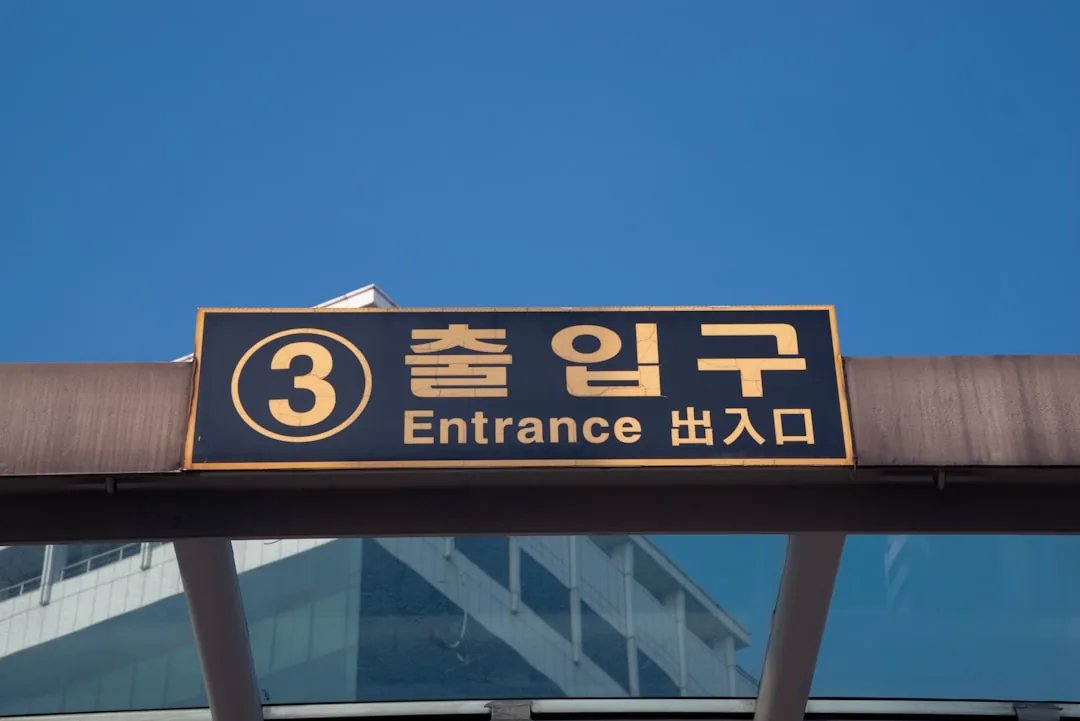
Exit 5 at Gyeongbokgung Station on Line 3 puts you 492 m from Gyeongbokgung Palace. Exit 2 at Gwanghwamun Station on Line 5 puts you 471 m from the same palace, by a different line and a different station. Seoul’s official city tourism guide lists both that way, with the exit number sitting where a street address would go in most countries. That is the whole point: Seoul subway exit numbers are the address. The moment you take a staircase you have committed to one corner of the surface, and at a big intersection the corner you wanted can be across a road you have no legal way to cross at street level.
Quick answers
- An exit number tells you where you will come out on the street, not which line you rode in on.
- A station built under a four-way crossing normally has eight exits, ringing the intersection in both directions on all four roads.
- Tag back in at the same station on the same line within 15 minutes and the ₩1,550 base fare is waived, transit card only, once per journey.
What Seoul Subway Exit Numbers Actually Encode
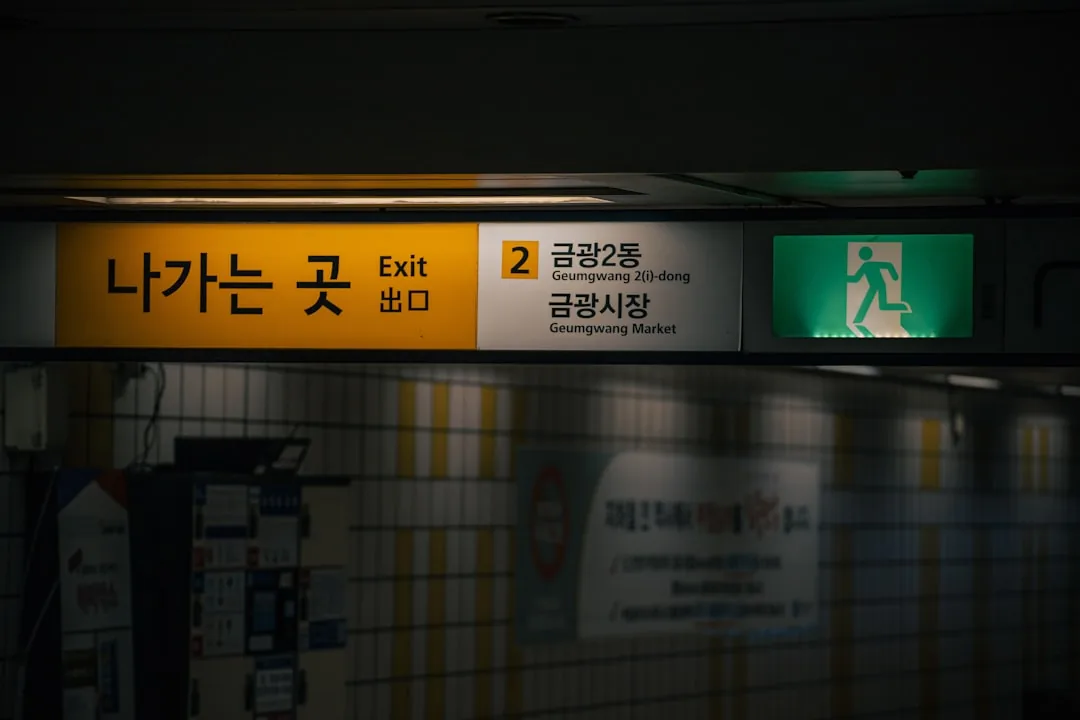
An exit number encodes a surface position and nothing else. It carries no information about which line you arrived on, which platform you used, or how deep the station is. Seoul’s city government puts the baseline plainly: when a station sits under a four-way crossing, the two sides of each of the four roads add up to eight exits, which is the normal count. So the numbers ring the intersection, and “one exit off” can mean a full lap of a junction with no pedestrian crossing.
Which corner gets number 1 depends on how the individual station was laid out, so treat the number as a label to look up rather than a compass bearing. Carry the number you were given and the guessing never starts.
Branch numbers are the one part of the system that does carry meaning. An exit written as 8-1 or 5-2 was added after the station opened. The city’s rule of thumb is that a station gaining a lot of new exits gets renumbered outright, while a station gaining roughly one keeps its existing numbers and hangs a branch number off the nearest one, so that residents who have used Exit 8 for years still find Exit 8 where they left it. Suseo, Jonggak and Jongno 3-ga all carry branch-numbered exits for exactly that reason.
The number is also the key that official systems index by. The national Railway Industry Information Center’s station system publishes exit information and step-free routes for passengers with reduced mobility, station by station, so once you have a number you can check whether that particular staircase has a lift before you drag a suitcase up it.
What to Check Before You Tap In
Check which piece of plastic you are holding, because it decides whether the recovery move in Step 4 happens at the gate by itself or needs a station attendant. A transit card charges a ₩1,550 base fare for the first 10 km. A single-use card bought from a station machine costs ₩100 more, so ₩1,650 for the same ride, and it carries a ₩500 deposit on top that you claim back from a deposit refund machine before you leave the station. Youths pay ₩900 and children ₩550 on a transit card. Beyond the first 10 km the meter adds ₩100 for every 5 km up to 50 km, then ₩100 for every 8 km after that. Those fares took effect on 28 June 2025.
The rechargeable card is the right call here for a reason that has nothing to do with convenience. Leftover value is not stranded either, since refunding a T-money balance at the airport is an ordinary convenience-store transaction on the way out.
Step 1: Take the Exit Number From the Venue, Not the Address
Copy the exit number out of the venue’s own listing and carry it with you. Korean destination listings are built around the exit number: Seoul’s official tourism guide gives Gyeongbokgung Palace as Line 3, Gyeongbokgung Station, Exit 5, 492 m, and again as Line 5, Gwanghwamun Station, Exit 2, 471 m. Adult admission for foreign visitors aged 19 to 64 stands at ₩3,000 in 2026, and the palace is one of the sites covered if you are weighing up the Seoul palace integrated ticket. A street address alone will not tell you which of two stations is the shorter walk, and in this case the two walks differ by barely 20 m.
Step 2: Confirm the Number Before You Tap Out
Settle the exit while you are still inside the gates. Concourse signs carry the exit numbers, and reading them costs thirty seconds; getting it wrong costs a detour, and possibly a second fare. This is the easiest step to skip, because the flow of people moves toward the nearest staircase and following the crowd feels like navigation.
One more reason to confirm early: consecutive numbers are not necessarily neighbours you can walk between. On a ring of eight exits around a junction, the exit next in sequence may be on the far side of the road.
Step 3: If the Right Exit Is Across the Road, Stay Underground
Go back down rather than up. Whether the concourse links both sides of the road, and whether that link sits inside or outside the fare gates, is shown on the station map at the gate line. Read that map before you climb, because once you are up the wrong staircase you are outside a building you may need to be inside, which is why Step 2 matters. In dense neighbourhoods this is the difference between arriving and wandering, and it is why exit numbers come up constantly in comparisons like Seongsu versus Hongdae.
Step 4: Fix a Wrong Exit With the 15-Minute Re-Entry Rule
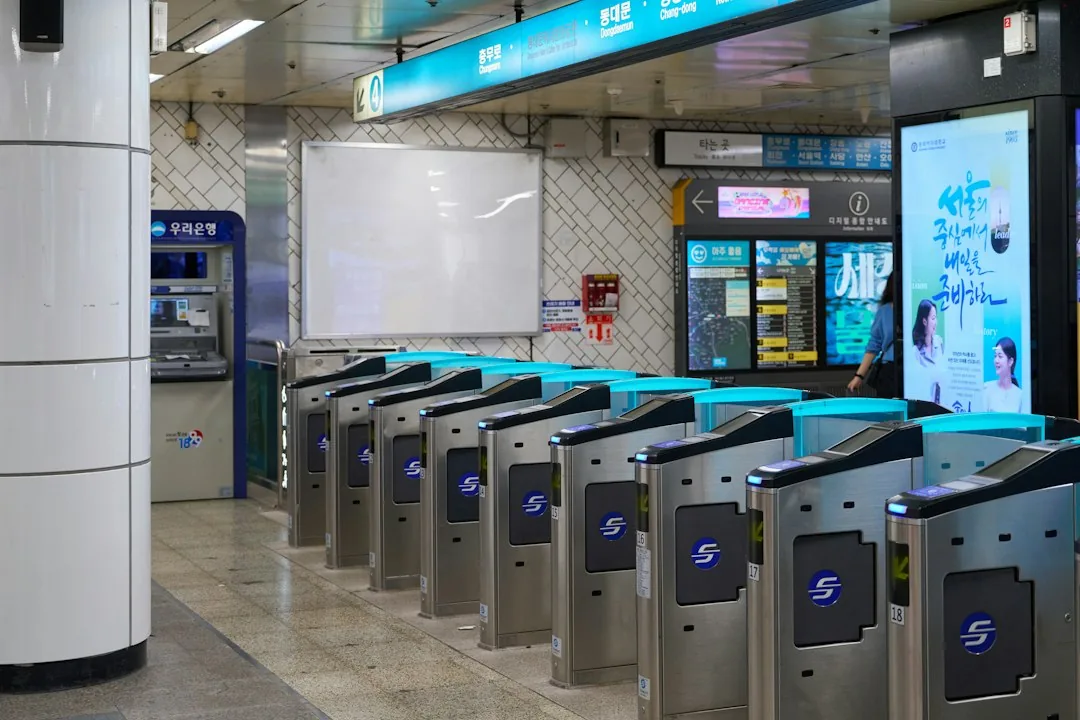
Tap back in at the same station, through a gate for the same line, within 15 minutes. The system treats it as a transfer rather than a new journey, so the base fare is not deducted, and you can walk under the road and come up at the exit you actually wanted. Seoul introduced the rule on its own network on 1 July 2023 at 10 minutes, stretched it to 15 minutes on 7 October 2023 and added the Ui-Sinseol and Sillim light rail lines at the same time. On 20 June 2026 the Ministry of Land, Infrastructure and Transport extended it to the Korail-operated stretches of the metropolitan network: Lines 1, 3 and 4, plus the Suin-Bundang, Gyeongui-Jungang, Gyeonggang and Seohae lines. Its own estimate for those sections alone: roughly 6.04 million journeys and ₩5.6 billion a year.
Common Mistakes at the Gate
Four mistakes are the ones that cost a second fare.
The first is the ten-minute number. It was correct for roughly three months in 2023 and has been wrong ever since. You have 15 minutes.
The second is the ticket. The gate reads prepaid and postpaid transit cards only. If you bought a single-use card or hold a commuter pass, the automatic waiver does not apply — the official instruction is to call station staff and go back in through the emergency gate, the same way it worked before the system existed.
The third is the line. At a transfer station, re-entering through the other line’s gates breaks the condition, because the rule is same station and same line. Coming off Line 3 and tapping in at the Line 5 gates upstairs is a new journey.
The fourth is treating the waiver as unlimited. It applies once per journey, and after it is used the normal distance-based surcharges resume as if nothing happened.
Frequently Asked Questions
Q: How much is a single subway ride in Seoul in 2026?
₩1,550 on a transit card for the first 10 km, or ₩1,650 if you buy a single-use card, which also takes a ₩500 deposit you reclaim from a refund machine. Longer trips add ₩100 per 5 km from 10 km to 50 km.
Q: Does the free re-entry work on the train from Incheon Airport?
No. Airport Railroad trains are left out of the scheme, along with the Sinbundang Line, the Gimpo Goldline and the Incheon subway, so a mistake there is a fresh fare.
Q: Where can I check whether a particular exit has a lift?
Exit details and step-free routes are listed station by station in the Railway Industry Information Center’s station information system, which is the check worth doing before you commit to a staircase with luggage.
Q: What happens if I take longer than 15 minutes to come back?
The exemption lapses and the gate charges a normal base fare, currently ₩1,550 on a transit card. Your clock runs from the moment you tapped out, not from the moment you realised the mistake.
Learn the number, confirm it underground, and the city stops feeling like a maze the second you reach the top of the stairs.
Part of Getting Around Korea