Why Is Korean Pronunciation So Hard? The Three K Sounds
On this page
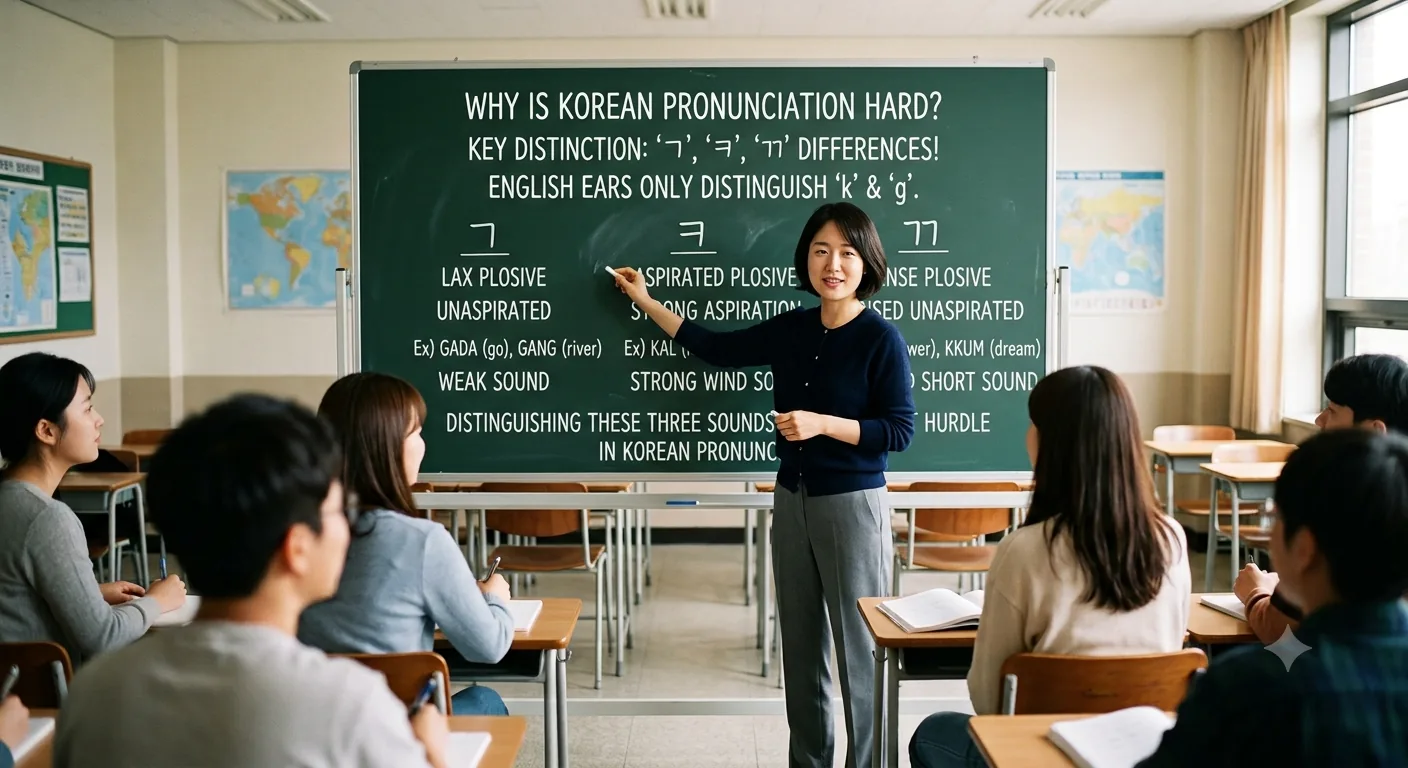
Kimchi and gimbap start with the same Korean syllable, 김. Korea’s official romanization writes it gim, the English word kimchi kept a k, and neither letter is a good fit. That small spelling quarrel is the shortest answer to why Korean pronunciation is so hard for English speakers: where English has room for a k and a g, Korean has three different consonants, plain ㄱ, aspirated ㅋ and tense ㄲ. The same three-way split runs through ㄷ·ㅌ·ㄸ, ㅂ·ㅍ·ㅃ and ㅈ·ㅊ·ㅉ. Vowels and final consonants bring their own puzzles, but this split is the one an English-trained ear has no slot for. The good news is that it isn’t a matter of talent. It comes down to three cues, and each one can be trained.
Quick answers
- Korean splits the k, t, p and ch sounds three ways each, so 12 of the 19 consonants in the 1988 Standard Pronunciation rules belong to just four sound families.
- ㄱ, ㅋ and ㄲ differ in the puff of air after the consonant, the tension in the throat, and the pitch of the vowel that follows, while English listens mainly for the puff.
- In a 2023 study of 28 American English listeners, Korean ㅂ and ㅍ were heard as English “p” almost every time, while tense ㅃ was split between “b” and “p”.
Why Is Korean Pronunciation So Hard for English Speakers?
Korean pronunciation is hard mainly because Korean draws a line through the middle of sounds that English treats as one. Korea’s Standard Pronunciation rules, issued in 1988, list 19 consonants. Twelve of them sit in four three-way families that share a mouth position and differ only in what the breath and throat are doing, and two more (ㅅ and ㅆ) form a pair:
| Sound | Plain (예사소리) | Aspirated (거센소리) | Tense (된소리) |
|---|---|---|---|
| k | ㄱ | ㅋ | ㄲ |
| t | ㄷ | ㅌ | ㄸ |
| p | ㅂ | ㅍ | ㅃ |
| ch | ㅈ | ㅊ | ㅉ |
| s | ㅅ | none | ㅆ |
The National Institute of Korean Language’s dictionary defines the three columns in plain terms. A plain consonant is said with low air pressure and low tension in the speech organs. An aspirated one comes out on a strong breath. A tense one is made by tightening the muscles of the larynx, with almost no breath at all.
Now the English side. English sorts its stops into two bins at each position (k and g, t and d, p and b), while phoneticians describe all three Korean versions as voiceless, a contrast they call typologically unusual. Three boxes have to fit into two, so something doubles up. Which one doubles up is the surprising part.
What Is the Difference Between the Korean K Sounds?
Three things change between ㄱ, ㅋ and ㄲ: how much air puffs out after the consonant, how tight the throat is, and how high the next vowel starts. Here’s the trio with one short word each, so you can play them side by side in any dictionary app:
- ㅋ in 키 (ki, “height”): a strong puff of air and a vowel that starts high. It’s the nearest match to the English k in “kite”.
- ㄲ in 끼 (kki, a colloquial word for a performer’s flair): almost no puff, a tightened throat, and again a high start to the vowel.
- ㄱ in 기 (gi, “energy”): a medium puff at the start of a phrase, a relaxed throat, and a vowel that starts low. Between vowels it softens into a true g, which is why 고기 (gogi, “meat”) has a k-like first consonant and a real g in the middle.
Phoneticians measure the puff as voice onset time (VOT), the gap between releasing the consonant and the vocal folds starting to buzz. The 2023 study recorded the p family (ㅃ, ㅂ, ㅍ), which follows the same three-way pattern, from four Korean talkers, two women and two men:
| Measure | ㅃ tense | ㅂ plain | ㅍ aspirated |
|---|---|---|---|
| Delay before voicing starts (average VOT) | 13 ms | 53 ms | 71 ms |
| Pitch at the start of the vowel (women) | 288 Hz | 245 Hz | 326 Hz |
Look at what separates plain from aspirated. The puff differs by less than 20 milliseconds, while the vowel after ㅂ starts about 80 Hz lower than the vowel after ㅍ. The men’s voices showed the same order, just lower overall. In that sample, the plain consonant was less “a weaker ㅍ” than “a ㅍ said on a lower note.”
That balance is recent. David Silva’s 2006 study of 36 Korean speakers of different ages found that the VOT of tense stops had not changed since the 1960s, while the gap between plain and aspirated had shrunk, for some speakers to complete overlap, with pitch carrying the difference instead. A 2020 study by Jiyoun Choi, Sahyang Kim and Taehong Cho went further: young women in Seoul showed a complete merger of the puff at the start of a phrase and did not use it to separate the two at all.
Why Do English Ears Hear ㄱ and ㅋ as the Same K?
English decides between k and g at the start of a word mostly by the puff of air, and ㄱ and ㅋ both have one. Try it with a palm in front of your mouth: “kin” pushes air onto your hand, “skin” barely does. English doesn’t care, because both are simply k to an English speaker. Meanwhile the g at the start of “gill” is often not truly voiced at all; phonetically it’s frequently an unpuffed k, the same kind of sound as the one in “skin”.
So the working rule an English ear uses at the start of a word is simple: puff means k, no puff means g. Run Korean through that filter and you get exactly what the 2023 study found. Plain ㅂ and aspirated ㅍ both carry a puff, so the listeners heard both as English “p” almost every time and rated both as good examples of it. Tense ㅃ, with almost no puff, was the ambiguous one: most listeners filed it under “b”, and several under “p”. Carry that over to the k family and ㄲ is the sound most likely to pass for a g, while ㄱ and ㅋ both pass for k.
Here’s the twist that makes this harder than a missing sound. The cue younger Seoul speakers lean on to separate ㄱ from ㅋ is pitch, and the authors of the 2023 paper note that English speakers, although sensitive to pitch, rely primarily on the puff. Your ear is tuned to the one signal Seoul Korean is phasing out for this pair at the start of a phrase.
Spelling won’t rescue you either. Official romanization writes both ㄱ and ㅋ as k in some positions (the FAQ below has the rule), and older spellings of names add another layer, which is how the surname 김 stays Kim in English even though the general romanization rules would write it Gim.
How Can You Learn to Hear and Say Korean Tense Consonants?
Train one cue at a time, using minimal pairs, words that differ in nothing but the consonant. Start with these and read each row aloud from left to right:
| Plain | Aspirated | Tense |
|---|---|---|
| 불 (bul, fire) | 풀 (pul, grass) | 뿔 (ppul, horn) |
| 달 (dal, moon) | 탈 (tal, mask) | 딸 (ttal, daughter) |
| 자다 (jada, to sleep) | 차다 (chada, to kick) | 짜다 (jjada, to be salty) |
| 기 (gi, energy) | 키 (ki, height) | 끼 (kki, flair) |
The s family has only two members, so practice it as a pair: 사다 (sada, to buy) and 싸다 (ssada, to be cheap).
Then work through the three cues in this order:
- Remove the puff for the tense column. Say “skin” with your palm in front of your mouth, then say it again without the s, keeping the k exactly as it was. No air should reach your hand. That’s the starting point for ㄲ, ㄸ and ㅃ.
- Add the squeeze. The dictionary definition of 된소리 is about tightening the larynx, so give your throat a slight brace and let the vowel come out higher and a little sharper.
- Use pitch, not breath, for plain versus aspirated. The tissue test only gets you so far, because in current Seoul speech ㄱ and ㅋ can carry nearly the same puff. Start 기, 불 and 달 on a low note and 키, 풀 and 탈 on a high one. Silva’s analysis gives plain stops a default low tone and the other two a high tone, which is exactly the pattern to copy.
Two things will still catch you out after the cues click. Spelling doesn’t always show which version you’ll hear: after a final ㄱ, ㄷ or ㅂ, a plain consonant turns tense, so 학교 (school) is said [학꾜] (hak-kkyo), one of the four sound-change rules that make Korean words read faster. And the pitch cue is clearest at the start of a phrase, so practice on whole phrases from real dialogue, such as K-drama lines, not only on single words. If ㄲ clicks first and ㄱ versus ㅋ takes much longer, that’s the expected order for an English speaker’s ear, not a sign you’re doing it wrong.
Frequently Asked Questions
Q: Is the Korean ㄲ just the k in “skin”?
It’s a good first approximation. Both have almost no puff of air, but ㄲ adds a tightened throat and a higher-pitched vowel, so the “skin” k gets you about halfway. Master the no-puff part first, then add the tension.
Q: Do all Koreans tell ㄱ and ㅋ apart by pitch?
No. A 2012 study by Hyunjung Lee and Allard Jongman compared 16 male speakers and found that Seoul speakers used pitch together with the puff of air, while South Gyeongsang speakers relied mainly on the puff, because their dialect already uses pitch accent to tell words apart. Within Seoul, research describes the shift toward pitch as led by women.
Q: Why is ㄱ romanized as both g and k?
The Revised Romanization of Korean spells it by position: g before a vowel, k before another consonant or at the end of a word. That’s why 국밥 (rice soup) is written gukbap, with one ㄱ showing up as each letter. ㅋ is always k and ㄲ is kk, so a romanized k on its own can’t tell you which Korean letter you’re looking at.
Q: Which pair of Korean consonants trips up English learners the most?
Plain versus aspirated: ㄱ and ㅋ, ㄷ and ㅌ, ㅂ and ㅍ, ㅈ and ㅊ. In the 2023 study both halves of the ㅂ/ㅍ pair landed in the same English category as good examples of it, and the authors point out that when both sounds of a contrast map onto one native sound, learning to perceive the difference “could be very challenging.” The tense consonants, which most listeners already heard as something different, start from a better position.
Q: Are Korean vowels and final consonants hard too?
They take work, but of a more familiar kind. The 1988 rules list 10 simple vowels and 11 diphthongs, and a few of them, like ㅓ (eo) and ㅗ (o), need ear training of their own. Final consonants bring the sound-change rules from the reading guide linked above. Neither asks your ear to use a cue English ignores, which is what makes the three-way split the hardest part.
Train the pitch cue on purpose, and 기, 키 and 끼 will stop sounding like one word said three times and start sounding like the three different words they are.
Part of Korean Pronunciation Guide