How Long Is Chuseok? Days Off, Substitute Rule & Closures
On this page
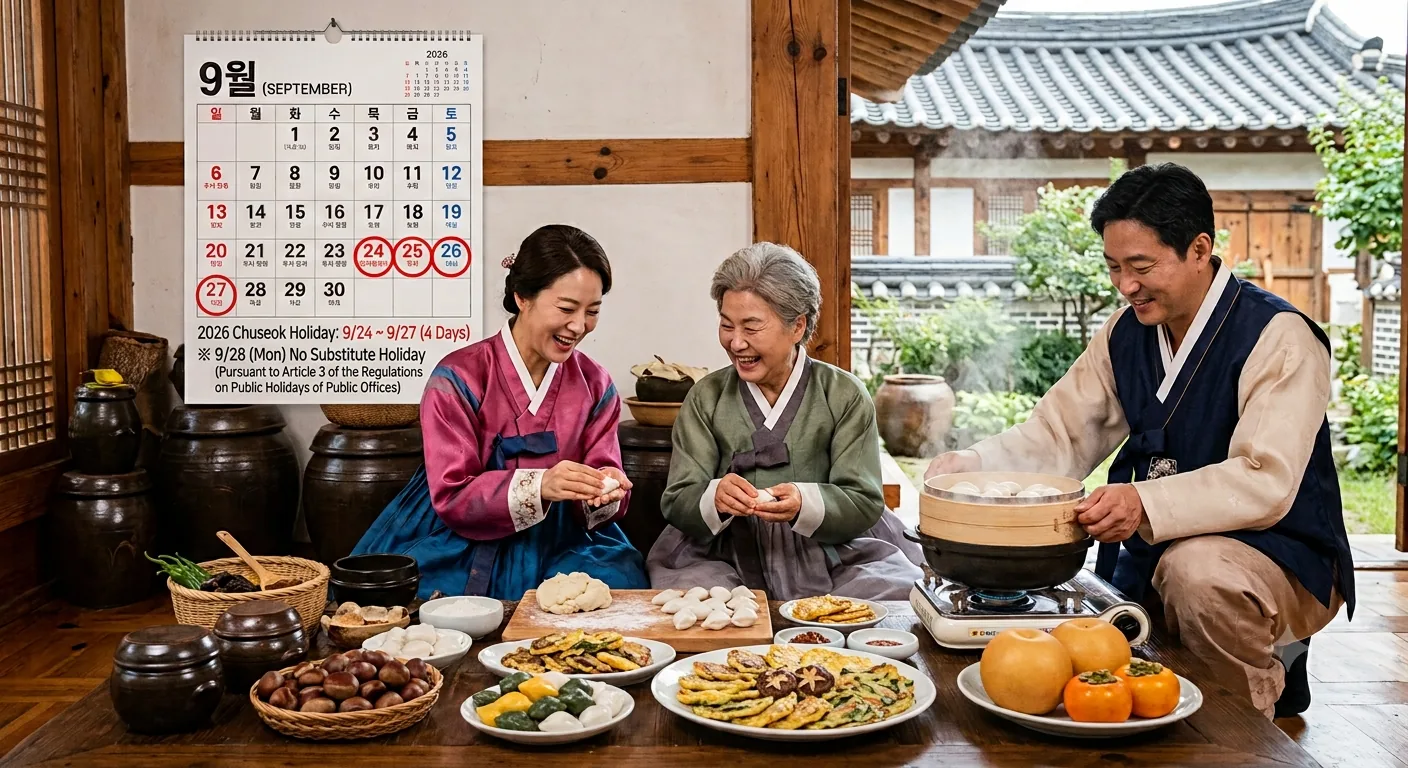
Three squares on the calendar, printed in red: Thursday September 24, Friday September 25 and Saturday September 26. That is Chuseok in 2026 as the law defines it, and the third square is the one that stings, because a Saturday was already a day off for anyone on a Monday-to-Friday week. So how long is Chuseok? Three official days every year, but the break people actually get depends on where those days fall in the week. This year it comes to four, Thursday to Sunday, with no substitute day and no bridge into October.
Quick answers
- Chuseok is always three public holidays: the day before, the day of and the day after the 15th day of the eighth lunar month, which in 2026 means Thursday September 24 to Saturday September 26.
- There is no substitute holiday in 2026, because a Chuseok day only earns one when it falls on a Sunday or clashes with another public holiday on a weekday, and a Saturday counts as neither.
- Government offices and bank branches close for the break (loan and card payments roll over to Monday September 28), the palaces stay open and free, the National Museum of Korea closes on September 25 only, and shops from department store chains to family-run restaurants set their own closing days, some for several days.
How Long Is Chuseok? Three Days by Law, Four This Year
Chuseok lasts three days by law, and in 2026 the break stretches to four only because a Sunday follows it. The Regulations on Public Holidays of Government Offices, the presidential decree that decides which days are printed in red, lists Chuseok as the day before Chuseok, Chuseok itself and the day after, pinned to the 14th, 15th and 16th days of the eighth lunar month. Because the dates follow the moon, they drift across the solar calendar from year to year. In the six years covered by the table further down, Chuseok Day moves between September 12 and October 6.
It hasn’t always been three days. Until 1986 only Chuseok Day was a holiday; that year’s revision of the decree added the day after to create a proper holiday break, and the 1989 revision added the eve, giving both Chuseok and Seollal the three-day shape they still have. The three days map neatly onto what the holiday involves: a day on the road out, a day with family for the ancestral rites and grave visits, a day on the road back.
What you actually get off depends on the weekday. A Chuseok day on a weekday is a straightforward day off. One that lands on a Sunday produces a substitute day (more on that below), while one that lands on a Saturday simply disappears for anyone on a Monday-to-Friday week. That last case is 2026. The official 2026 calendar that the Korea AeroSpace Administration (KASA) announced in June 2025 describes September 24 to 27 as a four-day run, “the Chuseok holidays and Sunday”, and nothing more.
The same three days produced a very different result a year earlier. Chuseok fell on Monday October 6 in 2025, the eve landed on a Sunday and earned a substitute holiday on Wednesday October 8, and National Foundation Day and Hangul Day sat on either side, so the official calendar showed seven straight days off, October 3 to 9.
Nothing in early October joins up with the break this year. National Foundation Day on October 3 falls on a Saturday and earns its own substitute on Monday October 5, and Hangul Day on Friday October 9 makes another three-day weekend, but a full working week separates both from Chuseok. Five days of annual leave, September 28 to October 2, would bridge the gap and turn September 24 to October 5 into a twelve-day stretch.
Is There a Chuseok Substitute Holiday in 2026?
No. Under Article 3 of the decree, as amended in April 2026, a Chuseok day triggers a substitute holiday in only two situations: when it falls on a Sunday, or when it falls on a weekday that is already another public holiday. The substitute is the first day after the break that isn’t a holiday. In 2026 the three days run Thursday, Friday and Saturday, so neither condition applies and Monday September 28 is an ordinary working day.
The Saturday detail is the part that gets garbled. Seollal and Chuseok are the strict cases in the decree: Sunday counts because Sunday is itself listed as a public holiday, but Saturday is not a holiday anywhere in the text, so a Chuseok day spent on a Saturday is simply gone. Most other holidays are treated more generously. The national days (Independence Movement Day, Liberation Day, National Foundation Day, Hangul Day and, since 2026, Constitution Day), along with Buddha’s Birthday, Labor Day, Children’s Day and Christmas, earn a substitute when they fall on either a Saturday or a Sunday. New Year’s Day and Memorial Day earn none, whatever day they land on. If a summary tells you January 1 gets a substitute for a Sunday, it is wrong.
You can watch both halves of the rule inside a single holiday next year. Seollal 2027 falls on Sunday February 7, so its three days run Saturday February 6 to Monday February 8. The Saturday earns nothing, and the Sunday earns a substitute on Tuesday February 9, according to the 2027 calendar that KASA announced on June 29, 2026.
That leaves one route to a day off on Monday September 28: a temporary public holiday (임시공휴일, imsi gonghyuil), which the government declares by Cabinet decision. It has happened next to Chuseok before. October 2 was made a holiday in 2017, creating a ten-day break, and again in 2023, stretching that year’s Chuseok to six days, and in both years the Cabinet approved it on September 5, well before the holiday. No such designation had been made for September 28, 2026 when this was written on September 15.
When Is Chuseok in 2027 and Beyond?
Chuseok falls on Wednesday September 15 in 2027, Tuesday October 3 in 2028, Saturday September 22 in 2029 and Thursday September 12 in 2030. Here is how each lands, with 2025 and 2026 for comparison:
| Year | Chuseok Day | Official three days | Substitute day | Days off in a row (Mon-Fri week) |
|---|---|---|---|---|
| 2025 | Mon Oct 6 | Sun Oct 5 to Tue Oct 7 | Wed Oct 8 (the eve fell on a Sunday) | 7: Oct 3 to 9, with National Foundation Day and Hangul Day |
| 2026 | Fri Sep 25 | Thu Sep 24 to Sat Sep 26 | None (a Saturday doesn’t count) | 4: Sep 24 to 27 |
| 2027 | Wed Sep 15 | Tue Sep 14 to Thu Sep 16 | None | 3: Sep 14 to 16 |
| 2028 | Tue Oct 3 | Mon Oct 2 to Wed Oct 4 | From Thu Oct 5 (clash with National Foundation Day) | At least 6: Sep 30 to Oct 5 |
| 2029 | Sat Sep 22 | Fri Sep 21 to Sun Sep 23 | Mon Sep 24 (the day after falls on a Sunday) | 4: Sep 21 to 24 |
| 2030 | Thu Sep 12 | Wed Sep 11 to Fri Sep 13 | None | 5: Sep 11 to 15 |
The 2025, 2026 and 2027 rows come from the official calendars (월력요항, wollyeok yohang) that KASA announces each June for the following year. For 2028 to 2030, the Chuseok dates come from the lunar-to-solar conversion service of the Korea Astronomy and Space Science Institute (KASI), and the substitute days are the current rule applied to them; each year’s official calendar, published the June before, has the final word.
2028 is the year to watch. Chuseok Day falls on National Foundation Day, a weekday clash that makes Thursday October 5 a substitute holiday at the very least, and with Hangul Day on Monday October 9, the calendar sits one bridge day away from a ten-day run. The 2027 break, by contrast, is a midweek three days. Taking the Monday and the Friday as leave stretches it to nine, from Saturday September 11 to Sunday September 19.
What Closes During Chuseok in Korea, and What Stays Open?
Anything that runs on the government calendar closes for all three days, big attractions generally stay open, and businesses, from department store chains to family-run shops, set their own closing days. The Korea Tourism Organization’s own holiday guidance puts it in two lines: government offices and banks close on public holidays while palaces, museums, department stores and amusement facilities generally remain open, and over Seollal and Chuseok some businesses close for several consecutive days.
Government offices and banks. Offices from district service centers to immigration offices shut on September 24, 25 and 26, as on any public holiday. The Financial Services Commission’s Chuseok notice for 2026 spells out what happens to money in the meantime. Loan repayments and card bills that fall due between September 24 and 27 move to Monday September 28 with no late fees, and deposits that mature during the break pay out that day. Twelve banks are running 11 mobile branches at expressway rest areas and similar stops, for deposits, withdrawals and exchanging cash for new banknotes. Another 11 flexible branches, at airports and in neighborhoods with many foreign workers, handle currency exchange and remittances.
Museums. The National Museum of Korea closes on only one day of the break, Chuseok Day itself, Friday September 25, 2026. It opens on Thursday September 24 and Sunday September 27 from 9:30 to 17:30, and on Saturday September 26 it keeps its late hours until 21:00, with free entry to the permanent galleries on every open day.
Palaces. They stay open, and this year they are free. The government’s Chuseok plan, announced at the September 1, 2026 Cabinet meeting, waives admission over the break at the four main palaces, Jongmyo Shrine, the Joseon royal tombs and the National Museum of Modern and Contemporary Art, much as the Korea Heritage Service did for the whole break in 2024 and 2025. In those years the agency’s own notice, posted only days ahead, set the exact dates and left out Changdeokgung’s Secret Garden; the 2026 notice had not appeared by September 15, so check it before you plan around one specific site. The regular closing days are fixed by the agency: Changdeokgung, Deoksugung, Changgyeonggung and the royal tombs shut on Mondays, Gyeongbokgung and Jongmyo on Tuesdays, and when a closing day collides with a public holiday the site opens and closes on the next non-holiday instead. In 2024, when the break swallowed a Monday and a Tuesday, every site closed on the Thursday after. The 2026 break runs Thursday to Sunday and swallows no closing day, so unless the holiday notice says otherwise, Monday September 28 and Tuesday September 29 are the usual closures. Ticket prices, and whether the integrated pass is worth buying once the free days are over, are in our palace pass breakdown.
Clinics and pharmacies. Emergency rooms keep their round-the-clock hours through the holiday, but outpatient clinics are another story. Many private clinics close, above all on Chuseok Day itself. The health ministry’s E-Gen emergency medical portal and app list the clinics and pharmacies open on each holiday date, and the ministry’s 129 call center or the 120 city and provincial call centers will give you the same information by phone.
Small shops, markets and neighborhood restaurants. This is the shutdown no regulation announces. The length of Chuseok for a family-run restaurant, a neighborhood bakery or a stall in a traditional market is whatever the owner writes on the notice taped to the door. It might be the day itself, or it might be several days.
Department stores. They are no safer bet: the tourism organization lists them among places open on public holidays, but the big chains close most branches for two days over Chuseok (in 2025, the eve and Chuseok Day itself at most Lotte, Shinsegae and Hyundai stores), and the days differ by company and branch, so check the specific branch before you go.
What keeps moving is transport. Trains and express buses run through the whole break, and the scarce thing is seats rather than service, since Korail sells its Chuseok trains in a separate advance sale weeks before the holiday, a process our Chuseok KTX booking guide walks through step by step. Drivers get a break of their own, since the same government plan waives expressway tolls nationwide from September 24 to 27. If a closure catches you out, the Korea Tourism Organization’s 1330 Travel Helpline (dial 1330 in Korea, or +82-2-1330 from abroad) is the fallback.
Frequently Asked Questions
Q: Is Monday, September 28, 2026 a public holiday in Korea?
No. It could only become one through a temporary holiday declared by the government, and none had been declared by September 15. Banks reopen that day and process everything that fell due during the break, including loan repayments and card bills.
Q: Why doesn’t a Chuseok day on a Saturday get a substitute holiday?
Saturday isn’t a public holiday under the decree, and the Chuseok rule only compensates for clashes with other public holidays, a category that includes Sunday. The 2013 revision that introduced substitute holidays drew the line that way from the start: Seollal and Chuseok were covered only for clashes with other public holidays, while Children’s Day was covered for Saturdays too.
Q: Can foreigners exchange money in Korea during Chuseok?
Yes, though not at an ordinary bank branch. For 2026 the Financial Services Commission lists 11 flexible branches at airports and in areas with many foreign workers that handle currency exchange and remittances during the holiday.
Q: Do workers in Korea get paid for Chuseok?
At workplaces with five or more employees, yes: the three days and any substitute day are paid days off, a requirement that reached firms with 5 to 29 staff on January 1, 2022. Workplaces with four or fewer regular employees don’t have to give them unless the employment contract says so.
Q: Should I avoid visiting Korea during Chuseok?
Not if you plan around it. Palaces and museums largely stay open, the government’s 2026 Chuseok plan makes the palaces free for the break, and the National Museum of Korea loses just one day. The cost falls on transport and food: holiday trains sell out in advance, and the small restaurants that make a neighborhood worth visiting may be shut, so book intercity travel early or stay put in one city for the four days.
Three red squares, then, but the real length of Chuseok is written in two places: the decree, and the paper sign on the shop door. Check both before you plan the week.
Part of Korean Traditional Holidays