How to Wear a Hanbok Dress: Layer Order and the Otgoreum Bow
On this page
Two ribbons hang from the front of a hanbok jacket, one plainly longer than the other, and nothing on the garment tells you which one goes where. That is the moment a hanbok dress stops looking simple. Getting it right comes down to three things: putting the layers on in the right order, wrapping a skirt that closes with ties instead of a zip, and turning those two ribbons, the otgoreum, into a single neat loop. None of it is hard once you know what each piece is for. The steps below follow a Hanbok Advancement Center class written up by a student reporter for Korea’s Ministry of Culture, the palace dress rules published by the Royal Palaces and Tombs Center, and the Encyclopedia of Korean Culture.
Quick answers
- The order is socks, underpants and underskirt first, then the outer skirt (chima), an inner blouse if you have one, and the jacket (jeogori) last.
- To tie the otgoreum, hold the long ribbon in your left hand and the short one in your right, cross the short one on top, and fold the long one into a single loop.
- A hanbok gets you into Seoul’s royal palaces free (Gyeongbokgung’s adult ticket is ₩3,000 in 2026), but a one-piece hanbok dress worn without a separate jeogori doesn’t qualify.
What does “hanbok dress” actually mean?
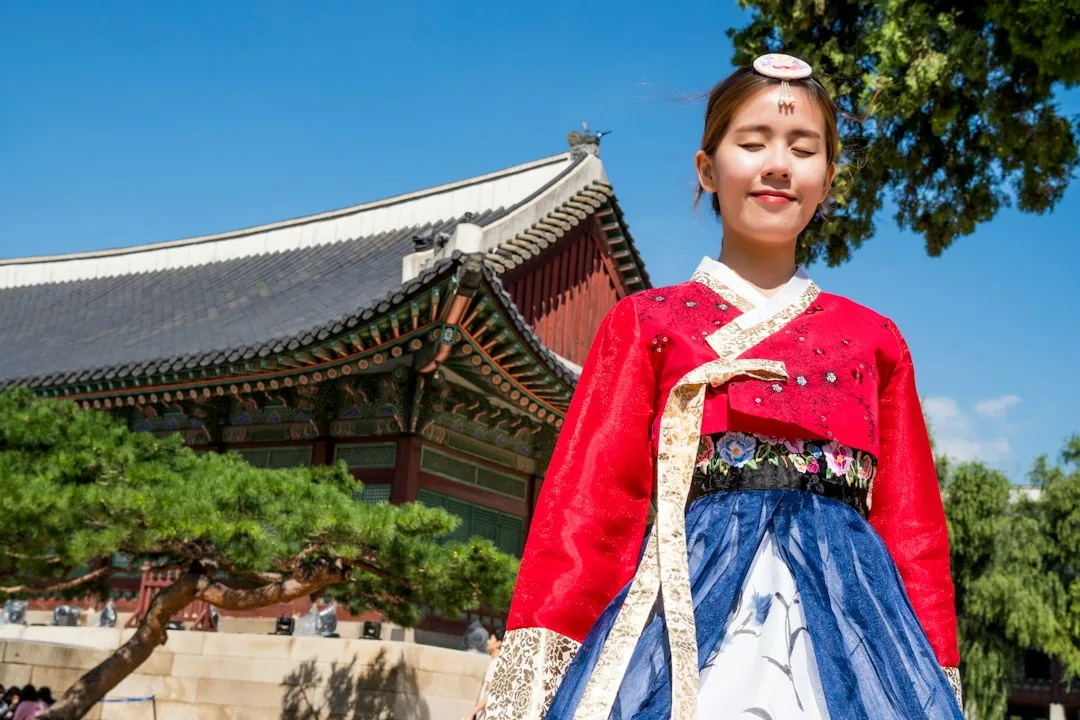
A woman’s hanbok is a two-piece outfit rather than a dress: a wrap skirt called the chima and a short jacket called the jeogori, worn together as chima jeogori. The English phrase “hanbok dress” gets stretched over three different things, and it helps to know which one is hanging in your closet.
The first is that traditional two-piece, the version with the most steps and the one this guide walks through. Next comes saenghwal hanbok, literally “everyday hanbok,” a term the Encyclopedia of Korean Culture dates to the 1990s for traditional hanbok simplified to suit modern life. The third is the one-piece dress that borrows a hanbok collar or a full skirt. If yours is a zip-up one-piece, you mostly just step in; the bow section below still applies if it has ribbons.
The jacket is short and the skirt is full, a silhouette the Encyclopedia of Korean Culture calls hahusangbak, “thick below, thin above.” Keep that shape in mind and the steps make sense. The skirt is tied high, around the chest, and the cropped jacket sits over the top of it.
How to Wear a Hanbok Dress, Layer by Layer
Dress from the inside out: socks and underlayers first, then the chima, then an inner blouse, then the jeogori, which goes on last so its ribbons sit on top of everything. A Ministry of Culture student reporter’s account of a Hanbok Advancement Center class lists the women’s order exactly that way: beoseon socks, underpants and underskirt, outer skirt, inner blouse, outer jacket.
- Beoseon (socks). Pull these on before anything else. Bending down to reach your feet once a full skirt is on is awkward.
- Sokbaji (underpants). A Suncheon City folklore record lists the full set older households layered under a skirt: darisokgot, soksokgot, gojaengi and dansokgot. Of Korea’s traditional undergarments, the Encyclopedia of Korean Culture notes that only the trousers are still worn, because a long hanbok skirt needs them underneath to look full.
- Sokchima (underskirt). Put it on the same way as the outer skirt, and check the length. It should be slightly shorter than the chima so it never shows at the hem.
- Chima (outer skirt). Wrap it around you so the right-hand edge crosses over the left-hand edge and the loose outer tail finishes on your left side. That same Suncheon record notes that high-ranking families once wrapped to the left and commoners to the right, and that wrapping to the left has since become the norm across the country. For a traditional chima, tie the band high, around the chest, not at your natural waist.
- Sokjeoksam (inner blouse). If your set includes this thin under-jacket, it goes on now. The encyclopedia describes it as mainly a sweat layer, which spares the jeogori.
- Jeogori (jacket). Slip it on, line up the two ends of the white collar strip so they meet evenly, fasten the inner tie or snap if there is one, and then tie the otgoreum. Lean forward slightly and smooth out the creases around the armholes before you straighten up.
Your skirt may have a sleeveless vest top instead of a plain band. If it does, put your arms through the vest first, then wrap. The tie on the left panel goes through the slit under the right armhole and comes round to the front; the tie on the right panel wraps around your left side to the front. Knot the two in front the same way you’ll knot the jacket ribbons, and tuck any spare length under the band. Shoulder straps on hanbok skirts aren’t new, either: the encyclopedia credits teachers at Ewha Haktang with adding them in the early 1910s, to stop long skirt ties from slipping loose and squeezing the chest.
If you don’t own a set yet, this guide to renting or buying hanbok outside Korea covers where to find one, including made-to-order pieces that ship abroad.
How do you tie the otgoreum bow?
The otgoreum is tied into a half-bow: one loop and two hanging tails, made by crossing the short ribbon over the long one and folding the long one into the loop. You’ll find the knot sits near the chest, where the two front panels of the jacket overlap.
Start by working out which ribbon is which. The Encyclopedia of Korean Culture describes the long ribbon as attached to the panel on the outer-collar side and the short ribbon to the panel on the inner-collar side. Smooth both flat before you begin, because a twisted ribbon stays twisted in the finished knot.
- Take one in each hand. Hold the long ribbon in your left hand and the short ribbon in your right, the grip a Seoul Metropolitan Government guide gives.
- Cross them. Lay the short ribbon over the long one so the two form an X.
- Make the first knot. Tuck the short ribbon under the long one and pull it up through the gap. You now have a simple knot with the short ribbon on top and the long ribbon hanging below.
- Form the loop. Fold the long ribbon, the one hanging below, back on itself into a loop.
- Wrap and push through. Bring the short ribbon around the base of that loop to make a ring, then push the folded long ribbon through the ring.
- Tighten and shape. Draw the loop upward and the short ribbon downward until the knot is firm, then adjust the loop so it lies flat.
When it’s done, the knot has one loop and two tails, and the Seoul guide notes the two finished ribbons come out at almost the same length. If you see two loops, you’ve tied a shoelace bow. Undo it and repeat step 4, folding only the long ribbon.
Which mistakes give a hanbok away, and how do you fix them?
A few small slips give a hanbok away: a two-loop bow, an underskirt peeking out, collar ends that don’t meet, or modern clothes mixed in. Each one is quick to fix.
- A shoelace bow. Two loops means the ribbons were tied like a shoe. Untie them and fold only the long ribbon into the loop.
- Underskirt showing at the hem. The sokchima should be slightly shorter than the chima. Hitch it up at the band, or swap it for a shorter one.
- A collar that doesn’t meet. Line up both ends of the white collar strip before you touch the ribbons, because it’s fiddly to fix once the bow is tied.
- A jacket that stops above a waist-height skirt. If your skirt sits at the waist rather than the chest, the palace dress guidelines say the jeogori has to come down to the waist.
- Jeans or a T-shirt in the mix. A jeogori over jeans, or a hanbok skirt under a T-shirt, isn’t counted as hanbok at the palace gates, and neither is a saenghwal top cut like a T-shirt.
- Skirt wrapped the wrong way. The loose outer edge should end up on your left side. If it’s on your right, unwrap and start again from step 4.
- Ribbons left hanging. The Royal Palaces and Tombs Center asks for all goreum and buttons to be fastened or tied at all times.
Does a hanbok dress get you into Seoul’s palaces free?
Yes, if it reads as a hanbok: Gyeongbokgung and the other sites run by the Royal Palaces and Tombs Center let hanbok wearers in free, but they want a jacket plus a skirt or trousers, not a dress on its own. With Gyeongbokgung’s adult ticket at ₩3,000 in 2026, the saving is small, though it adds up across a day of palace-hopping.
The center’s published guidelines spell out what counts:
- Traditional and saenghwal hanbok both count.
- The basic unit is a top plus a bottom, a jeogori with a skirt or trousers. A durumagi overcoat thrown over ordinary clothes doesn’t count.
- The jacket needs a wrapped, overlapping collar. The ribbons themselves are optional: a jeogori with that collar shape counts even without an otgoreum.
- Any skirt cut works, wrapped or not.
- A waist-height skirt is fine as long as the jacket reaches the waist.
The center also reserves the right to refuse entry to anyone it considers inappropriately dressed, and it asks visitors to keep the jeogori on at all times. Since a hanbok already gets you in free, the palace integrated ticket makes little sense on a hanbok day. For choosing between the two biggest palaces for photos, see Gyeongbokgung vs Changdeokgung.
Frequently Asked Questions
Q: What does the colour of the otgoreum mean?
It once signalled a woman’s marital status. The Encyclopedia of Korean Culture records that a woman living without a husband wore ribbons the same colour as her jacket, while a married woman wore a contrasting colour: scarlet (dahong) when very young, bright purple-red (kkotjaju) as a young woman, and dark purple-red (geomjaju) when older.
Q: What is the white strip on a hanbok collar called?
It’s the dongjeong, a long white strip sewn along the top of the collar. It protects the collar edge, which soils easily, and can be unpicked and replaced instead of washing the whole jacket. Households made their own until it was sold ready-made from the 1950s, and the encyclopedia puts its modern width at under 1 cm.
Q: Why is the hanbok jacket so short?
It shrank over three centuries. The Encyclopedia of Korean Culture gives jeogori lengths of 60 to 80 cm in the 1600s, about 45 cm in the 1700s, about 35 cm in the 1800s and about 22 cm in the 1900s.
Q: Is it okay for foreigners to wear hanbok in Korea?
Yes. The palace guidelines explicitly count foreign visitors in hanbok for free admission on the same terms as Koreans. The same dress rules apply too, so a foreign visitor still needs the jacket as well as the skirt.
Get the layers in order and tie one loop instead of two, and a hanbok holds up anywhere, from a palace gate to a family table at Chuseok.
Part of Hanbok & Traditional Clothing