Korea Fall Foliage Peak Dates by Region, North to South
On this page
- How to Read Korea Fall Foliage Peak Dates by Region
- 1. Seoraksan: First Foliage Late September, Peak Late October
- 2. Odaesan and Chiaksan: Gangwon’s Second Wave
- 3. Songnisan and the Central Belt: The Last Week of October
- 4. Seoul and Bukhansan National Park: Late October into Early November
- 5. Jirisan and the Southern Ranges: Around the End of October
- 6. Naejangsan and Baegyangsa: The First Half of November
- 7. Hallasan and Jeju: Altitude Beats Latitude
- Frequently Asked Questions
Korea fall foliage peak dates move by region, not by month, and that one fact decides whether an autumn booking lands in a forest that is still entirely green or one that is already bare. Autumn itself starts well before the color does. The Korea Meteorological Administration counts September through November as autumn in its seasonal climate statistics, the first tinge of foliage reaches the highest northern ridges in the last week of September, and peak color arrives nowhere before the second half of October. Color then crosses the peninsula on its own schedule, taking roughly three weeks to travel from the ridges of Gangwon down to the valleys of Jeolla, and any single mountain holds its best look for about a week of that stretch. This list follows the cascade in order, north to south. Every date below states which of two separate events it refers to, because Korean forecasters track them separately and most English guides quietly merge them, which is exactly why visitors keep arriving to half-green mountains. Where a figure comes from an official Korean forecast, the agency and the edition year are named; where no official figure exists, you get a range instead of false precision.
Quick answers
- Autumn as a season starts on September 1 by the Korea Meteorological Administration’s September-to-November reckoning, but first foliage does not reach even Seoraksan until about September 27 in a normal year, and Seoul’s peak is roughly five weeks after that.
- Peak color reaches Seoraksan and the Gangwon high country in the second half of October, Seoul and the central belt around the turn of the month, and the far south (Jirisan, Naejangsan) in the first half of November.
- First foliage (첫단풍) means roughly 20% of a mountain has turned, counted down from the summit, while peak (절정) means about 80%, and the Korea Meteorological Administration puts the gap between the two at about 20 days.
- The authoritative annual forecast is the Korea Forest Service’s 산림단풍 예측지도 prediction map, and the 2026 edition had not been published as of mid-August 2026. The 2025 edition landed on October 1 and the 2023 edition on September 25.
How to Read Korea Fall Foliage Peak Dates by Region
Treat every published date as one of two events, never as “the foliage date”. The Korea Meteorological Administration (KMA) defines 첫단풍, first foliage, as the day roughly 20% of a mountain has changed color measured from the summit downward, and 절정, peak, as the day about 80% has turned. Its own guidance puts peak about 20 days after the start, not the “week or so” that English write-ups tend to imply. That one distinction decides whether the dates you already booked are worth a five-hour drive.
Two agencies matter, and they do different jobs. The Korea Forest Service (산림청) issues the nationwide prediction map, built with the Korea National Arboretum and nine regional public arboretums from long-term phenology records (112 observation points in the 2024 edition) combined with mountain weather data from the National Institute of Forest Science. That map is the forecast, and the 2025 edition was published on October 1 of that year. The KMA reports what actually happened instead, tracking foliage status at 21 famous mountains and posting dated photographs at each stage. Private weather companies publish their own maps every September, but the Forest Service edition is the one worth waiting for.
1. Seoraksan: First Foliage Late September, Peak Late October
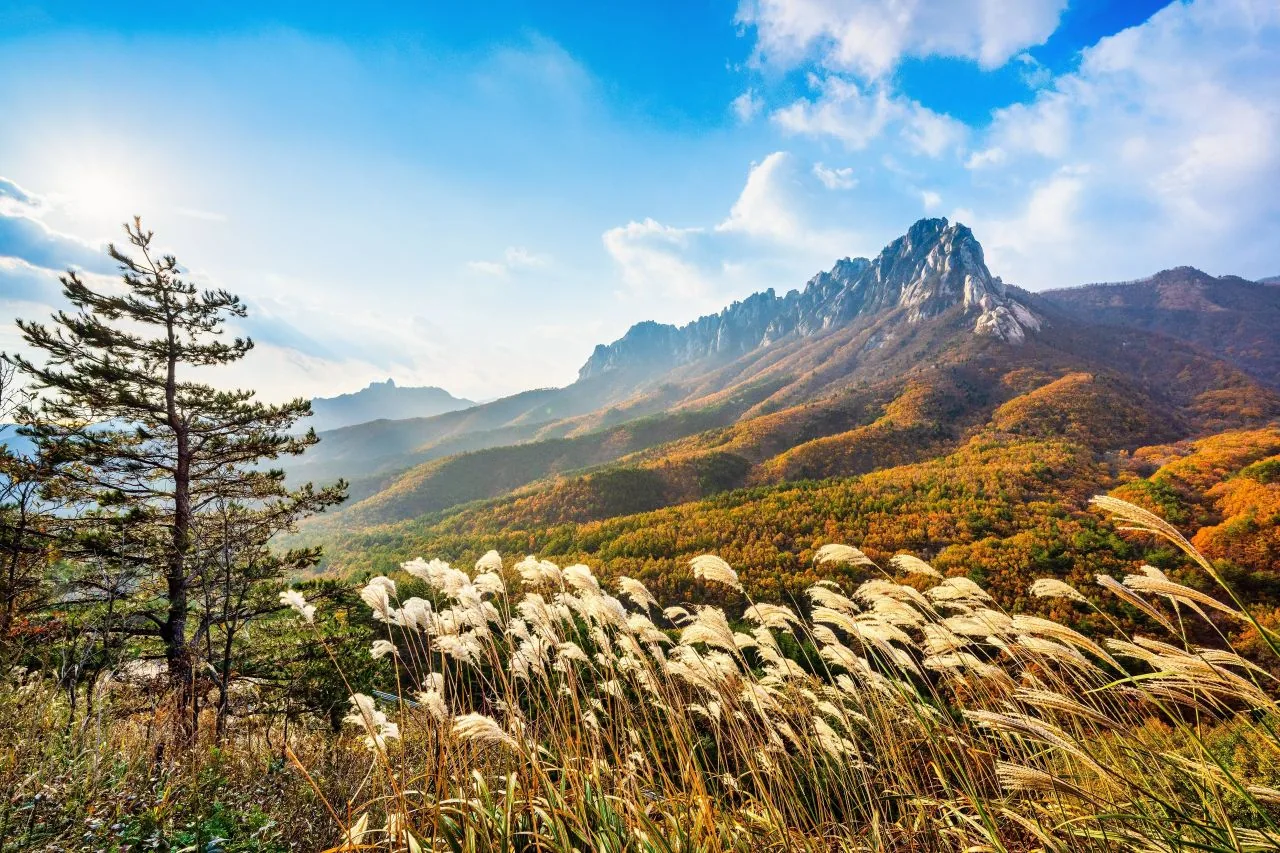
Seoraksan (1,708 m) turns first every year, and first foliage normally lands in the last week of September. The KMA’s Gangwon foliage material gives a long-term normal of September 27 for the mountain. In 2025 it was recorded on October 2, four days later than normal and two days earlier than the year before. Peak is the date that actually matters, and it arrives far later than most itineraries assume: KMA guidance has put Seoraksan’s whole-mountain peak around October 18, while the Forest Service’s 2025 map forecast the mountain’s maples for October 25. Both figures can be correct, because one measures the entire slope and the other a single species.
In practice, a trip landing in the last week of September gets a rim of color on the ridgeline and green everywhere below it. Aim for the third or fourth week of October if you want the full mountain. Entry to the park itself is ₩0, since admission was dropped on January 1, 2007, and the one fixed cost at Sogongwon is the Gwongeumseong cable car: ₩16,000 return for adults and ₩12,000 for children, sold as a return ticket only and with no advance booking, so foliage weekends are a queue rather than a reservation. For the transport side, korealogue has a separate Seoraksan day trip guide; this article is only about the calendar.
2. Odaesan and Chiaksan: Gangwon’s Second Wave
Odaesan and Chiaksan follow Seoraksan by a few days, which is why the KMA bundles all three into its Gangwon foliage-and-weather service with live camera feeds and normal-year statistics for each. Their dates swing more than Seoraksan’s do: both sit lower and more sheltered, so a warm mid-October week can stall them while the higher ridges push ahead. Treat them as the fallback play. If Seoraksan has already blown past peak by the time you land, the fir-lined approach to Woljeongsa at Odaesan and the Guryongsa valley at Chiaksan are the nearest things still holding.
3. Songnisan and the Central Belt: The Last Week of October
Songnisan peaks in the last week of October; the Forest Service’s 2025 map put its maples at October 27, only two days behind Seoraksan in that same forecast. Two days is the whole gap between Gangwon’s headline mountain and the middle of the country, which tells you the cascade is not a smooth conveyor belt. It stalls, then jumps. Chungcheong’s advantage is access rather than fame. Songnisan, Gyeryongsan and the smaller ridges around Daejeon are reachable as day trips from Seoul or Busan, and they are nowhere near as crowded as the two mountains everyone flies in for.
4. Seoul and Bukhansan National Park: Late October into Early November
Seoul peaks later than nearly everyone expects, later even than the mountains two hours east of it. The Forest Service’s 2025 map gave nationwide average peak dates of October 28 for ginkgo, October 31 for oaks and November 1 for maples, and the capital sits with those averages rather than ahead of them. What surprises most first-timers is that the opening days of November are often the better Seoul week, not the last week of October.
Bukhansan National Park is why Seoul has two autumn dates rather than one. Rising to Baegundae at roughly 836 m on the city’s northern edge, the park runs a few days ahead of the streets below it purely on elevation, so the order inside a single metro area is granite ridge first, palace grounds and boulevards last. In practice that means late October on the upper Baegundae course and the Bukhansanseong fortress ridge, then the first week of November down on the Dulle-gil foothill trail and around the trailheads. Admission is ₩0, dropped in the same 2007 reform that ended entrance fees at Seoraksan, and the park service posts course-by-course difficulty ratings and closure notices on its Bukhansan visitor pages, which are worth reading before a foliage weekend because individual sections can be shut. If you are arriving without boots, korealogue covers hiking gear rental in Seoul separately.
5. Jirisan and the Southern Ranges: Around the End of October
Jirisan peaks at the very end of October: the Forest Service’s 2023 map put its Korean maples at October 31, two days after Naejangsan in that same edition. That inversion is worth sitting with, because it breaks the tidy north-to-south story — Jirisan is a massive high-elevation block, so it behaves like a northern mountain that happens to sit in the south. Inside the park the spread is just as wide. Piagol and Baemsagol color before the low approaches do, and regulars will tell you the valley you pick matters as much as the week you pick.
6. Naejangsan and Baegyangsa: The First Half of November
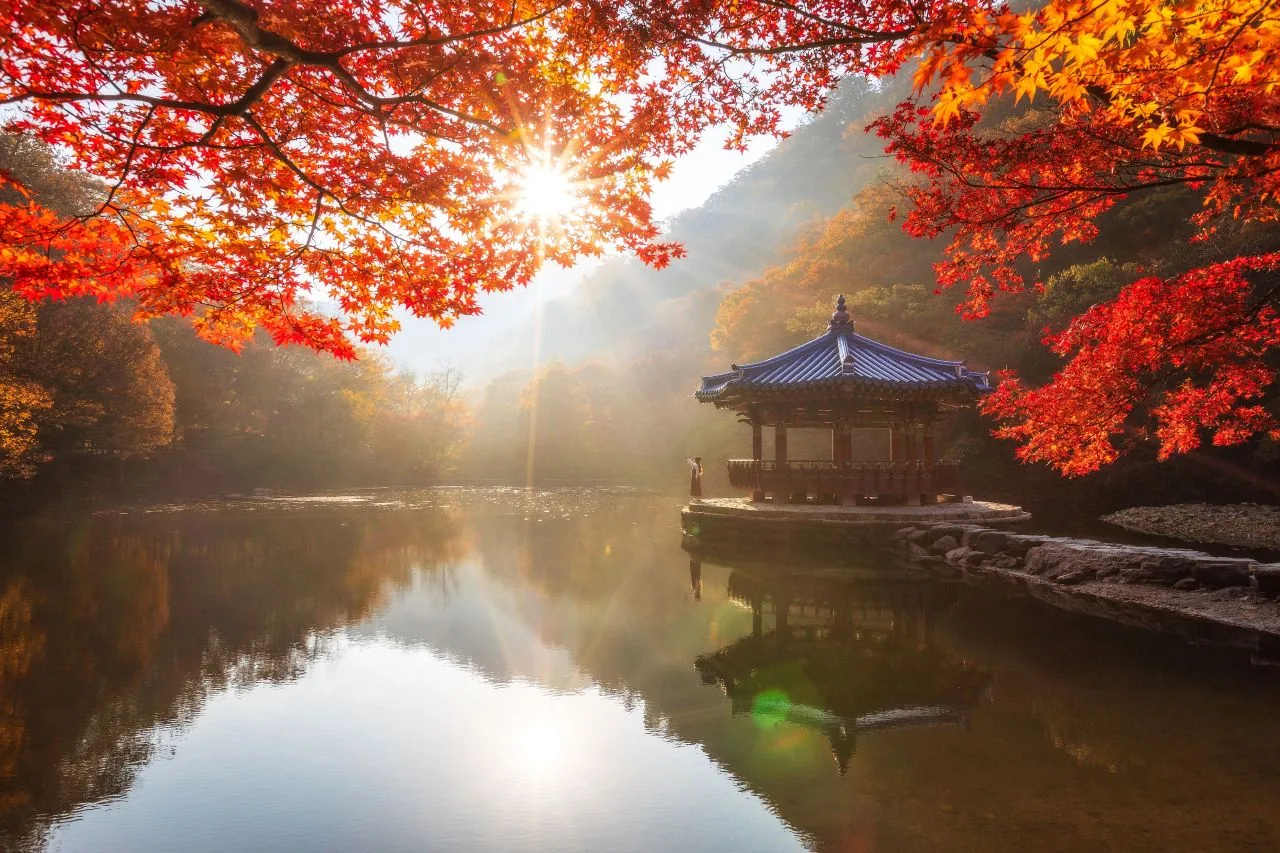
Naejangsan is the most photographed foliage destination in the country and among the last to turn, which is the entire reason it works as the closing stop on a November trip. The Forest Service’s 2025 map forecast its maples for November 6; the 2023 map had the same mountain at October 29. That eight-day swing between two editions of one official forecast is the strongest argument in this article against locking a date a year ahead. The draw is the maple tunnel on the approach road to Naejangsa temple and the reflections at Uhwajeong pavilion, plus the quieter Baegyangsa district on the far side of the park. Gayasan ran even later in the 2025 map, at November 11, making it the last major peak on the calendar.
7. Hallasan and Jeju: Altitude Beats Latitude
Jeju is the southernmost point in Korea and still does not finish last, because Hallasan is the country’s highest mountain and color starts near the summit. The Forest Service’s 2023 map put Hallasan’s Korean maples at November 1 — after Jirisan, which latitude alone would not predict, and the mountain’s own slopes then run their own internal schedule from crater rim down to the coastal roads over the following weeks. For a trip that has to be in November, Jeju gives you two things the mainland can’t: a foliage window that stays open late, and a plan B that doesn’t depend on leaves at all if the season runs early.
Frequently Asked Questions
Q: When does fall start in Korea, and is that when the leaves turn?
Those are two different dates. The Korea Meteorological Administration treats September through November as autumn in its climate statistics, so the season is under way from September 1, and the first genuinely cool, dry days in Seoul tend to arrive in the second half of September. The leaves run weeks behind that: first foliage reaches Seoraksan around September 27 in a normal year, and peak dates across the country fall between mid-October and mid-November. Booking a trip for “autumn in South Korea” and expecting color is the single most common way to miss it.
Q: When do Bukhansan’s autumn colours peak, and where on the mountain?
Late October on the high granite around the Baegundae course, then the first week of November lower down on the Dulle-gil and at the trailheads. Bukhansan sits a few days ahead of central Seoul on elevation alone, so the park and the palace gardens are not the same weekend.
Q: When is the best time to visit Korea in autumn?
The last ten days of October cover the most ground — Gangwon is at or just past peak, the central belt is arriving, and Seoul is only a few days out. If your trip has to center on the south, the first week of November is the better pick. For the opposite end of the travel calendar, korealogue also covers the early-June window before monsoon season.
Q: What is Seoraksan’s fall foliage peak time?
Mid-to-late October. KMA guidance has put the whole-mountain peak around October 18, while the Forest Service’s 2025 map forecast the mountain’s maples for October 25, so plan a window rather than a day.
Q: When is the best time for Naejangsan autumn leaves?
Early-to-mid November on recent forecasts (November 6 in the Forest Service’s 2025 map), but the same agency’s 2023 map said October 29, so check the current year’s edition before you book anything.
Q: Is the Korea autumn foliage forecast for 2026 out yet?
Not as of mid-August 2026. The Forest Service has released recent editions between late September and early October, so expect the 2026 map in that window and treat anything published earlier as a private-sector estimate or a historical average.
Q: Does peak foliage arrive at the same time every year?
No, and the drift is measurable. Between the Forest Service’s 2023 and 2025 maps the forecast peak for Naejangsan’s maples moved from October 29 to November 6, and Seoraksan’s from October 23 to October 25 — the southern shift was the larger of the two.
Q: How long is a mountain actually at peak?
Plan on a usable window of roughly a week rather than a single perfect day, with the best of it in the middle. Wind and heavy rain shorten it sharply, which is why a two-day buffer in the itinerary is worth more than a precisely chosen date.
Work down this list in order rather than starting from a mountain you’ve seen photographed: fix the week you can genuinely travel, find the region that peaks in it, then book the mountain. When the Forest Service’s 2026 map lands in the autumn, check it against the region you picked — a two-day shift changes nothing, an eight-day one changes the trip.
Part of Best Time to Visit Korea