What Is Korean Butter Tteok? Not the Tteok You Know
On this page
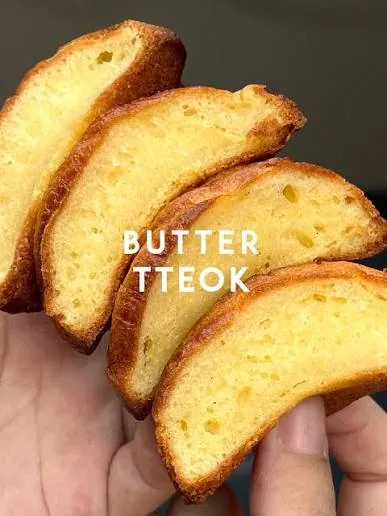
Crack one open while it’s still warm and the shell shatters like the lid of a crème brûlée, then the middle stretches back at you like mochi that hasn’t decided whether it wants to be cake. That contrast is the whole appeal of butter tteok, the palm-sized baked rice cake now sitting in what feels like every third bakery cabinet in Seoul. Almost nothing in the name survives contact with the facts, though. It isn’t a traditional Korean tteok, it didn’t start in Korea, and the gluten-free label people keep attaching to it is only conditionally true.
Quick answers
- Butter tteok is a small cake of glutinous rice flour, butter, egg, milk and sugar, baked in a mould until the edges caramelise and the centre turns springy.
- It is not traditional Korean tteok: Korea’s official rice-cake canon is steamed, pounded or hand-shaped, and none of those methods involve an oven.
- Rice carries no gluten, so the batter is normally wheat-free, but the FDA’s “gluten-free” line is 20 parts per million, and clearing it is a claim about the whole kitchen rather than just the recipe.
Korean Butter Tteok, Explained: What It Actually Is
Butter tteok is a baked glutinous-rice-flour cake — a batter, not a dough — poured into a small mould and baked hot enough to caramelise the outside while the inside stays chewy. Think canelé shape, mochi interior, croissant-adjacent butter content.
The texture is doing something clever. Glutinous rice starch is 95–100% amylopectin, the heavily branched starch that gelatinises into something stretchy rather than crumbly, which is why a rice cake pulls and a sponge cake tears. Wheat gets its structure from gluten; this gets it from starch alone. Meanwhile the butter and sugar pressed against the hot metal wall of the mould brown into a thin, brittle shell you can hear. What surprises most first-timers isn’t the sweetness (there is less of it than the smell promises) but how quickly that shell gives up. Leave it on the counter for the length of one coffee and the crack is already gone.
Is Butter Tteok Actually Traditional Korean Tteok?
No, and it isn’t a close call. Korea.net, the government’s own culture portal, sorts traditional tteok into three families by method: steamed, pounded and hand-shaped. Batter poured into a buttered mould appears nowhere on that list, and neither does butter. When the Cultural Heritage Administration designated tteok making a National Intangible Cultural Heritage on 1 November 2021, it named no holder at all, individual or group, on the grounds that the whole country practises it. What earned the listing was the siru earthenware steamer, the wooden mallet and the habit of handing tteok to your neighbours when you move in. A buttered mould was not in the file.
The recipe’s paper trail leads to China. Chinese food-trade coverage credits a bakery studio in Nantong, in Jiangsu province just north of Shanghai, with rebuilding the French canelé around glutinous rice flour and a great deal of butter, and selling it as 黄油年糕 — huangyou niangao, butter nian gao. It detonated across Chinese bakeries first, crossed into English as “Shanghai butter mochi”, a label that’s geographically loose at best, and only then reached Korean cafés, which restyled it and gave it a Korean name. As of 2026 the Korean version is the one the rest of the world is copying, which is how a Chinese pastry ended up with a Korean passport.
How Is It Different From Tteokbokki Tteok and Baekseolgi?
Three genuinely different foods share the word tteok, and that overlap is where most of the confusion starts.
| Garaetteok (tteokbokki sticks) | Baekseolgi / jeolpyeon | Butter tteok | |
|---|---|---|---|
| Made from | rice flour, steamed then pounded | rice flour steamed in a siru | glutinous rice flour batter with butter, egg, milk |
| Cooked by | steaming and pounding | steaming | baking in a mould |
| Texture | dense, bouncy, deliberately bland | soft, powdery-moist, barely sweet | crisp shell, stretchy centre |
| Eaten | hot, in sauce, as a meal | at holidays, weddings and memorials | with coffee, as a pastry |
Notice that the first two are savoury or ceremonial and the third is dessert. If it’s the sauce-and-a-fork end of that table you’re after, our guide to the types of tteokbokki covers which styles are worth ordering first. Butter tteok lives at the coffee end, and it never touches gochujang.
Is Butter Tteok Gluten-Free?
The recipe usually is; the plate in front of you might not be. Rice simply isn’t a gluten grain. Since 2013 the FDA has reserved the gluten-free label for foods holding under 20 parts per million of gluten, and the grains it names as gluten-containing are wheat, rye, barley and crossbreds such as triticale. Glutinous rice flour sits comfortably outside that list. The “glutinous” is describing stickiness, not protein.
Three things break the claim in practice:
- Cake flour in the ancestor recipe. Many of the Chinese 黄油年糕 formulas this trend grew out of blend low-protein wheat flour into the rice flour. Korean and Western versions typically don’t, but “typically” is carrying weight there.
- Shared kitchens. A café baking butter tteok in the oven that just did croissants, on the same trays, handled with the same tongs, is not running a gluten-free operation.
- Packaged versions. Supermarket and mail-order butter tteok can carry wheat starch or a wheat-derived flavouring that the photograph will never tell you about.
Where Do You Find Butter Tteok, and How Should You Eat It?
Independent cafés and neighbourhood bakeries, not convenience stores: this is still a made-that-morning product, and it prices like a single pastry rather than a slice of cake. Start in the café districts where new bakery trends land first (Seongsu, Yeonnam-dong, Mangwon) and look in the glass cabinet beside the canelés it’s descended from. Flavoured variants have multiplied fast: injeolmi powder, black sesame, red bean, matcha, salted caramel.
Regulars will tell you the same two things. Buy it warm if the tray is fresh out, and eat it the same day, because the shell softens overnight into something merely chewy. A few minutes in an air fryer brings most of the crack back if you’re late. It goes better with black coffee than with anything sweet, and if you’re building a route through cafés, our Seoul cafe hopping guide covers the neighbourhoods where you’ll trip over it. Working through the rest of the café-dessert canon, our Korean bingsu guide covers the other counter that draws a queue.
Frequently Asked Questions
Q: Butter tteok vs butter mochi: what is the difference?
Pan versus mould. Hawaiian butter mochi is baked in one large tray with coconut milk and cut into soft squares, so it has almost no crust; butter tteok is baked in individual moulds precisely to build a shell that cracks. Same flour, opposite objective. The confusion is worth knowing about when you order, because English-language menus abroad often file this under “butter mochi” anyway.
Q: Can I find butter tteok outside Korea?
Increasingly, though you may have to look under another name. Korean-style bakeries overseas picked it up quickly, and Chinese bakeries have been selling the original 黄油年糕 for longer than Korean cafés have sold theirs. If a cabinet shows small, individually moulded cakes rather than a tray of cut squares, that is this, whatever the card in front of it says.
Q: Can a coeliac eat butter tteok from a Korean bakery?
Not without asking first. The batter is normally wheat-free, but shared ovens, shared trays and the occasional cake-flour recipe mean a Korean bakery cabinet is not a gluten-free environment by default.
Q: Why did mine come out chewy instead of crispy?
Heat and fat at the mould wall build the crust, so under-greased moulds, an oven running cool or a batter that was too loose will all give you an all-chew result. Letting them cool in the tin steams the shell soft as well, so turn them out the moment they set.
Order one warm, eat it standing up, and let the naming argument go. That crack, then the pull, was never Korean or Chinese in the first place.
Part of Korean Café & Dessert Culture